

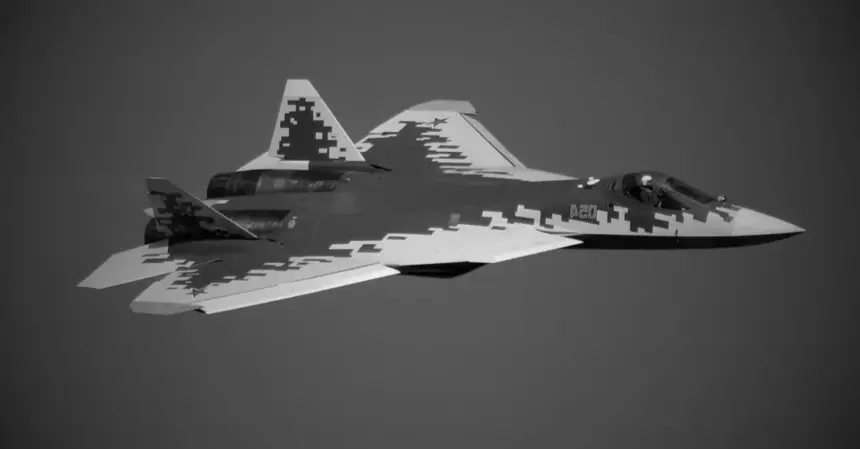
Twelve to fourteen aircraft were ordered in 2021 for several billion dollars, with the first units arriving in 2025 at the Oum El Bouaghi air base. The official message is clear: Algeria would now be the first stealth air power in Africa and the Arab world. That narrative deserves to be checked against the facts, and the facts are considerably less flattering than the communication surrounding them.
Because on closer examination of the available documents, foreign countries’ experience with the same aircraft, and the Su-57’s only real-world combat exposure, one conclusion stands out: this aircraft has proven absolutely nothing of its advertised capabilities, and every available indicator points the other way.
An aircraft its own air force accepted in degraded form
The most damning signal doesn’t come from a Western rival but from inside the Russian program itself. Internal documents obtained by Ukrainian investigative outlet Frontelligence Insight show that Russia’s Ministry of Defense formally accepted Su-57s as early as 2021 without the 101KS-N electro-optical targeting system, one of the technological building blocks supposedly justifying its fifth-generation status. An ad hoc administrative decision allowed the Russian military to receive these aircraft in a stripped-down configuration, with a promised upgrade that was never fully delivered.
The cause is well documented: Western sanctions cut off supplies of the microchips needed to manufacture the MPPU-50 module and the CNC machine tools required to produce certain parts. Further leaks, published by InformNapalm based on documents from the OKBM company, reveal that even basic components such as gearboxes and hydraulic actuators still depend on foreign technology that Russian industry has been unable to replace. The result is a production rate that borders on the derisory for a program billed as the spearhead of advanced aviation: roughly ten aircraft a year according to several defense analysis firms, against a promised 76 units for Russia’s own forces by 2028.
A country whose own military receives an export jet in incomplete form can hardly present that same sale as proof of technological superiority.
India tested the aircraft from the inside, and rejected it
Algeria is not the first country to have examined the Su-57 closely. India co-developed the aircraft for nearly a decade before withdrawing in 2018, after sinking several hundred million dollars into the program. India’s verdict, far from a diplomatic posture, was based on hands-on testing: the AL-41F engines were judged unreliable, airframe build quality was found lacking, and stealth performance fell well short of what was claimed. According to defense analyst Abhijit Iyer-Mitra, cited in the Indian defense press, the Su-57 remains close to the Su-30 in terms of radar signature, with semi-recessed rivets, partially exposed turbine blades, and panel gaps that undermine its low observability.
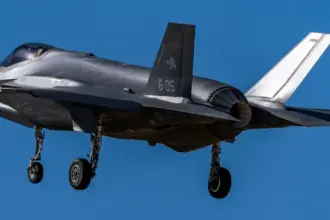
What is most telling is that this assessment doesn’t only come from foreign critics: Sukhoi’s own technical documentation places the Su-57’s frontal radar cross section between 0.1 and 1 square meter. The French Rafale, a 4.5-generation fighter and not a fifth-generation one, is generally estimated between 0.05 and 0.1 square meter. The American F-35 sits around 0.001 square meter. On its own home turf, stealth, the aircraft Moscow markets as a rival to the F-35 shows, by its own figures, a radar signature equal to or worse than that of a jet it is supposed to outclass.
One real-world engagement, and a failure
If there was ever an opportunity to demonstrate its capabilities, it was the war in Ukraine. The result leaves little room for doubt: the Su-57 has been used with extreme caution, largely confined to long-range missile strikes launched from within Russian airspace, carefully avoiding exposure to Ukrainian air defenses. No documented demonstration of air superiority, no confirmed stealth penetration mission, more than two years after the aircraft entered service.
The most embarrassing episode involves its intended companion, the S-70 Okhotnik stealth drone. On October 5, 2024, one unit was shot down by a Russian fighter over Donbas after apparently losing its data link with its controlling Su-57, seemingly destroyed rather than risk falling intact into Ukrainian hands. The wreckage, recovered by Ukrainian forces, delivered its own verdict: Ukraine’s military intelligence directorate counted roughly thirty Western components among the debris, including parts from Analog Devices, Texas Instruments, Xilinx-AMD, Infineon and STMicroelectronics, despite sanctions that had been in place for more than two years. A program meant to showcase Russian technological self-sufficiency turns out, in practice, to be barely disguised dependence.
Even Moscow’s longtime clients are walking away
The regional context does little to support the Algerian narrative either. Egypt, long a loyal customer of Russian defense industry, simply cancelled its Su-35 contract following Russian aviation’s losses in Ukraine. During exercises held on Egyptian soil, a Rafale jammed the Su-35’s active-array radar using its Spectra electronic warfare suite, preventing the Russian jet from guiding its weapons, before being declared the winner of the simulated engagement. Cairo has since turned to French and Chinese offers instead. If a longstanding client of Russian aviation walks away after watching the aircraft fail against a supposedly lesser Western competitor, caution should be the order of the day for anyone considering a similar purchase.
Key figures
- Su-57 frontal radar cross section per Sukhoi’s own documentation: 0.1 to 1 m², versus 0.05 to 0.1 m² for the Rafale and roughly 0.001 m² for the F-35
- Actual Su-57 production rate: about 10 aircraft a year, far short of the 76-unit target set for 2028
- Western components found in the downed S-70 drone’s wreckage, despite sanctions: at least thirty
- Indian investment abandoned after withdrawing from the FGFA program in 2018: several hundred million dollars
- Algerian contract: 12 to 14 aircraft ordered in 2021, deliveries spread through 2027
A purchase built for image, not for the balance of power
Nothing in any of this supports the narrative of Algeria joining the world’s stealth aviation elite. What the Russian leaks, India’s experience, the sole Ukrainian engagement’s failure, and Egypt’s reversal actually document is a program undermined by sanctions, delivered incomplete to its own air force, and one that has never had the chance, or never dared, to prove anything on a real battlefield. None of this information, despite being publicly available for months, has been addressed in any official Algerian communication. That silence speaks for itself: in a context of regional rivalry with Morocco, the Su-57’s value to Algerian authorities appears to rest less on operational performance than on the propaganda effect it produces. A capability mirage, sustained only as long as the deliveries stay shielded from scrutiny, and one likely to dissipate the moment these aircraft are called to prove themselves somewhere other than on a runway.
FAQ
Is the Algerian Su-57 really a fifth-generation stealth fighter?
According to Sukhoi’s own technical data, its radar cross section is comparable to, or worse than, that of the Rafale, a 4.5-generation aircraft, directly contradicting how Algiers presents it.
Has the Su-57 actually demonstrated its capabilities in combat?
No. Its only real theater of engagement, Ukraine, shows nothing but cautious standoff use, with no documented mission confirming its advertised performance.
Why did India and Egypt abandon comparable Russian programs?
India withdrew after finding reliability and stealth shortfalls, while Egypt cancelled its Su-35 contract after an exercise in which a Rafale jammed its radar and “shot it down” in simulation.
What does the capture of the S-70 drone by Ukraine reveal?
That a program billed as a showcase of Russian technological independence actually depends on dozens of Western electronic components, despite sanctions meant to cut off exactly that access.