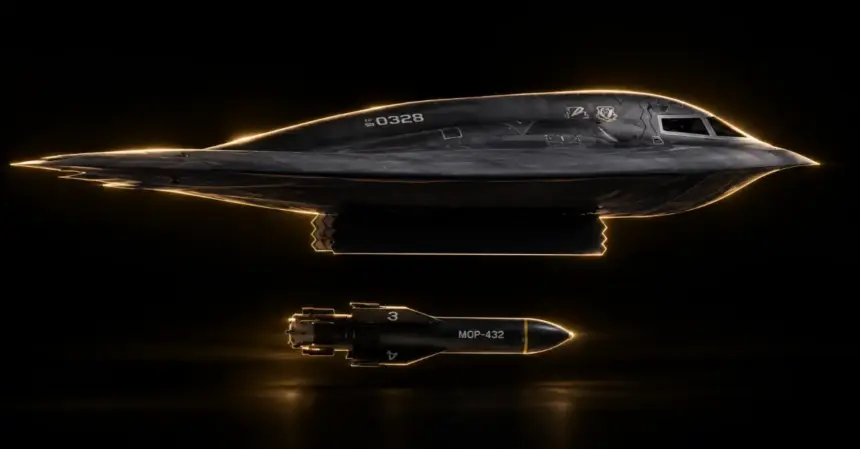
When people talk about the GBU-57, the Massive Ordnance Penetrator or MOP, they mostly remember its sheer size: 13.6 tonnes, more than six meters long. Yet I have the impression that what really matters about this weapon is almost always poorly explained. Here is how it works, what it showed at Fordow, and why it weighs on strategic calculations, from the Eastern Mediterranean to the Gulf.
A weapon built for a single type of target
The MOP is not a general-purpose bomb. It was designed for buried and fortified facilities: underground nuclear complexes, command centers, tunnels dug into rock. It is the largest conventional bunker-busting bomb ever built.
A few benchmarks, as reported by public US Air Force sources:
- weight: 30,000 pounds, or about 13.6 tonnes
- length: 20.5 feet, or about 6.2 meters
- diameter: 31.5 inches, or about 80 centimeters
- explosive charge: 5,342 pounds (2,423 kg) of AFX-757 and PBXN-114
- delivery platform: the B-2 Spirit stealth bomber, the only aircraft able to carry it today, with two bombs per mission
This dependence on the B-2 is an issue in itself. It limits the number of platforms that can carry out this type of strike, and therefore the options available to US decision-makers.
Step one, reaching depth
The logic of the weapon comes down to two stages: getting there, then destroying. For the first, physics does the work.
The B-2 releases the bomb from high altitude. Its ceiling is about 50,000 feet (15.2 km), but the exact release parameters remain classified. During the fall, gravitational potential energy is converted into kinetic energy, according to the formula E = ½ m v². Since speed is squared, doubling the speed multiplies the energy by four.
According to General Dan Caine, Chairman of the US Joint Chiefs of Staff, the MOPs dropped on Fordow went down the ventilation shafts at more than 1,000 feet per second, or about 1,100 km/h.
The fall is not blind, though. The bomb is guided by GPS and inertial navigation, and corrects its trajectory using grid fins at the rear.
The casing does the penetrating
On impact, everything rests on the casing. The MOP is cast in a high-performance steel alloy, both hard and ductile, designed not to shatter. It behaves like a giant projectile: it concentrates mass and speed on a narrow tip, crushes and fractures concrete and rock, and keeps advancing as long as it has energy left.
Public penetration figures vary depending on the source. The US Air Force cites up to 200 feet (61 meters) of an unspecified material. Janes analysts put it at about 200 feet of soil or 60 feet (18 meters) of concrete. Very hard rock or very high-strength concrete reduces this range. These are estimates, not publicly released test measurements.
A commonly misunderstood point, kinetic energy does not destroy
This is the clarification I find most useful. Kinetic energy is used to bring the bomb to the target, not to destroy it.
Let’s do the math. At 1,000 feet per second, or about 1,100 km/h, the bomb’s 13.6 tonnes carry about 630 megajoules. That is roughly equivalent to 330 pounds of TNT, or 150 kg. It is small next to the payload on board, more than 2.4 tonnes of explosive.
Destruction therefore comes from the explosion, not from the impact. Penetration only ensures that the detonation happens in the right place.
The fuze decides the right place
That “right place” is chosen by the fuze. The US Air Force equips the MOP with a smart fuze, the Large Penetrator Smart Fuze, whose characteristics are classified.
What is known, however, is how fuzes of this family generally work. They use deceleration sensors to identify the layers they pass through (rock, concrete, soil) and the empty spaces, such as rooms or galleries. They then trigger the explosion at the programmed point. At Fordow, each bomb was fitted with an individually programmed fuze.
When the charge explodes deep inside the rock mass, the shock wave stays confined and propagates through rock and concrete. Tunnels collapse, chambers are crushed, and sensitive equipment is subjected to pressures that a surface explosion could never transmit.
Fordow, the demonstration and its limits
In June 2025, during Operation Midnight Hammer, seven B-2s dropped 14 MOPs: 12 on Fordow and 2 on Natanz. These figures are those released by US authorities.
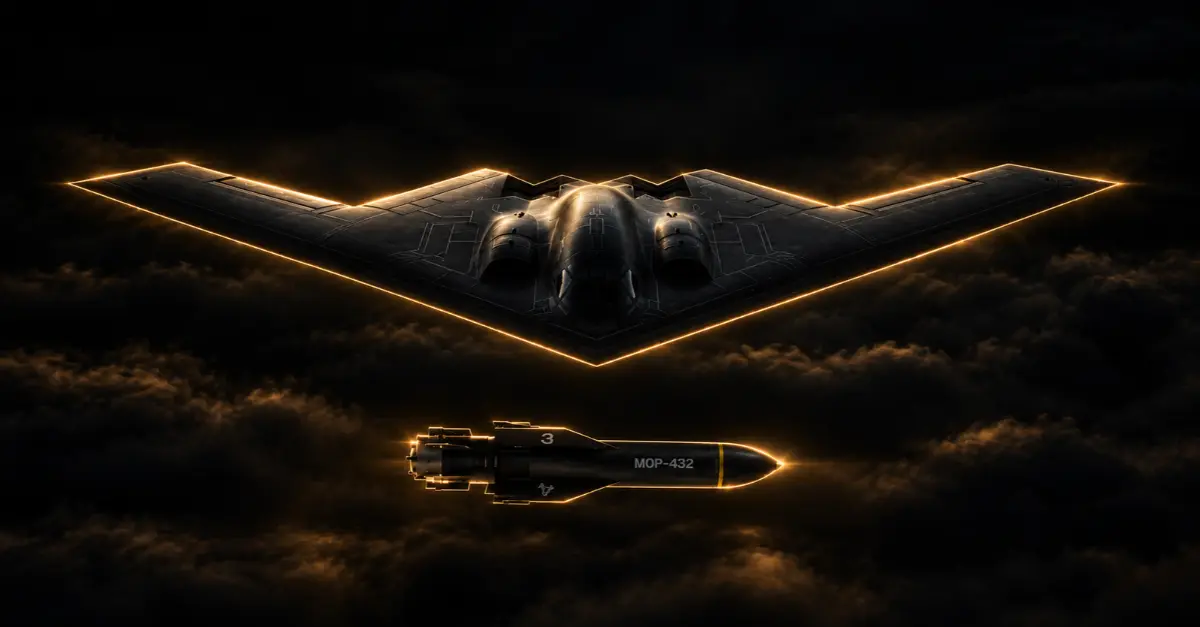
What struck me most is the approach chosen at Fordow. The United States did not try to go through the mountain. It targeted two ventilation shafts. The first bomb in each group tore off the concrete slab Iran had placed over the entrance. The following ones went down the shaft and exploded inside the complex. In total, six bombs for each entrance.
This configuration says two things at once. It shows the bomb’s effectiveness when the access path is known and exploitable. It also shows its limit: against a facility buried under too thick a layer of rock, with no vulnerable entry point, the MOP is not enough on its own. A design weakness had to be targeted rather than forcing through the rock mass.
What this changes for the region
For the Eastern Mediterranean and the Middle East, the lesson is twofold. On one side, some advocates of the military option see it as proof that a deep site is no longer out of reach. On the other, analysts point out that success depends on the site’s geometry, the precision of intelligence and a large expenditure of munitions, with a single carrier aircraft. Some experts therefore judge that the strike delays a program rather than eliminating it, while others believe it imposes a real and lasting cost.
The debate remains open, and it is played out as much in foreign ministries as in ballistic calculations. As for the next generation of underground facilities, dug deeper or better protected, it will probably adapt to what the MOP has revealed.
FAQ
Which aircraft can drop the GBU-57?
Today, only the B-2 Spirit stealth bomber is capable of it. It carries two per mission.
How deep can the MOP penetrate?
The US Air Force cites up to 200 feet (61 meters) of an unspecified material. Janes estimates about 200 feet of soil or 60 feet (18 meters) of concrete. Hard rock or very high-strength concrete reduces this range.
Is it kinetic energy that destroys the target?
No. It serves to bring the bomb deep underground: at 1,000 feet per second, it is equivalent to about 150 kg of TNT. Destruction comes from the charge of more than 2.4 tonnes, triggered at the right place by the fuze.
Why were ventilation shafts targeted at Fordow?
According to the information released, they offered a path into the complex. The first bomb removed the concrete slab, and the following ones exploded inside.