


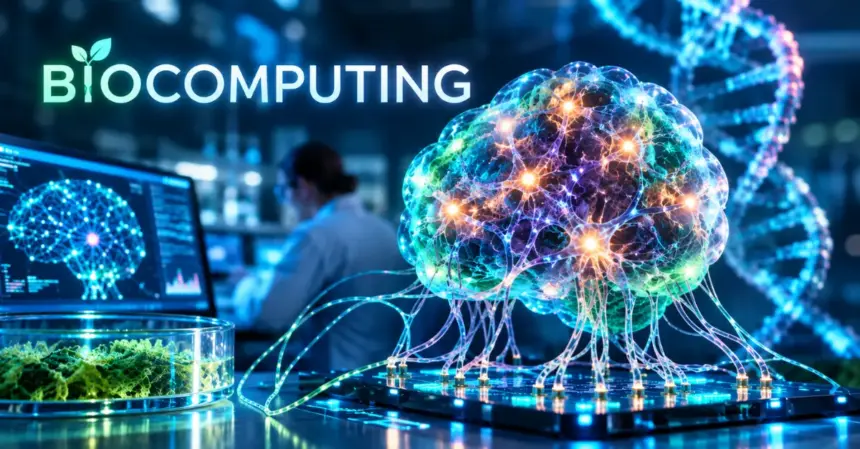
Since Cortical Labs opened its first biological data centers in Melbourne and then Singapore, the question is no longer whether brain cells can compute, but how far this living form of computing will take us. Caught between an energy breakthrough and an ethical vertigo, I wanted to sort out what’s real from what’s hype in a story that blends biology, video games, and the philosophy of consciousness.
This hybrid format, where brain cells talk to silicon, promises an energy efficiency that classic AI will likely never match. But it also opens a dizzying gap: that of living tissue put to work, without anyone really knowing what it experiences.
Human neurons playing Doom
The image went viral across the tech world in March 2026: a cluster of roughly 200,000 human neurons grown on a chip managed to control a character in Doom, handling movement and shooting in a crude but genuine way. The demo, widely shared across social media, wasn’t some engineer’s joke gone too far. It was the showcase for a system called CL1, capable of running code deployed directly onto living neural tissue.
This wasn’t the startup’s first splash. Back in 2021, its team had already trained cells to play Pong, using a setup made of more than 800,000 living brain cells grown on microelectrode arrays capable of sending and receiving electrical signals. Doom is simply the next step in a trajectory the company has clearly committed to: proving that a biological neural network can learn a task through trial and error, without a single line of classic machine-learning code behind it.
What struck me most while digging into this story is the raw biological comparison. The human brain runs on roughly 20 watts continuously, handling perception, memory, and fine motor control all at once. A high-end GPU, by contrast, burns several hundred watts for a fraction of that versatility. That gap is precisely what launched the whole biocomputing venture.
AI’s energy black hole
To understand why a startup would start growing neurons inside server racks, you have to look at the energy bill of conventional AI, and it’s staggering. According to the Energy Institute, global data center electricity demand reached 787.8 terawatt-hours in 2025, up nearly 20% year over year. The International Energy Agency, using a narrower scope, puts the figure closer to 485 TWh for the same year, but both curves point the same way: relentlessly upward.
The real accelerant is AI servers specifically. Per an analysis reported by Le Monde Informatique, their consumption is expected to jump 84.2% between 2025 and 2026, from 95 to 175 TWh, before climbing further the following year. In concrete terms:
- global data center electricity consumption could double by 2030, surpassing 950 TWh under the IEA’s central scenario
- AI-dedicated servers could account for nearly half of that total consumption by the end of the decade
- a single query to a conversational assistant is, according to the IEA, up to ten times more energy-intensive than a standard search engine query
- in Ireland, data centers already consumed 17% of national electricity in 2022, up from under 5% in 2015
It’s against this backdrop of strained power grids that biocomputing takes on real strategic weight. Each CL1 unit, its founder Hon Weng Chong claims, consumes less power than a pocket calculator. The full rack installed in Singapore, with twenty units, tops out at around 20 kilowatts — a trivial figure compared to the megawatts a conventional GPU server room devours. I’ve already covered generative AI’s energy surge in our report on data center power consumption, and the contrast with these new biological installations is striking.
How do you actually grow neurons for a computer
The process looks a lot more like a molecular biology protocol than an electronics assembly line. It starts with stem cells, usually drawn from a simple blood sample, which are reprogrammed in the lab to differentiate into functional neurons. That’s the work led in part by Rickie Patani, who heads the neurobiology program at the National University of Singapore’s life sciences institute, where these cells are transformed before being transferred onto CL1 chips.
Once mature, the neurons are deposited onto a multi-electrode array, a silicon chip capable of sending and receiving electrical impulses. The whole system runs on biOS, Cortical Labs’ in-house operating system, which orchestrates the constant back-and-forth between the living tissue and the electronics. The latest chip generation carries fifty-nine electrical inputs, up from just eight on the original prototype, which gives a sense of how fast this architecture is moving.
Each CL1 unit costs around $35,000 to buy outright, or can be rented weekly for shorter-term use. Cortical Labs markets this business model under the banner “Wetware as a Service,” a fairly blunt way of saying it wants to turn living neurons into a cloud-consumable resource, the same way you’d rent compute power from any conventional host.
The DishBrain project, or how do you train a cell
Before the commercial CL1, there was DishBrain, published in 2022 in the journal Neuron. The principle is almost Pavlovian: researchers applied the free energy principle to the neurons, a theory holding that the brain constantly works to reduce uncertainty about its environment. In practice, when the neuron culture missed the ball in a game of Pong, it received disordered, unpleasant electrical stimulation. When it succeeded, the stimulation became ordered and predictable.
The result: the cells learned, within minutes of training, to improve their gameplay. Notably, human neurons achieved longer rallies than the mouse neurons tested in parallel, over an equivalent training time. So you don’t train a biological neural network the way you train a deep-learning model through gradient backpropagation. You condition it, quite literally, by manipulating sensory reward and punishment. It’s this ability to learn from very little data, combined with near-instant adaptation to changing conditions, that’s now drawing industry interest.
Where does consciousness hide in all this
This is the question that haunts me most in this whole story, and honestly, no one has a satisfying answer. Does a cluster of 200,000 or 800,000 human neurons, wired to a chip and capable of learning to play a video game, possess some minimal form of subjective experience? Modern neuroscience generally locates the correlates of consciousness in large-scale networks involving the cortex, the thalamus, and complex recurrent loops — a far cry from the flat structure of a cell culture sitting on an electrode array.
But the reassuring argument has its limits. No one can say with certainty that some precise threshold of neural complexity separates simple signal processing from subjective experience. Cortical Labs itself requires clients to obtain ethics clearance before any commercial use of the CL1 — a safeguard that, implicitly, acknowledges the moral ambiguity of what it’s selling. In-Q-Tel, the CIA-linked venture fund, has also invested in the startup, alongside Horizons Ventures and Blackbird Ventures, which shows the interest here reaches well beyond the neuroscience research community.
My own take, after weeks spent poring over the papers and the announcements: what we’re witnessing isn’t so much the creation of a conscious brain as the exploitation of a very specific biological property — synaptic plasticity — repurposed for computation. But I wouldn’t underestimate how fast this field is moving, or how badly it needs a regulatory framework built ahead of time rather than in reaction to a scandal.
The risk of total dehumanization
This is the trickiest point, and it goes well beyond the technical side. Turning living human tissue into an industrial resource, however tiny the amount of cells involved, opens up a genuinely slippery slope. Several tension points deserve to be laid out clearly:
- the moral status of neural cultures, which fit into no existing legal category — neither that of research animal subjects nor that of persons
- the origin of the stem cells, often drawn from blood donations, and the question of long-term consent to their industrial use
- the normalization of commercial language like “Wetware as a Service,” which treats living human tissue as just another cloud capability
- the absence, so far, of any harmonized international framework governing the production, sale, and disposal of these neural cultures
That last point is probably the most urgent. Regulators are structurally always playing catch-up with innovation, and biocomputing is moving faster than any biomedical ethics commission can. France, with roughly 300 data centers already active in 2026, has no biological installation of this kind yet, but nothing rules out a pilot project emerging in the coming years, driven by the same push for energy efficiency already shaping our analysis of France’s data center power challenges.
I don’t buy into a science-fiction scenario of brains in jars taking over the world. The real danger is more mundane: a gradual industrialization, without enough public debate, of a biological resource whose moral implications we still barely understand. Biocomputing deserves to be watched closely — with genuine enthusiasm for its energy promise, and real vigilance about its gray areas.
FAQ
Is biocomputing already commercially available in 2026?
Yes. Cortical Labs has been selling the CL1 since 2025, with operational installations in Melbourne and a twenty-unit rack in Singapore, run in partnership with the National University of Singapore and data center operator DayOne.
Are the neurons taken directly from a human brain?
No. The neurons come from reprogrammed stem cells, usually derived from a blood sample, then differentiated in the lab before being deposited onto the chips.
Does a biological computer really use less power than a GPU?
According to Cortical Labs, each CL1 unit uses less power than a pocket calculator, compared to several hundred watts for a conventional AI GPU — though direct performance comparisons remain difficult to establish.
Is there a specific legal framework for biocomputing?
Not yet, at the international level. Cortical Labs enforces an internal ethics clearance requirement for its clients, but no harmonized public regulation currently governs the production or use of these neural cultures.