

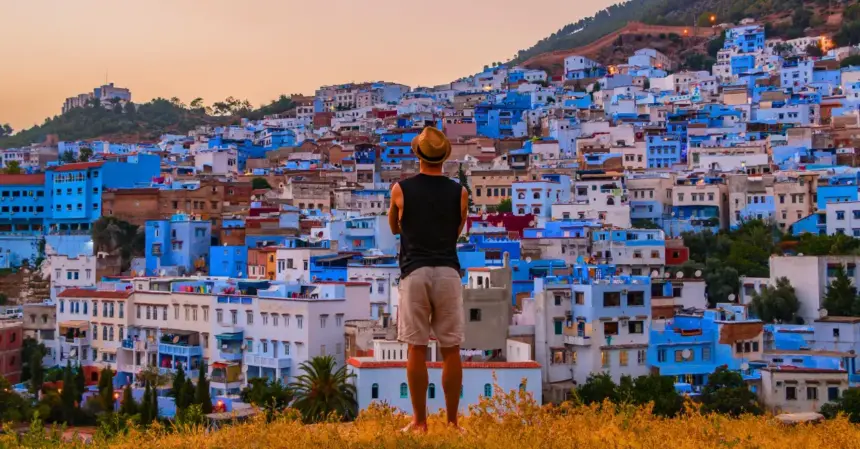
A cascade of Instagram likes has done more for Chefchaouen’s fame than decades of institutional marketing ever could. Tucked into the foothills of the Rif Mountains, the small city founded in the 15th century by Ali Ben Rachid to defend the region against Portuguese incursions has become, over the past decade or so, one of the most photographed backdrops in the Maghreb. That success raises a simple question rarely addressed with much rigor by conventional travel guides: how does one visit a town built for a few thousand residents without getting caught up in the commercial machinery that has grown around its image.
A destination that has changed scale
Moroccan tourism is going through a period of sustained growth. The Ministry of Tourism reported a record number of visitors to the kingdom in 2025, up roughly 14% from 2024, driven largely by expanded air connectivity and the international promotion strategy launched under the 2023-2026 tourism roadmap. Chefchaouen has benefited substantially from this national momentum. The Tangier-Tetouan-Al Hoceima Regional Tourism Council has set a target of 700,000 visitors for the region, with the blue pearl as a centerpiece, by 2026 — a figure worth weighing against the town’s roughly 45,000 residents.
Before the pandemic, close to 70% of Chefchaouen’s visitors came from abroad, according to data circulated by regional tourism authorities. That share, driven by European and North American markets, has largely reshaped the town’s commercial offering: souvenir shops, improvised dyeing workshops, café terraces built for the perfect photo. A local economy has reorganized itself almost entirely around the passing visitor, with all the opportunism — and the abuses — that implies.
The fake guide trap
Chefchaouen’s medina, unlike those of Fez or Marrakech, is modest in size. Getting lost rarely takes more than half an hour. Yet it’s on this small stage that the most common scam in Morocco’s historic cities plays out: the fake guide. The mechanism is well documented in other Moroccan medinas and shows up here in near-identical form. A local resident, or someone posing as one, offers unprompted to walk the visitor to their riad, points out a convenient shortcut, or warns that a particular alley is closed for repairs. The help is never disinterested: a sum is demanded on arrival, or the detour ends in a shop where the impromptu guide earns a commission on whatever gets sold.
The trick works because it plays on a natural reflex in a traveler who is tired or disoriented after a long journey. The countermeasure is well known and fairly simple: politely but firmly decline any unsolicited offer of company, check the route to your accommodation in advance using an offline map, and only use guides affiliated with an official bureau or recommended by your lodging. Rates charged by local French-speaking guides remain, on the whole, reasonable and fixed in advance, which limits the risk of unpleasant surprises for anyone who takes the trouble to book rather than recruit one on the spot.
Ras El Ma and Akchour, nature as an escape valve
Local authorities have taken stock of the pressure on the historic core and have, in recent years, invested in relieving the medina by developing nearby natural sites. The Ras El Ma area, the spring where women traditionally came to wash laundry, was renovated and reopened to the public in March 2024. A few kilometers away, the Akchour waterfalls, at the gateway to Talassemtane National Park — designated a UNESCO biosphere reserve — are the subject of a development project meant to better distribute visitor flows between the town and its surroundings.
These initiatives point to a fairly clear strategy: rather than artificially capping medina traffic, the goal is to open alternative spaces capable of absorbing part of the demand. For travelers, this is also the best way to step outside the postcard scenery and find a less standardized experience. A hike to the smaller Akchour waterfalls, through Rif orchards and gorges, offers a connection to the region that no blue alleyway can match — provided you set out early enough to beat the midday crush of organized tour groups.
What the numbers and local priorities reveal
A few figures help put the destination’s challenges in perspective.
- 700,000: visitor target set by the Tangier-Tetouan-Al Hoceima Regional Tourism Council for Chefchaouen by 2026.
- 70%: share of foreign visitors in the town’s tourist traffic before the Covid-19 pandemic.
- March 2024: reopening to the public of the renovated Ras El Ma area.
- May 2024: official opening of the Maison de la Diète Méditerranéenne, dedicated to the region’s culinary heritage.
- 14%: increase in the number of visitors to Morocco in 2025 compared with 2024, according to the Ministry of Tourism.
That last figure, which far outpaces the town’s population growth, explains why the question of managing tourist flows now carries the same weight in local discussions as it does in Marrakech or Essaouira — even though Chefchaouen remains, for now, on a much smaller scale than those destinations.
Eating and shopping off the beaten path
Restaurants set up on the medina’s most photogenic squares, particularly around Place Outa Hammam and its 15th-century kasbah, charge noticeably more than establishments just a few streets away, without quality necessarily following the same curve. It’s a pattern common to any destination where image outweighs culinary substance, and Chefchaouen is no exception. Moving just a few hundred meters away from the most sought-after viewpoints is usually enough to find more authentic food at prices in line with what locals pay.
The same logic applies to weaving workshops and craft shops. Many of those along the busiest routes function primarily as showrooms for organized tour groups, with margins priced accordingly. Women’s weaving cooperatives, less visible from the main thoroughfares but listed by local tourism offices, offer an alternative where the price reflects the actual work involved rather than simply the shop’s location.
Outlook for a destination under moderate strain
Chefchaouen has not yet reached the saturation point seen in some European cities, where overtourism has prompted restrictive regulatory measures. For now, the town remains in a phase of managed growth, driven by targeted public investment rather than an uncontrolled explosion of supply. But its visitor trajectory, closely tied to Morocco’s own strongly rising tourism numbers, calls for vigilance. The real issue, for local authorities and visitors alike, has less to do with raw visitor numbers than with how they are distributed across space and time. A town whose appeal rests largely on an aesthetic infinitely reproducible on social media carries the risk of seeing its authenticity erode at the same pace as its popularity grows.
FAQ
Do I need to hire a guide to visit Chefchaouen?
No, the medina is easy to explore on foot without one. An official, bureau-affiliated guide can add historical context, but is by no means essential for finding your way around.
When is the best time to avoid crowds?
Spring and autumn, outside European school holidays, offer pleasant weather and noticeably fewer visitors than summer.
Are the Akchour waterfalls worth the trip?
Yes, especially for anyone looking to step outside the urban setting. Setting out early helps you avoid the organized groups that arrive around midday.
How can I spot a fake guide in the medina?
Anyone who offers unsolicited help, with no connection to your accommodation or a recognized guide bureau, should be treated with caution — especially if they claim a street is closed or offer a convenient shortcut.