

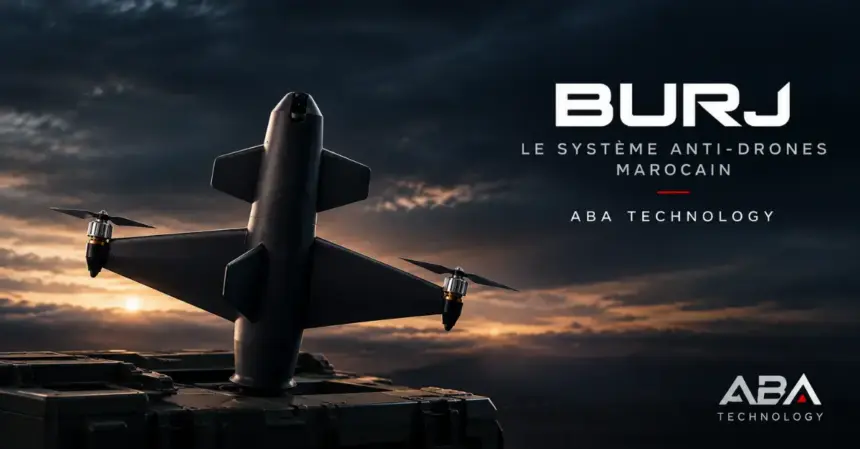
Moroccan company ABA Technology is presenting “Burj”, a protection and counter-drone system. According to the information accompanying its presentation, it includes an interceptor drone of entirely Moroccan design, capable of reaching speeds above 250 km/h. We report these claims as statements from the manufacturer, pending independent validation.
- ABA Technology is presenting “Burj”, an anti-drone system, at the Marrakech Airshow 2026.
- It includes an interceptor drone billed as 100% Moroccan and capable of exceeding 250 km/h.
- These characteristics are statements from the manufacturer and have not yet been independently confirmed.
- Morocco is seeking to produce its defence equipment locally, under Law 10-20.
- No public order has been confirmed at this stage.
A show that embraces industrial ambition
The Marrakech Airshow runs from 7 to 10 October at the military air base in Marrakech. This eighth edition brings together nearly 200 exhibitors from 27 countries, with the United Arab Emirates as strategic partner. The announced themes are industrial sovereignty, resilient supply chains, advanced defence systems, artificial intelligence and satellite technologies.
What stands out is the simultaneous presence of players rarely gathered on the same site: American, Chinese, French, Israeli, Turkish, Indian, Korean and Emirati companies. In his remarks at the opening of the show, Abdellatif Loudyi argued that the Kingdom should move from being a buyer to being a producer of defence equipment. According to figures cited by the Moroccan and international press, the aerospace sector counts more than 150 companies and around 26,000 skilled jobs, with local integration above 40%.
It is in this setting that “Burj” takes on its meaning. It is not only a product, but a signal sent to foreign partners and Moroccan authorities alike: national companies can offer solutions in a segment that has become central.
ABA Technology, a player from the digital world
ABA Technology is not a historic defence manufacturer. The company, led by its founder and chairman Mohamed Benouda, made its name in digital infrastructure. On 2 April in Rabat, it presented an artificial intelligence platform called ABA Fusion AI, developed with Nvidia and Dell Technologies and described as designed, produced and operated from Morocco. At the Marrakech Airshow, according to Médias24, its space is devoted to IoT, electronics and connected solutions.
This background sheds light on the logic behind “Burj”. An anti-drone system relies as much on software, detection and data processing as on the physical vehicle. A company versed in integrating sensors, electronics and AI therefore enters this market with a real asset, even though building a reliable aerial interceptor is a different trade.
Why interceptor drones are gaining ground
To understand the significance of this announcement, we need to look at the economics of the threat. Low-cost attack drones, notably Shahed-type models, have shown in Ukraine and then in the Middle East that they can saturate defences designed for more expensive targets. Firing an anti-aircraft missile costing several hundred thousand euros at a machine that is dozens of times cheaper is an equation that is hard to sustain over time.
Hence the rise of interceptor drones, which are faster and far cheaper than missiles and are engaged against slow targets. We have already covered in these columns the case of Sting, developed in Ukraine by the Wild Hornets collective. The Iranian attacks launched against the United Arab Emirates since 28 February 2026, a large share of which were intercepted by Emirati defences according to open sources, confirmed the same lesson: counter-drone defence is no longer a peripheral segment but a pillar of protecting civilian and military sites.
In this context, a claimed speed of more than 250 km/h is a relevant selling point, as it allows the interceptor to catch up with attack drones whose cruising speed is considerably lower. On its own, however, it says nothing about real-world effectiveness: interception rate, resistance to jamming, performance at night or in bad weather, unit cost and production rate all remain to be documented.
What is at stake for Morocco
The Kingdom is no newcomer in this field. According to specialist sources, it acquired the Ukrainian Bukovel-AD electronic warfare system as early as 2019, and it has partnerships with the United States, Israel and Turkey in the drone sector. The announcement of “Burj” follows a different logic, that of localisation.
This orientation rests on Law 10-20, which sets a legal framework for developing local defence production through joint ventures, technology transfers and domestic assembly. At the opening of the show, agreements covered advanced manufacturing research, aircraft components, local sourcing and defence technologies, including a Moroccan drone. According to the MAP news agency, a partnership with the French company Harmattan AI also covers next-generation counter-drone technologies, from research to production, integration and testing.
The stakes fall into three areas:
- Strategic: reducing dependence on foreign suppliers for equipment whose demand will keep growing
- Economic: creating skilled jobs and a network of subcontractors around electronics and AI
- Geopolitical: positioning Morocco as a potential supplier for African countries facing low-cost aerial threats
What we will be watching
We will closely follow the next steps: the publication of verifiable technical specifications, any public trials, interest expressed by the armed forces or by critical-infrastructure operators, and ABA Technology’s ability to build a local production chain. The question is no longer whether Morocco wants to produce its own anti-drone equipment, but how fast and with how much industrial depth it will get there.
FAQ
What is the “Burj” system?
It is a protection and counter-drone system presented by the Moroccan company ABA Technology, which includes an interceptor drone.
How fast can the interceptor drone fly?
According to the manufacturer’s announcement, it can exceed 250 km/h. This figure has not yet been confirmed by an independent source.
Is the system already used by the Moroccan army?
We have found no public information confirming an order or entry into service by the Royal Armed Forces.
Why are interceptor drones developing?
They cost far less than anti-aircraft missiles and suit slow, inexpensive attack drones, which can saturate conventional defences.