Furientis’s announcement belongs to the second category. This California company, founded in 2025 in the Los Angeles area, has been selected as one of four suppliers to take part in a US Army live-fire competition scheduled for the end of fiscal year 2027. The goal is to provide a second interceptor missile for the IFPC Increment 2 system.
According to its co-founder and CEO, Brody Franzen, this is a preselection ahead of a final round, due around September 30, 2027, the closing date of the US fiscal year. He did not name the three other companies selected.
I find this sequence revealing. A company that did not exist a year ago now sits at the same table as players established for decades. What remains is to understand what this changes, and what it does not.
What IFPC Increment 2 is
IFPC (Indirect Fire Protection Capability) Increment 2 is the US Army’s medium-range air defense system. It is designed to protect bases and troops against several threats: cruise missiles, drones, rockets and artillery fire.
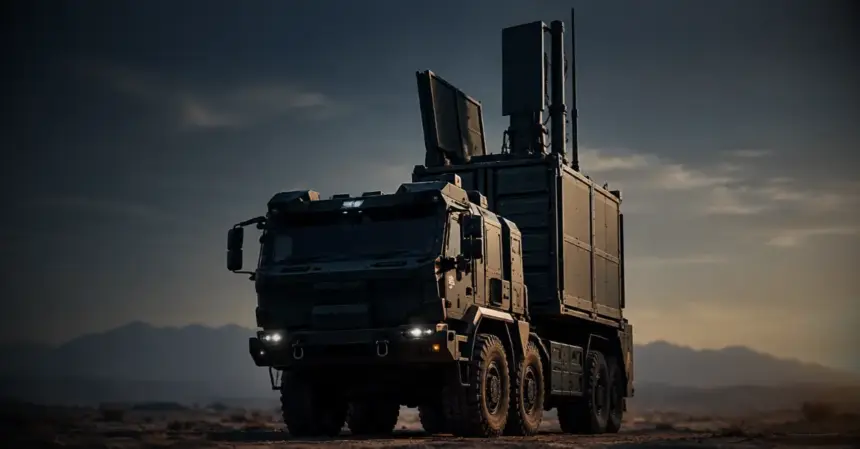
Its launcher, called Enduring Shield, is truck-mounted. It is built by Dynetics, a Leidos subsidiary, and currently fires RTX’s AIM-9X Sidewinder missile. That missile was originally designed for air combat, which is precisely why a complement is being sought.
The US Army has been looking for a second missile for several years, with two requirements:
- More performance, in particular against fast, low-flying cruise missiles.
- More volume, meaning a missile that can be produced in larger quantities.
The second point is just as important as the first. Recent conflicts have shown that an air defense system is judged not only by the quality of its interceptors, but also by their numbers and their cost against cheap threats. This is my own analysis, not an official statement, but it sheds light on the logic of the program.
Two tracks for a single need
The official second interceptor program entered its demonstration phase in September. Two teams are already engaged: Lockheed Martin on one side, and a group formed by Boeing and Anduril on the other. Rafael’s US subsidiary was not selected for this phase.
At the Association of the United States Army (AUSA) conference this week, Lieutenant General Frank Lozano, the Army’s weapon systems acquisition chief, announced the opening of a parallel track. It is aimed at companies that were not selected in the first round but have continued to invest their own funds in their projects. According to Breaking Defense, which reported his remarks, these companies will be invited to showcase their missiles in comparative tests in the fourth quarter of fiscal year 2027.
Furientis’s selection appears to fit into this approach. I deliberately use the conditional: to my knowledge, neither General Lozano nor the Army has publicly established this link. It is a reading consistent with the timeline, not a confirmed fact.

Who Furientis is
Furientis was founded by Brody Franzen and Aris Simsarian, both former engineers at Virgin Orbit and Castelion. Their bet is first and foremost industrial: to build interceptors designed for serial production, using readily available parts.
The company puts forward two figures about its method, which I report as it presents them:
- a final assembly time of about 30 minutes;
- prototype flight tests roughly every two weeks, rather than years of design before a first flight.
These claims come from the company itself. To my knowledge, they have not been validated by a third party at this stage, and a fast testing rhythm does not, on its own, guarantee performance against a low-flying cruise missile.
A very rapid ramp-up
The young company’s financial timeline is dense:
- May: emerged from stealth mode with a $5 million pre-seed round.
- October 6: $25 million seed round led by Benchmark, and announcement of its first funded government contract.
- The contract: a prototyping agreement with the US Department of War for an interceptor with a range of 160 kilometers, intended for homeland defense.
According to Franzen, the IFPC selection capped two busy weeks. Furientis carried out its first horizontal test flight on a government range, as part of the Army’s low-cost interceptor program. At AUSA, it also unveiled, with Rheinmetall, a containerized launcher for the Army’s Common Autonomous Multi-domain Launcher (CAML) program.
This last point deserves attention. The partnership with Rheinmetall, a leading German group, gives the startup a heavyweight industrial partner on the launcher side. It also illustrates a broader phenomenon: transatlantic ties are multiplying in land armaments, even within American programs.

Why this matters
I see three issues, which I keep distinct from what is established.
The strategic issue. The US Army wants an interceptor capable of handling low-altitude, fast and numerous threats. The question goes beyond the United States: European armies and those around the Mediterranean are wrestling with the same equation of performance, cost and production rate. The American choice could influence acquisition practices elsewhere, although nothing guarantees it.
The industrial issue. Franzen thanked the Army’s Program Executive Officer for Fires and his defensive fires team, led by Brigadier General Guy Yelverton, for opening the door to non-traditional suppliers and giving them the means to accelerate. This suggests an institutional will to widen the supplier pool. That is his reading, but it is consistent with the parallel track announced by General Lozano.
The economic issue. For a fund like Benchmark, backing a defense company at this stage is a sign of venture capital’s appetite for the sector. Caution is still in order: $25 million in seed funding is no match for the resources of a prime contractor.
Limits and debates
A more cautious viewpoint deserves a hearing. Being selected for a live-fire competition is not the same as being chosen. Four companies are in the running, and Furientis will have to prove its performance in real conditions. Weapons programs also have a history of slipping schedules, and moving from prototype to serial production is often the hardest step.
Conversely, supporters of this approach argue that speed of iteration and industrial simplicity are decisive assets. In their view, classic methods, which are slow and costly, do not answer threats that evolve quickly. Both positions are defensible, and only the 2027 tests will settle the matter.
What to watch
Several deadlines and unknowns will shape what comes next:
- the identity of the three other selected companies, not disclosed to date;
- the results of the first horizontal test flight and the tests that follow;
- whether the final’s schedule holds, announced for the end of the fiscal year, September 30, 2027;
- the evolution of the official program led by Lockheed Martin and the Boeing-Anduril group.
I therefore remain cautious about the outcome. Furientis has cleared a step that is both symbolic and real, but the hardest part, technical and industrial proof, still lies ahead. The real question is whether the agility of a young company can compete with the experience of the established players on such a demanding requirement.
FAQ
What is Furientis?
An American missile startup founded in 2025 in the Los Angeles area by Brody Franzen and Aris Simsarian, former engineers at Virgin Orbit and Castelion. It develops interceptors designed for serial production.
What exactly did Furientis obtain?
A selection among four suppliers for a US Army live-fire competition, due by the end of fiscal year 2027. This is a preselection, not a production contract.
What is IFPC Increment 2 for?
It is the US Army’s medium-range air defense system, intended to protect bases and troops against cruise missiles, drones, rockets and artillery.
Who else is competing for the second interceptor?
In the official program, Lockheed Martin and a team combining Boeing and Anduril. Furientis falls under the parallel track opened to companies not initially selected.