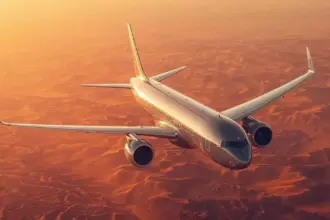

Over the past twenty-five years, Morocco’s aerospace industry has changed dimension. According to figures put forward by the sector, it now counts around 160 companies, 27,000 jobs and nearly 3 billion dollars in exports, with the ambition of doubling that figure in the coming years.
Key takeaways
- Morocco’s aerospace sector counts around 160 companies, 27,000 jobs and nearly 3 billion dollars in exports.
- Safran is investing in engine maintenance, LEAP-1A assembly and a landing gear plant in Casablanca and Nouaceur.
- The country is gradually moving from subcontracting to higher value-added activities.
- Risks remain real: dependence on Airbus and Boeing, still-limited engineering, and a need for skills.
- Doubling exports will be the real test of this change of dimension.
Communiqués released at the Farnborough airshow in July 2026 give similar figures: more than 155 companies, more than 25,000 people employed and nearly 3 billion dollars in annual exports.
The question deserves to be asked without hype. Is Morocco changing category? Is it moving from a competitive industrial platform to a genuine technology partner of the world’s major players? I think the answer is nuanced: the movement is real and documented, but it remains unfinished.
Where it started, a platform built on competitive costs
To measure the distance travelled, we need to go back to the starting point. The first aerospace company to set up in Morocco, Safran Aircraft Engine Services Morocco, dates from 1999: it built a maintenance centre there for CFM56 engines. The sector was then structured by state industrial policy, notably the Industrial Acceleration Plan, which set job creation and export targets for 2020.
The initial model was a classic one: attract foreign principals through competitive labour costs, geographic proximity to Europe, free zones and tax incentives. The activities involved were first wiring, precision machining, sheet metal work and parts assembly on behalf of large groups. This is what is called subcontracting: Morocco carries out tasks defined elsewhere, from plans designed elsewhere.
This model worked. The president of the Moroccan Aerospace Industries Association (GIMAS), Adil Jalali, cites average export growth of 15% a year over a quarter of a century, roughly three times the global growth rate of the sector. The sector’s exports reached a record 26.45 billion dirhams in 2024, according to Foreign Exchange Office data relayed by the economic press.
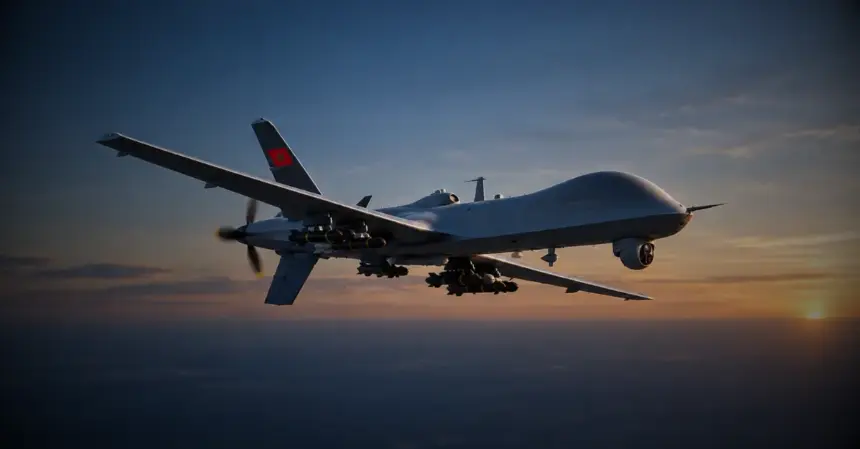
🚨 Harmattan AI dévoile l’IRIFI, un drone de frappe à longue portée annoncé avec une autonomie de 2 000 km.
Une portée présentée comme deux fois supérieure à celle du Geran-5 russe. 🇷🇺
#Defense #Drones #IRIFI #AI #DefenseTech #Maroc #Morocco https://t.co/ZW87P6cneN
— Silicon Valley (@SiliconValleyMa) October 7, 2026
Signs of a move upmarket
What distinguishes the recent period is the nature of the announced investments. Morocco no longer simply hosts assembly workshops; it hosts higher value-added activities.
Safran is the most telling case. The French group has started work in Casablanca, in the airport zone, on a maintenance, repair and overhaul (MRO) shop dedicated to the LEAP engine, which powers the Airbus A320neo and the Boeing 737 MAX. The announced investment is around 120 million euros, for a surface of 25,000 m² and a capacity of 150 engines a year. Safran has also announced a LEAP-1A assembly line, the engine of the A320neo. Assembling a complete engine is an industrial act of a different order from manufacturing a part.
In February 2026, the group presented a 280 million euro investment for a landing gear plant in Nouaceur, operated by Safran Landing Systems. According to figures published in the press, its cumulative commitments in Morocco exceed 630 million euros between 2025 and 2027, with more than 2,500 jobs planned by 2030. Safran already employs more than 4,800 people across ten sites in the country, according to its October 2025 press release.
Around it, the ecosystem has grown. Boeing, Airbus Atlantic, Spirit AeroSystems, Collins Aerospace, Hexcel, Eaton, Daher, Latécoère and Thales are established there, covering, according to the Moroccan economic press, a large part of the value chain: wiring, machining, composites, aerostructures, electrical systems, hydraulic equipment, engines, maintenance and engineering.
Key figures for the sector
- Around 160 companies, according to sector figures (155 according to the Farnborough 2026 communiqués)
- Around 27,000 jobs (more than 25,000 according to those same communiqués)
- Nearly 3 billion dollars in annual exports
- 26.45 billion dirhams in exports in 2024, a record according to the Foreign Exchange Office
- Average export growth of 15% a year over 25 years, according to GIMAS
What value creation really changes
We need to be precise about what the expression covers. Creating value, in industry, means capturing a larger share of a product’s final price: through engineering (designing rather than executing), through maintenance (a recurring, high-margin activity) and through the integration of complex subassemblies.
Safran’s chief executive, Olivier Andriès, justified these choices by the quality of local talent, but also by the ability to absorb the production ramp-up of Airbus and Boeing. According to the Moroccan press relaying his remarks, the footprint ensures production continuity in the event of disruptions elsewhere in the world. Ross McInnes, chairman of Safran’s board, summed up the strategy by saying that the group produces “with Morocco” rather than “in Morocco”. The phrase is a communications line, but it points to a shift: Morocco is becoming a resilience link for global supply chains, not just a low-cost site.
GIMAS itself describes this transition. According to Adil Jalali, the country’s positioning is gradually evolving from that of a production platform to that of a strategic industrial partner. This is the position of a player in the sector rather than an outside observer, but it is consistent with the investment announcements.
Training plays a key role. At Farnborough, the Moroccan pavilion brought together an industrial player, a start-up, GIMAS and the Casablanca Institute of Aerospace Trades. This presence illustrates the desire to show a complete chain, from training to production, with the support of financing structures such as the Mohammed VI Investment Fund.
🇲🇦 Made in Morocco : Tata a produit des véhicules au Maroc
Retour sur le camion Tata fabriqué localement à Berrechid, symbole d’une industrie automobile marocaine déjà présente il y a plusieurs années.
#Maroc #MadeInMorocco #TataMotors #Industrie #Automobile #Morocco #militaire https://t.co/zJJUYscAhQ
— Silicon Valley (@SiliconValleyMa) October 7, 2026
A change of category, but not yet complete
So, has Morocco changed category? I would say the country has crossed a stage. It is no longer just a place where things are assembled at low cost: players such as Safran are setting up maintenance, engine assembly and complex equipment activities there, which require lasting trust and skills.
But moving to the status of a genuine technology partner would require more: engineering and design centres, a larger share of Moroccan suppliers integrated into the chain, and national companies able to compete in certain segments. These elements are under construction, but they have not yet been demonstrated on a large scale.
The doubling of exports mentioned by the sector will be the test. If it comes with a rise in the share of local value added, and not just a higher production volume, then the change of dimension will be confirmed. If not, Morocco risks remaining a high-performing production site, but one still dependent on decisions taken elsewhere.
FAQ
How many companies and jobs does Morocco’s aerospace industry have?
According to figures put forward by the sector, around 160 companies and 27,000 jobs. The Farnborough 2026 communiqués speak of more than 155 companies and more than 25,000 people.
What is the difference between subcontracting and value creation?
Subcontracting means manufacturing parts or assembling to supplied plans. Value creation means capturing a larger share of the final price: engineering, maintenance and the integration of complex subassemblies.
What are the major recent projects in Morocco?
Safran has started work in Casablanca on an MRO shop for LEAP engines and a LEAP-1A assembly line. It has also announced a landing gear plant in Nouaceur, for a cumulative commitment above 630 million euros.
What are the main risks for the sector?
Dependence on Airbus and Boeing production, the limited scope of design activities in Morocco and the need for skilled labour.