


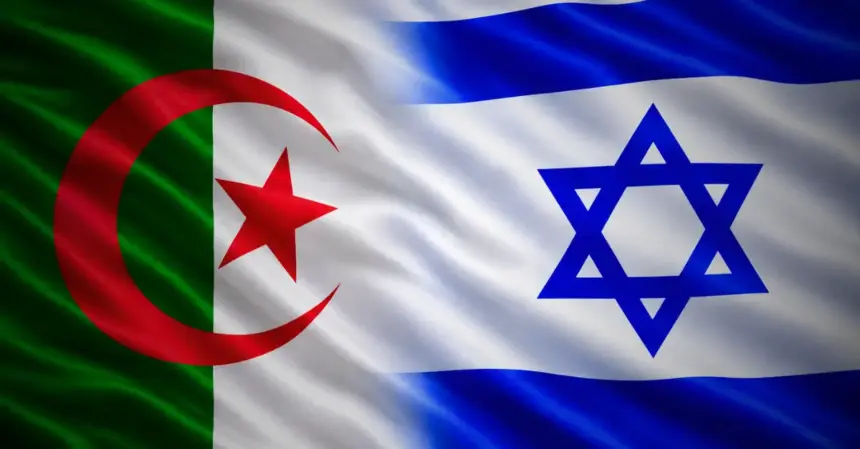
Speaking on the channel Echorouk News, Abdelhamid Abdaoui, who served as Algeria’s ambassador to Rabat between 2019 and 2021, claimed that Morocco is “under occupation” by what he calls the “Zionist entity,” and refused to even use the word “ambassador” to describe Israel’s representative in the kingdom, preferring instead to call him the “resident-general of the Zionist entity in Morocco.” According to him, the mere presence of Moroccan Jewish citizens in the kingdom is enough to prove that the country “belongs to the Zionists.”
This is not an anonymous internet commentator or a panel provocateur with no institutional standing. This is a career diplomat who represented the Algerian state for two years in Morocco, precisely during the pivotal period that saw Morocco normalize relations with Israel in December 2020, followed by Algeria’s break in diplomatic relations with Morocco in August 2021. It is this diplomatic pedigree that transforms a personal opinion, however shocking, into a marker of something broader: a growing porousness, within the Algerian state apparatus itself and the media outlets close to it, between anti-Zionist rhetoric and openly antisemitic discourse.
The immediate context behind the remarks
Abdelhamid Abdaoui’s intervention did not occur in a vacuum. It came just days after the announcement, on September 15 in New York, that Rabat and Tel Aviv were upgrading their diplomatic representations to full embassy status, with an exchange of ambassadors. This is the news that prompted his appearance. The former diplomat went on to develop a theory dating back to the 1965 Arab summit in Casablanca, claiming that King Hassan II allegedly allowed Mossad to spy on Arab leaders present at the gathering, which he says explains the Arab defeat in the 1967 Six-Day War. He further alleged that the same monarch received payment for every Moroccan Jew who emigrated to Israel in the early 1960s — a serious accusation, unsupported by any verifiable source, and one that fits squarely within a well-documented conspiratorial register.
This kind of statement is not isolated within the Algerian media landscape. Back in 2020, the official state news agency APS had described seven European lawmakers as “Moroccan Zionists” in a dispatch, a choice of wording that was denounced at the time as antisemitic by several American foreign policy observers, including academic William Lawrence and former State Department spokesman Adam Erly, who saw it as an instrumentalization of Jewish identity for purposes of political discreditation. More recently, an Algerian television commentator, Mehdi Ghezzar, attacked André Azoulay, the Jewish advisor to King Mohammed VI, on air, calling him the “real ruler of Morocco” and echoing, almost verbatim, the conspiratorial framework of the Protocols of the Elders of Zion. Those remarks sparked outrage in Morocco, as well as in France, where Les Républicains party leader Éric Ciotti called them “unacceptable and disgraceful.”
« Le Maroc appartient aux sionistes » Un exemple de l’antisémitisme d’État sur une chaîne de télévision algérienne car celui qui s’exprime est l’ex-ambassadeur d’Algérie au Maroc qui considère que la seule présence de Juifs marocains dans le royaume est la confirmation que le… pic.twitter.com/LyFpdCGBKh
— Chawki Benzehra (@ChawkiBenzehra) September 24, 2026
A history that still weighs on the present
To understand the symbolic weight of these statements, one has to revisit the history of Algeria’s own Jewish community. Since the 1870 Crémieux Decree, Algerian Jews held French citizenship, a status that set them apart from the Muslim population and shaped, up until independence, a distinct communal identity — one also marked by the antisemitic riots in Constantine in 1934 and by the decree’s repeal under the Vichy regime in 1940. At the moment of independence, in July 1962, the overwhelming majority of that community, estimated at around 130,000 people, chose to leave the country in a matter of weeks and settle in France rather than in Israel. Today, only a handful of Jews remain in Algeria.
The contrast with Morocco is stark. The kingdom still retains a Jewish community, admittedly reduced to roughly 3,000 people according to the most recent estimates, but one whose institutional presence remains visible: a Jewish royal advisor in the person of André Azoulay, Jewish heritage sites restored under the monarchy since the late 1980s, and an official policy recognizing the Hebraic component of Moroccan national identity, enshrined in the 2011 Constitution itself. It is precisely this visibility that the former Algerian ambassador turns into an accusation, presenting Jewish presence as proof of national allegiance to Zionism rather than as a matter of historical and communal fact.
Anti-Zionism and antisemitism, an increasingly blurred line
The Algerian government has always denied any hostility toward Jews as such, insisting that its foreign policy targets the state of Israel and its policy toward the Palestinians, not a religion or an ethnic origin. That is a defensible argument in principle: criticizing a state and its policies is not, in itself, equivalent to antisemitism. Several Algerian diplomats and intellectuals indeed claim a Third-Worldist, anti-colonial tradition in which support for the Palestinian cause holds a central place, independent of any religious animosity.
But the Abdaoui case illustrates exactly where that line dissolves. Claiming that the mere presence of Jewish citizens in a country proves its allegiance to Zionism is no longer a critique of Israeli policy: it is a religious essentialization that assigns to every Jew, wherever they live, a presumed loyalty to a foreign state. That is precisely the working definition of antisemitism adopted by the International Holocaust Remembrance Alliance, widely used by European institutions and much of the academic community, even though some scholars contest its political use. That this discourse is voiced by a former state representative, on a national television channel, rather than by an anonymous social media user, changes the nature of the problem: it is no longer an individual slip but a discourse circulating within the Algerian diplomatic and media apparatus itself.
What these repeated episodes reveal
A few reference points help measure how recurrent the phenomenon has become:
- 2020: state agency APS describes European lawmakers as “Moroccan Zionists,” a wording denounced as antisemitic by American observers
- 2021-2026: several Algerian television commentators target named Moroccan Jewish public figures, including André Azoulay
- September 2026: former ambassador Abdelhamid Abdaoui claims on Echorouk that Jewish presence in Morocco proves the country’s allegiance to “the Zionists”
This obviously does not implicate Algeria’s entire political class or society, and it would be equally excessive to claim this discourse amounts to a formally assumed state policy in Algiers. But the repetition of these episodes, carried by figures with institutional or media authority, against a backdrop of maximum tension with Morocco over regional rivalry and the Western Sahara dossier, paints a picture of a climate in which anti-Jewish rhetoric serves as a convenient weapon against a diplomatic rival.
A debate set to continue
The accelerating normalization between Rabat and Tel Aviv, with a full Israeli embassy soon to open in Morocco, will likely fuel more of this kind of discourse in the months ahead, given how much the issue inflames tensions between the two Maghreb capitals. What remains to be seen is whether Algerian authorities will choose to publicly distance themselves from statements like Abdelhamid Abdaoui’s, or whether official silence will continue to be read, in Rabat and elsewhere, as a form of implicit tolerance.
FAQ
Who is Abdelhamid Abdaoui?
He served as Algeria’s ambassador to Rabat from 2019 to 2021, a period during which Morocco normalized relations with Israel and Algeria severed ties with Morocco.
What remains of Algeria’s Jewish community today?
Almost nothing: of the roughly 130,000 people present in 1962, the vast majority left the country at independence; only a handful of community members remain today.
Is anti-Zionism automatically antisemitism?
No, criticizing a state’s policy is not in itself antisemitism. The distinction breaks down, however, when the presence of Jewish citizens, regardless of their own views, is presented as proof of national allegiance to a foreign state.
Has the Algerian government responded to these statements?
No official position condemning or distancing itself from the former ambassador’s remarks has been reported to date.