

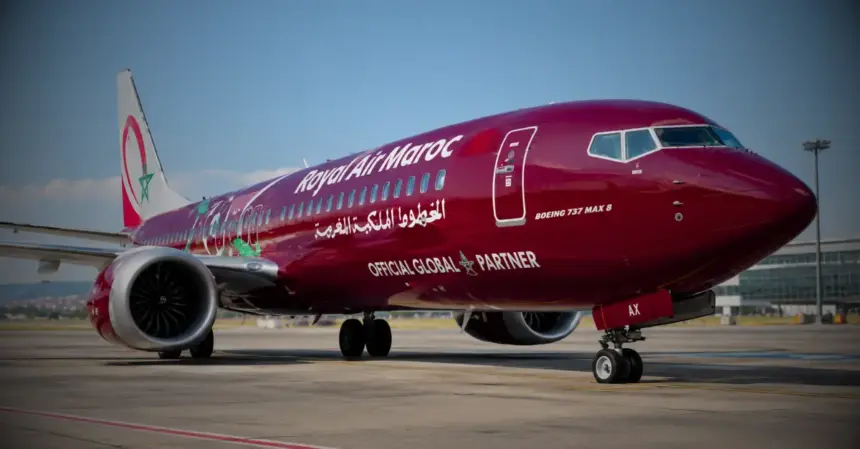
Beyond the logistical milestone, this delivery sheds light on the trajectory of an airline that has set itself the goal of quadrupling its fleet.
- Royal Air Maroc has received its sixth Boeing 737-8 in six months.
- The aircraft was delivered by lessor Aviation Capital Group.
- It is the last of the six aircraft planned for 2026.
- Aviation Capital Group manages about 500 aircraft for nearly 85 airlines.
- Royal Air Maroc aims for a fleet of 200 aircraft by 2037.
A delivery that completes the 2026 program
The information comes from a press release by Aviation Capital Group (ACG), an aircraft asset manager headquartered in the United States. The lessor announces the handover of a Boeing 737-8 to Royal Air Maroc, and specifies that it is the last of the six aircraft due to join the airline in 2026.
Carter A. White, ACG’s executive vice president and chief commercial officer, hailed “a remarkable achievement for all those involved,” noting that this sixth 737-8 was added to the Moroccan fleet within six months. The pace is notable: it amounts to one delivery per month on average, which requires close coordination between the manufacturer, the lessor and the carrier.
The 737-8, better known as the 737 MAX 8, is the most widespread version of Boeing’s MAX family. This single-aisle aircraft is designed for short- and medium-haul routes. It forms the backbone of Royal Air Maroc’s network between Morocco, Europe and part of Africa.
The lessor’s role in the ramp-up
This delivery illustrates a structuring choice: relying heavily on leasing to speed up growth. ACG is one of the major players in this market. As of June 30, 2026, its portfolio comprised about 500 aircraft, owned, managed or leased, operated by nearly 85 airlines in some fifty countries. Founded in 1989, the company is a wholly owned subsidiary of Tokyo Century Corporation.
For an expanding airline, leasing offers several advantages:
- it limits the capital tied up when quickly building out the fleet;
- it allows the airline to receive new aircraft without waiting for the full delivery of a direct order book;
- it offers some flexibility to adjust capacity to demand.
It also has a downside. Lease payments weigh on operating costs, and the airline does not benefit from the aircraft’s residual value as it would as an owner. This is a classic trade-off in the industry, and Royal Air Maroc is not the only carrier making it.
Turning to lessors is not new for the airline. According to the specialized press, Air Lease Corporation had announced lease agreements for five Boeing 737s. Dubai Aerospace Enterprise, for its part, signed the lease of 13 Boeing 737-8s due for delivery in 2027, following on from two similar aircraft delivered in 2025.
A program contract for 200 aircraft
To understand the significance of these deliveries, we need to go back to the program contract signed in July 2023 between the Moroccan state and Royal Air Maroc. The roadmap provides for a fleet of 200 aircraft by 2037, compared with about sixty before the health crisis. The objective is twofold: to strengthen Casablanca’s role as a hub between Africa, Europe, the Americas and Asia, and to support traffic growth at the Kingdom’s airports.
According to Le360, the airline expects to end 2026 with 74 aircraft, then reach 88 in 2027. The development plan relies on integrating, on average, ten to fifteen aircraft per year. These trajectories are those currently presented by the airline and the business press. They depend on manufacturers’ production rates and on conditions in the air transport sector.
The deadline of the 2030 FIFA World Cup, which Morocco is hosting with Spain and Portugal, adds a scheduling constraint. By then, the national carrier must have the capacity and network to handle an influx of visitors, which directly concerns tourism.
The big order, a file that remains open
The 2026 and 2027 deliveries stem from contracts that have already been concluded, notably with lessors. The real strategic question concerns the other component: the firm order for new aircraft, which is meant to drive most of the growth after 2027.
A tender launched in April 2024 pitted Boeing, Airbus, Embraer and ATR against one another. According to Bloomberg information relayed by the Moroccan press, Royal Air Maroc was considering the acquisition of about twenty Boeing 787 Dreamliners for long-haul, up to 50 Boeing 737s for short and medium-haul, and about twenty Airbus A220s to strengthen its regional service. I am unable to confirm here the progress of this file. It is therefore essential to check its status at the time of publication.
Two readings coexist. For supporters of a fleet that remains overwhelmingly American, standardization reduces training, maintenance and spare-parts costs. The 737 MAX is already well established within the airline, which also operates Boeing 787s on long-haul routes. Conversely, some observers stress the merits of diversification. It would strengthen bargaining power with manufacturers and reduce dependence on a single supplier, especially as Bladi.net reports technical visits by the airline to Airbus in Toulouse. At this stage, this is only a signal of interest.
What is at stake for the airline and for the country
Rapid fleet growth is not just about buying aircraft. It requires recruiting and training pilots, cabin crew and technicians, sizing maintenance capacity and adapting airport infrastructure. In Casablanca as in Marrakech, terminal capacity and traffic flow will determine the profitability of the new aircraft.
There is also a business model issue. An airline that quadruples in size must find markets to fill its seats without eroding its margins, in a sector sensitive to fuel prices, competition from low-cost carriers and geopolitical uncertainty. The hub positioning, which consists of routing passengers from Europe or the Americas through to sub-Saharan Africa, is the main source of added value being sought.
Finally, tourism is directly affected. More aircraft means more frequencies and direct routes, and therefore greater accessibility to Morocco as a destination. This effect will depend on hotel capacity and on the promotion strategy, which must progress at the same pace.
FAQ
What is the Boeing 737-8?
It is the most common version of the 737 MAX, a single-aisle aircraft for short- and medium-haul routes.
Who delivered this aircraft to Royal Air Maroc?
Aviation Capital Group, a US aircraft asset manager and a wholly owned subsidiary of Tokyo Century Corporation.
How many aircraft is Royal Air Maroc aiming for?
The program contract signed with the state in July 2023 provides for a fleet of 200 aircraft by 2037.
Why does the airline turn to leasing?
To speed up fleet growth while limiting the capital tied up, at the cost of lease payments that weigh on operating costs.