
Having tracked AI ecosystems across North Africa closely over the past year, I have to say this shift marks a fairly sharp break from the usual pace of public-sector announcements.
The message from Deputy Minister Amal El Fallah Seghrouchni is unambiguous: the Kingdom no longer wants to import its digital sovereignty, it wants to build it itself. And behind a phrase that could easily sound like a slogan, there are now real numbers, real programs, and a precise institutional architecture. That’s the mechanics I want to unpack here.
A strategy that has finally moved past intentions
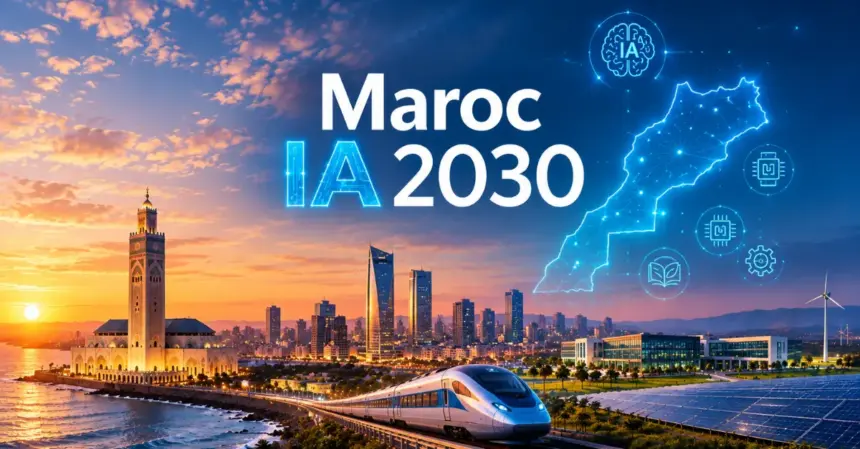
It’s worth remembering where this started. The National AI Assizes, held in July 2025, laid the groundwork for a structured national conversation around AI. Eighteen months later, that conversation has produced an operational framework called “AI Made in Morocco,” presented as the concrete translation of the Morocco AI 2030 strategy.
What stands out in this new phase is the shift from a regulatory framing exercise to a delivery-focused one. This is no longer about diagnostics or international benchmarking, it’s about deployment: research institutes that are actively hiring, a marketplace already listing solutions, a conversational assistant already answering citizens’ questions. For a public sector often criticized for the slow pace of its digital transformation, that speed is worth noting.
The strategy also builds directly on royal guidance around investment in artificial intelligence, new technologies, and renewable energy, framed as complementary levers of a single economic transition.
Three numeric targets that set the course through 2030
What I particularly like about this roadmap is that it doesn’t stop at grand statements, it commits to measurable outcomes, a risky move for any government.
The targets announced for 2030 are:
- 100 billion dirhams in value added to national GDP generated through artificial intelligence
- 50,000 jobs, direct and indirect, created within Morocco’s AI ecosystem
- 200,000 talents trained and certified, with AI literacy introduced starting in childhood
That last point deserves a closer look. Most national AI strategies focus on higher education or continuous training for engineers. Morocco is betting on the opposite: building algorithmic culture from early childhood onward, a choice that echoes certain Scandinavian approaches to digital literacy in schools, but is rarely seen at this scale across the MENA region.
Three pillars structuring the ambition
The Morocco AI 2030 roadmap rests on a three-pillar architecture, backed by ten structuring programs. It’s a design that echoes the logic behind other national AI strategies recently seen in Europe or the Middle East, but with a coloring specific to the Moroccan context.
Foundations of sovereignty and trust
This first pillar aims to ensure that data, infrastructure, and models remain controlled within Morocco. It’s the heart of the digital sovereignty narrative: no question of depending exclusively on foreign providers to host sensitive government or citizen data.
Engines of innovation and competitiveness
This second pillar covers the country’s ability to produce its own AI solutions, rather than simply integrating tools developed elsewhere. It’s a far more demanding challenge, one that requires solid academic research and a fabric of startups capable of turning that research into actual products.
Impact, adoption, and outreach
The third pillar focuses on real-world diffusion of these technologies to citizens and businesses, as well as Morocco’s international positioning as a player in South-South cooperation on AI. This is an axis that goes beyond the national frame and clearly targets a regional hub role.
The JAZARI network, the backbone of research
One of the most concrete elements of this roadmap is the rollout of the national JAZARI Institutes network, described as the operational arm of AI research and innovation. Four components structure this network:
- JAZARI ROOT, focused on the foundations of AI research
- JAZARI Smart City, oriented toward urban and territorial applications
- JAZARI EduTech, centered on education and digital skills training
- JAZARI Industrie X.0, geared toward industrial transformation through AI
This segmentation by use case rather than by traditional academic discipline is a smart move. It avoids the classic pitfall of fundamental research disconnected from the field, a recurring problem in public institutes worldwide. By directly tying each institute to a sector of application, Morocco is betting on research that has to prove its practical value fairly quickly.
Idarati AI and the sovereign marketplace, the part citizens will actually see
Beyond the institutional infrastructure, two concrete tools were highlighted during the presentation in Rabat.
The Sovereign AI Marketplace positions itself as a single space for accessing AI solutions deemed useful, simple, and secure, in an environment where data stays protected and infrastructure is controlled locally. The underlying idea: give Moroccan administrations and businesses a trusted catalog, rather than leaving everyone to cobble together their own integrations with foreign providers whose data-usage terms are sometimes opaque.
Among the first solutions listed is Idarati AI, an agentic AI assistant designed to inform, guide, and support users through their administrative procedures. This is exactly the kind of use case that can shift how citizens perceive digital government: a conversational agent capable of simplifying procedures often seen as opaque or tedious.
A Proof of Concept for a national meta-app and e-wallet was also presented, prefiguring a more integrated and interoperable administration, designed around user journeys rather than around ministries’ internal structures. That’s an important reversal of logic: starting from the citizen’s need rather than from the existing administrative structure.
My take on this acceleration
What strikes me most about this announcement isn’t the numbers themselves, always hard to verify upfront on a four-year horizon, but the pace of institutional execution. Standing up a network of four specialized institutes, launching a functioning marketplace, and rolling out a public-facing AI assistant within eighteen months of the July 2025 Assizes, that’s not nothing for a public administration.
The real question, in my view, remains energy infrastructure. AI is extremely power-hungry, and without sufficient electricity generation capacity, no technological sovereignty is truly sustainable. Morocco has the advantage of considerable renewable energy potential, but turning that potential into operational data centers will take time. That’s probably the indicator to watch closely over the coming months to gauge the real credibility of this trajectory.
FAQ
What is the Morocco AI 2030 strategy?
It’s Morocco’s national artificial intelligence roadmap, presented under the name “AI Made in Morocco,” aiming to build sovereign AI capabilities and generate 100 billion dirhams in added value by 2030.
What are the numeric targets of Morocco AI 2030?
The strategy targets 100 billion dirhams in GDP value added, the creation of 50,000 direct and indirect jobs, and the training of 200,000 AI talents by 2030.
What is the JAZARI network?
It’s the national network of AI research institutes, structured around four components: JAZARI ROOT, JAZARI Smart City, JAZARI EduTech, and JAZARI Industrie X.0.
What is Idarati AI?
It’s an agentic AI assistant developed as part of Morocco’s sovereign AI marketplace, designed to inform and guide citizens through their administrative procedures.