


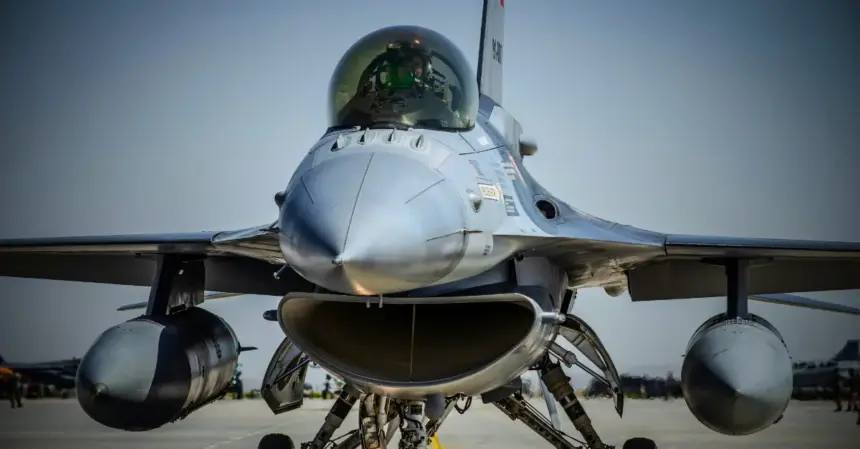
It is here, roughly forty kilometers from Casablanca, that a maintenance, repair and overhaul (MRO) center dedicated to the Royal Moroccan Air Force’s (RMAF) F-16 Fighting Falcon and C-130 Hercules fleets is set to rise.
I want to look here at this project, its stakeholders, and what it reveals about the Kingdom’s industrial and strategic ambitions in military aerospace.
A tripartite partnership serving a strategic fleet
The project is named Maintenance Aero Maroc (MAM). It is a joint venture bringing together Sabena Engineering, the Belgian MRO specialist under the Orizio Group, and Lockheed Martin, the original manufacturer of both aircraft types. Alongside them stands MEDZ, the infrastructure development subsidiary of the Caisse de Dépôt et de Gestion (CDG), which carries the public Moroccan dimension of the project. According to several concordant sources, the MAM structure originated in a partnership forged more than three years ago, also involving Maintenance Aeronautic Assets (MAA).
The future facility, with an announced surface area of more than 8,000 square meters, is intended as the first phase of a larger site. Its entry into service is projected for the second half of 2026. The ambition voiced by the project’s backers extends beyond servicing the national fleet alone: they have raised the possibility of eventually serving other F-16 and C-130 operators across the Mediterranean region and beyond.
This positioning is not incidental. It fits into a broader effort to structure Morocco’s defense industrial base, driven in part by Law 10-20, which governs the manufacture and maintenance of military equipment on national territory.
A fleet in the midst of transformation
To understand the significance of this center, one has to look back at the scale of the aerial modernization Morocco has undertaken since 2019. That year, the US State Department approved two distinct components of the same effort: on one hand, the upgrade of the 23 existing F-16C/D Block 50/52s, acquired between 2011 and 2012, to the F-16V Block 70/72 standard, for roughly 985 million dollars; on the other, the acquisition of 25 new F-16C/D Block 72 aircraft, worth approximately 3.7 billion dollars, intended to replace the aging Mirage F1s and F-5 Tiger IIs.
Ultimately, the Royal Moroccan Air Force should field a fleet of close to 48 latest-generation F-16s — a figure that conveys the scale of the heavy-maintenance requirements ahead. Until now, this kind of work has typically meant sending aircraft abroad, with the costs and delays that entails. Establishing a national MRO center changes that equation: it repatriates a strategic capability and reduces logistical dependence on foreign providers.
The transport fleet is no exception. A dozen C-130H tactical transport aircraft and two KC-130H tankers form the backbone of Morocco’s airlift and aerial refueling capacity. In July 2025, the RMAF awarded L3Harris Technologies a contract for the complete modernization of this fleet, covering avionics upgrades and engine overhauls. The Benslimane site is intended to complement this program by handling heavy airframe maintenance work.
Building on an existing industrial ecosystem
The MAM project does not emerge in an industrial vacuum. It builds on the Orizio Group’s already established presence in Morocco through its subsidiary Sabca Maroc, which has operated a 16,000-square-meter plant in Nouaceur since 2012, specializing in aerostructure assembly for Airbus, Pilatus and Dassault, and which has already worked with the RMAF on the modernization of Mirage F1 and Alphajet aircraft.
Add to that the mid-2023 announcement of Pratt & Whitney Maroc, an RTX subsidiary tasked with manufacturing machined structural and static parts for various engine models. Morocco’s aerospace hub, which already hosts players such as Safran, Stelia Aerospace and Spirit AeroSystems, is thus taking a further step, moving from aerostructure assembly into a more complex, higher-value segment: heavy maintenance of front-line US military platforms.
A few figures help gauge the scale of the project:
- Size of the Benslimane hangar: more than 8,000 m² (phase 1)
- Targeted entry into service: second half of 2026
- Eventual F-16 fleet: roughly 48 aircraft (23 upgraded + 25 new)
- Transport fleet involved: 12 C-130H and 2 KC-130H
- Cost of upgrading the 23 existing F-16s: roughly 985 million dollars
- Cost of the 25 new F-16 Block 72 aircraft: roughly 3.7 billion dollars
Economic and geopolitical stakes
Beyond its technical dimension, this project answers to several logics at once. The first is budgetary: repatriating heavy maintenance work helps reduce, over time, the life-cycle cost of a combat fleet that is already expensive to operate. The second is strategic: a sovereign maintenance capability reduces dependence on external timelines and decisions — no small consideration for aircraft expected to remain in service for several decades.
The third is industrial and social. The project’s backers point to the creation of skilled jobs and a transfer of expertise to the local workforce, in a sector where technical know-how remains scarce. Morocco, already regarded as one of Africa’s most dynamic civil aerospace hubs, is here seeking to replicate that success in the more closed, more demanding military segment.
Finally, the regional dimension cannot be ignored. By positioning itself as a service center for other F-16 and C-130 operators across the Mediterranean basin, MAM would compete with established MRO centers in Europe or the Gulf. That ambition, however, remains contingent on the site’s effective ramp-up, its certification by Lockheed Martin, and Morocco’s ability to convince foreign customers to entrust the upkeep of their aircraft to a facility still under construction.
What remains to be seen
The Benslimane project fits a coherent trajectory: that of a Morocco which, having accumulated some of the largest US equipment acquisition contracts in the MENA region, is now seeking to internalize the maintenance expertise that comes with them. What remains uncertain is whether the announced timeline — entry into service in the second half of 2026 — will hold, and whether the site will actually manage to attract regional clients beyond the immediate needs of the Royal Moroccan Air Force. Those two unknowns will determine whether Benslimane remains a purely national tool or becomes, as its promoters hope, a genuinely regional MRO platform.
FAQ
Who are the partners behind the MAM project in Benslimane?
Sabena Engineering (Orizio Group), Lockheed Martin and MEDZ Morocco (CDG Group), with Maintenance Aeronautic Assets involved in the partnership’s original structure.
When will the center become operational?
It is expected to enter service in the second half of 2026, for a first phase of more than 8,000 m².
How many F-16s will the RMAF eventually field?
Around 48 aircraft, combining the 23 upgraded F-16C/D Block 50/52s and the 25 new F-16 Block 72 aircraft ordered in 2019.
Will the site serve only the Royal Moroccan Air Force?
Initially, yes — but its backers have voiced ambitions to turn it, over time, into a regional MRO center open to other F-16 and C-130 operators.











This provides a detailed overview of Morocco’s planned F-16 and C-130 maintenance center in Benslimane and its potential role in developing the country’s aerospace industry. I found the discussion of the MAM partnership, the 8,000 m² facility, and the move toward local heavy-maintenance capabilities particularly interesting, as these factors could reduce dependence on overseas maintenance and support local technical expertise. The possibility of eventually serving other F-16 and C-130 operators also highlights the broader regional ambitions of the project, although its success will depend on the center’s operational ramp-up and certificat