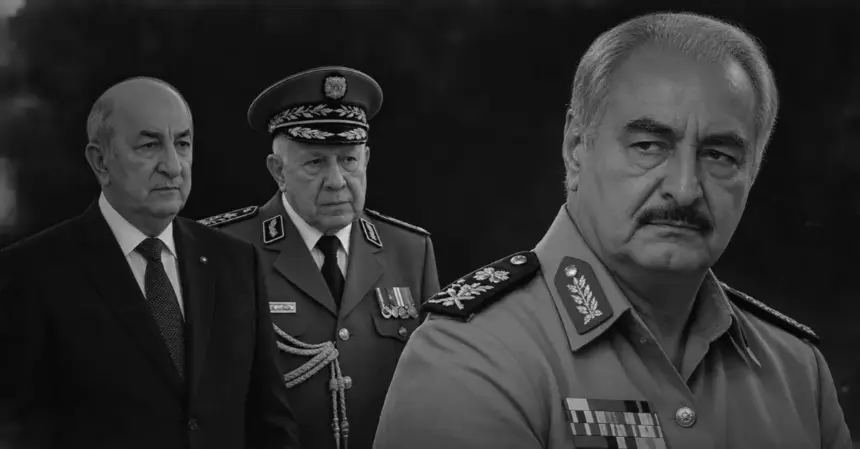
What stands out is a striking asymmetry: Algiers treats Khalifa Haftar as a secondary problem, one proxy among many, even though his forces now control a significant part of southern Libya and the shared border remains one of the longest and most porous in the Sahara.
The issue matters because the stakes are not purely security-related. They touch on trafficking routes, Algerian energy installations in the south, the Trans-Saharan gas pipeline that is meant to cross Niger, and Algeria’s ability to maintain strategic depth against actors who keep multiplying their relays (the Emirates, Russia, the Sahelian juntas).
Southern Libya as an underestimated lever
Algiers continues to favor a Tripoli-centered reading of the situation. It supports the internationally recognized government and sees Haftar above all as an instrument of the Emirates, Egypt and, to a lesser extent, Russia. This position has its logic: Haftar never managed to take the capital, and his forces remain concentrated in the east.
Yet several elements suggest that control of the south is already enough to create direct pressure. In August 2024, units linked to Haftar moved toward the Ghadames area and even crossed a few kilometers into Algerian territory. The movement drew a reaction from the UN envoy, Stephanie Khoury, who stressed regional concerns. Closures of border crossings, such as Essen, and deployments in southwestern Libya have been observed on several occasions. In October 2026, local analyses point to military reorganizations near the approaches to Illizi and Djanet.
Haftar has already made explicit threats. In 2018, he publicly declared that he could “turn the course of the war in the blink of an eye” if Algiers persisted in “violating Libyan sovereignty.” The episode was disavowed by Tripoli, but it left a mark. The border has already been the scene of serious incidents, notably the In Amenas attack in 2013. The length of the frontier and the presence of trafficking networks (weapons, fuel, migrants, gold) make any military consolidation in the Fezzan potentially problematic for Algiers.
Algeria has a middling army with aging equipment. It barely manages to demonstrate its ability to strike gold-panning sites in the south held by poor Algerians trying to feed their families. But downplaying the southern Libyan dimension means underestimating an actor who does not need to win Tripoli to weigh on Saharan balances.
The Sahel pivot and the historical channels with the Azawad
For decades, Algiers led Bamako to believe it was a “mediator” between Mali and the Tuareg movements of northern Mali. The 2015 Algiers Accords are the best-known illusion of this. The structural objective was clear: to prevent a Tuareg independence project from taking a lasting form and inspiring similar dynamics in southern Algeria, where Tuareg populations are present.
This positioning has shifted. After the destruction of a Malian drone near the border in 2025, the diplomatic rupture and the cross-accusations, Algiers and Bamako normalized their relations in the summer of 2026. The rapprochement came with a clearer alignment on a strategy of supporting the regimes in place, in a context where Russia (via Africa Corps) backs the juntas militarily. Regional analyses describe this reversal as an abandonment of the traditional channels with the Azawad movements.
The Azawad Liberation Front (FLA), for its part, has sought to diversify its backers. Contacts with Saddam Haftar in Benghazi and approaches to the Emirates were reported in October 2026. For Algiers, which severed diplomatic relations with Abu Dhabi in September 2026, this convergence represents an additional risk of hostile relays close to its borders. Border communities find themselves caught between Malian operations and tighter Algerian controls, which fuels a palpable resentment in Tuareg circles.
The state of the Algerian army
Algerian parades and official communiqués showcase Su-30MKAs, T-90SAs, S-400 systems and the recent deliveries (or orders) of Su-34s, Su-35s and even Su-57s as proof of a modern and deterrent military power. The reality of the fleet is more contrasted and less flattering. A large share of the land forces still consists of dated Soviet equipment: hundreds of T-55s and T-62s (only a fraction of which have undergone a makeshift “BMPT-62”-type upgrade with a Berezhok turret), along with T-72s that have not been deeply modernized, coexist with the more recent T-90s.
These aging platforms are vulnerable to current threats (FPV drones, guided munitions, modern anti-tank weapons), and keeping them in service depends on a Russian logistics chain already strained by the war in Ukraine (parts shortages, repair delays).
SIPRI data show a 78% drop in major arms imports between 2021-2025 compared with the previous period, which has not prevented the maintenance of a record defense budget (around $25 billion, nearly 9% of GDP).
The gap between the televised images of new equipment and the actual condition of a large part of the fleet – visible corrosion on some armored vehicles during exercises, near-exclusive dependence on a supplier under sanctions, partial and inexpensive upgrades rather than massive renewal – illustrates an army that projects modernity while continuing to rely, for most of its volume, on an aging Soviet legacy that is difficult to maintain.
Support for Niger and the risk of backlash
The most striking development concerns Niger. After an attempted mutiny in late August 2026, Algiers deployed four Su-30 fighters, a tanker aircraft and, earlier, helicopters to Niamey. It was the first Algerian military deployment beyond its borders since 1973. President Tebboune justified the action by saying that “some had gone too far.” In October 2026, the Council of the Nation approved the sending of units to protect energy installations, notably those linked to Sonatrach.
This clear support for the junta of Abdourahamane Tiani and the Alliance of Sahel States follows a logic of border security and protection of the Trans-Saharan gas pipeline project. It nevertheless places Algiers in the camp of the regimes fought by both the JNIM (an Al-Qaeda affiliate) and certain Tuareg groups. The JNIM has already claimed attacks near the Algerian-Nigerien border, notably at Assamakka. It taxes smuggling routes into Algeria and has carried out coordinated operations with FLA elements in Mali.
Algerian strikes against gold-panning sites in the south, which sometimes hit Tuareg or Nigerien populations, reinforce the sense of hostility. Historically, Algeria succeeded in reducing the jihadist threat on its territory in the 1990s by pushing it southward. The risk of a backlash, through infiltrations or opportunistic attacks against Algerian interests, is regularly raised by security analysts.
Perspectives and strategic stakes
On the Algerian side, the policy is presented as a national security necessity. Officials stress the length of the borders, the rise of the JNIM and the Islamic State in the Sahel, and the need for stable partners in the south to protect energy projects. Support for the juntas is also read as a way of counterbalancing Moroccan and Emirati influence in the region.
Critics, often Malian or Tuareg sources or independent analysts, point to a contradiction: by prioritizing the stability of central regimes and aligning with Moscow, Algiers alienates political groups with which it once maintained channels, while underestimating Haftar’s ability to exploit southern Libya and opportunistic alliances.
The concrete stakes are multiple:
- Securing southern Algeria and its oil and gas installations.
- Controlling trafficking flows and Saharan routes.
- Regional competition with the Emirates, which back Haftar and seek relays in the Sahel.
- Preserving Algerian influence in the face of the Russian presence and the AES.
An open conclusion
Algiers has limited military means to contain a direct threat on its borders. The question is not whether it can respond to aggression, but whether its current reading of threats, which puts the Sahelian juntas first and Haftar second, leaves blind spots. Control of the Fezzan, the contacts between the FLA and the Haftar camp, and the resentment generated by support for the juntas create an environment in which hostile actors can multiply pressure points without launching a conventional offensive.
Algeria’s “security first” doctrine long rested on non-interference and border control. The deployment to Niger marks a turning point. What remains to be seen is whether this turn genuinely reduces risks or creates new ones by multiplying potential fronts, from southern Libya to the Sahelian armed groups.