Ten companies have joined the first cohort of Women Forward. The programme is led by German development cooperation (GIZ) and the We4She association. Its ambition comes down to three verbs: recruit more women, support their advancement and remove the obstacles to their progression. The announcement could pass for one more initiative in a landscape already crowded with charters and commitments. I read it differently. It tackles a specific issue, the move from good intentions to managerial practice, in a country where women’s participation in the economy has been declining for twenty years.
A support programme rather than one more charter
Women Forward does not present itself as a label. It is a personalised support scheme designed to change organisational and managerial practices. It covers four areas: recruitment, talent retention, skills development and career paths. The stated goal is to turn companies’ commitments into concrete measures. Peer exchanges will also allow participants to share their experiences.
The distinction matters. Many companies sign declarations of intent without having the tools to implement them. That means revisiting recruitment criteria, identifying career breaks, adapting work organisation and training middle management. This groundwork, often less visible than signing a charter, is what the programme aims to support.
Ten companies chosen through a selection process
The ten companies were selected after a call for expressions of interest, followed by a qualification process. They are CIPLA, Sothema, Pharma 5, Burintel, Aishore, HPS, Holcim Maroc, Sonasid, Polydesign Systems and CEVA Logistics. The organisers specify that all of them are already engaged in initiatives promoting workplace equality.
This choice has a twofold effect. It guarantees a common starting point and avoids starting from scratch. It also limits the programme’s immediate reach: the companies being supported are already aware of the issue, not those that have yet to do anything. The panel is, however, diverse, spanning pharmaceuticals, construction materials, steelmaking, logistics and technology services. It will show which practices carry over from one sector to another and which depend on the trade.
A context marked by declining female labour participation
To gauge the stakes, one must look at figures from the High Commission for Planning (HCP). The female labour force participation rate remained almost stable between 2024 and 2025, from 19.1% to 19%, while it stands at 68.5% for men. In other words, fewer than one in five women of working age is active, meaning either employed or looking for work.
The long-term trend is even more worrying. Over twenty years, this rate has fallen from around 28% to 19%, even as women’s levels of education have steadily risen. This paradox is at the heart of the issue. It is not a shortage of qualifications.
HCP data on women graduates point the same way. Among women graduates aged 25 to 59, the participation rate was 33.9% in 2024, compared with 92.1% for male graduates. The HCP also notes that the participation rate is higher among divorced women than among married or single women, which suggests the weight of family circumstances in career paths.
Unemployment hits women harder. In 2025, the female unemployment rate stood at 20.5% nationally and their employment rate at 15.1%. More than half of working women are employed in agriculture, often on family farms. The skilled salaried segment, the one that directly concerns the companies in the cohort, is therefore only part of the problem.
Key figures
- Female labour force participation rate in 2025 according to the HCP: 19%, compared with 68.5% for men.
- Female employment rate: 15.1%.
- Female unemployment rate: 20.5%.
- Estimate by the CESE (Economic, Social and Environmental Council): integrating nearly 1.7 million currently inactive women would raise their participation rate to nearly 35% and increase national value added by about 13%.
Why companies are directly concerned
These figures are often presented as a social issue. They are also an economic one. The World Bank regards women’s low economic participation as a structural challenge weighing on the Kingdom’s growth prospects, and devotes a chapter to it in its 2026-2035 partnership framework. The country invests in women’s education, particularly in higher education, but does not reap all the benefits on the labour market.
For a company, the argument is concrete. In sectors struggling to recruit certain technical profiles, failing to retain female employees means losing an investment in training and experience. Career breaks after marriage or childbirth are documented by studies on the subject. They are partly shaped by work organisation, performance evaluation, access to positions of responsibility and the flexibility offered to employees. These levers fall under human resources departments, which explains the choice of a programme centred on internal practices.
The role of We4She and the INEFF project framework
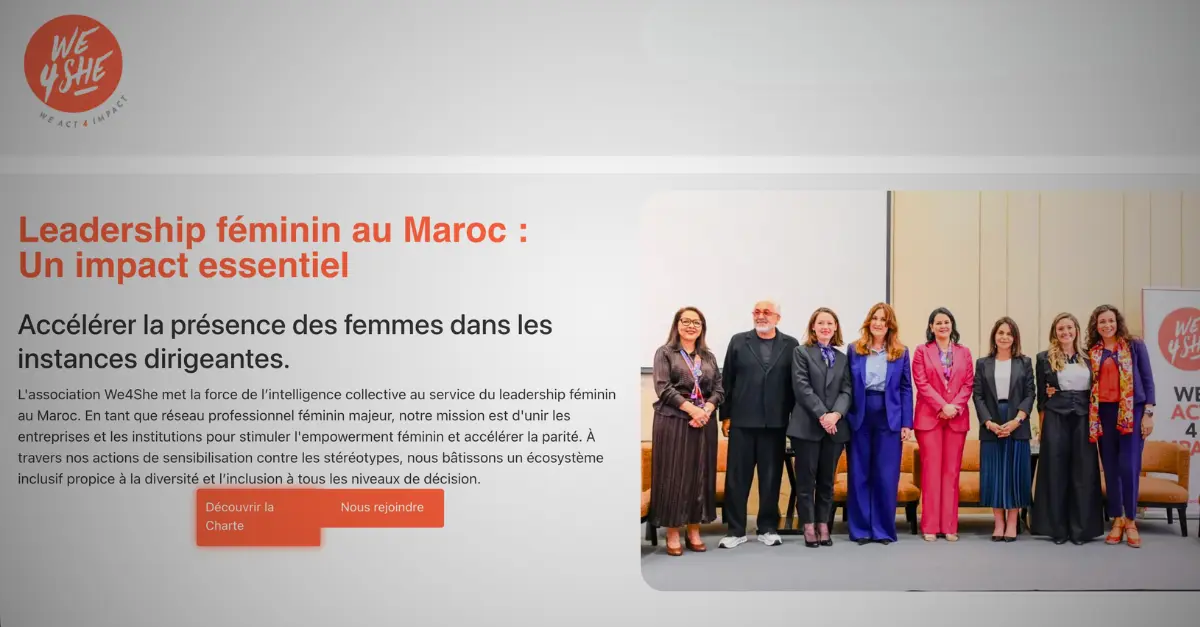
For Soumaya Benjelloun, managing director of We4She, the challenge is to make equality a management priority and to remove the barriers to women’s advancement. The association brings together more than a hundred companies around its Gender Diversity Charter. It has also drawn up an advocacy paper with proposals to change the legislative and regulatory framework in favour of economic equality.
Women Forward is part of the INEFF project, dedicated to the economic inclusion of women in the sectors of the future in Morocco. It is co-funded by the German Federal Ministry for Economic Cooperation and Development and by the European Union. GIZ implements it in partnership with the Ministry of Economic Inclusion, Small Business, Employment and Skills, with the support of We4She. The ambition is to strengthen companies’ capacity to recruit, promote and retain more women in the growth sectors of Morocco.
This combination of international cooperation, public administration and a business network is not trivial. It links field practices to public policy, and We4She’s advocacy on the legal framework is its natural extension.
The limits to keep in mind
One should stay measured about what a first cohort of ten companies can achieve. Their effect on national statistics will inevitably be very limited. The barriers to women’s labour participation are not solely a matter for employers: mobility, childcare services, the sharing of domestic tasks, regional disparities and the weight of family farm work all play a decisive role.
The national target, for its part, was ambitious. The roadmap of the new development model aimed for a female participation rate of 25% in 2025 and 45% in 2035. With 19% in 2025, the gap with the first milestone is clear. Several economists had in fact judged this target difficult to reach in the short term.
The programme is nonetheless useful. If it documents effective practices and makes them replicable, it can serve as a reference for other employers. The peer exchanges go in that direction. It remains to be seen whether the results will be tracked and made public: the number of hires, the share of women in management positions, retention rates. Only on that condition can Women Forward be judged on facts rather than declarations.
A question of method above all
What I take from this announcement is less the number of companies than the approach. Women Forward starts from the premise that workplace equality is built in recruitment processes, promotions and day-to-day management. The companies in the cohort will act as a laboratory. The question that will arise next is one of scaling up: how to make these practices the norm, including for small and medium-sized enterprises, which make up most of Morocco’s economic fabric?
FAQ
What is Women Forward?
It is a support programme launched on 15 October in Casablanca by GIZ and the We4She association. It helps companies recruit, retain and promote more women.
Which companies are in the first cohort?
Ten companies: CIPLA, Sothema, Pharma 5, Burintel, Aishore, HPS, Holcim Maroc, Sonasid, Polydesign Systems and CEVA Logistics. They were selected following a call for expressions of interest.
What framework does the programme fall under?
The INEFF project, dedicated to the economic inclusion of women in the sectors of the future in Morocco. It is co-funded by the German Federal Ministry for Economic Cooperation and Development and by the European Union.
What is the female labour force participation rate in Morocco?
According to the HCP, it stood at 19% in 2025, compared with 68.5% for men.