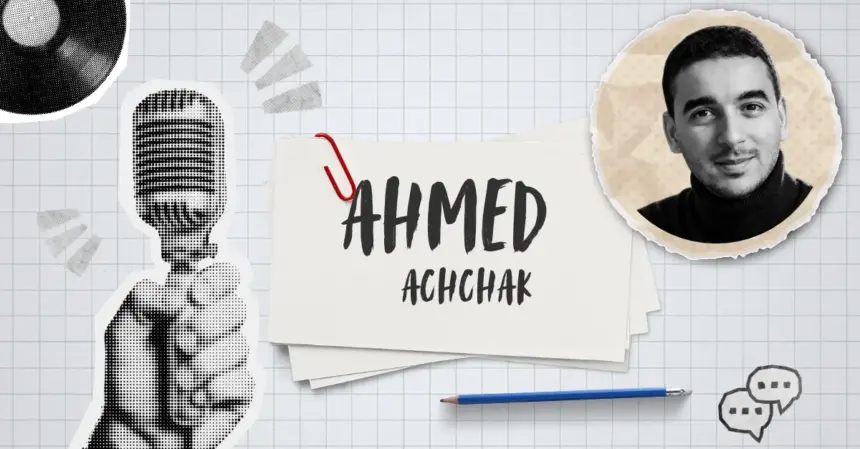
To separate fact from exaggeration, a recent podcast features Ahmed Achchak, co-founder of Qevlar AI, a startup that builds AI tools for companies’ security operations centers. His perspective is that of a player selling a solution, so his statements need to be read with appropriate caution. Still, he deserves credit for rejecting both catastrophism and naive optimism.
A long-standing imbalance that AI is amplifying
Ahmed Achchak starts by putting things in perspective: in his view, there is “nothing new” at heart. Cybersecurity has always rested on an asymmetry. The attacker only needs one breach, while the defender has to lock them all. The attacker cares about neither laws nor organizational constraints, whereas defense has to deal with budgets, procedures and regulation. Even a gap of a few months between a new attack method and its countermeasure can prove very costly.
What changes, according to the entrepreneur, is speed. AI lowers the cost and time needed to carry out operations that once required rare skills or near-state-level resources.
What AI changes on the attack side
The guest identifies three developments.
- Volume. A language model can help write malware, including for people who would not have had the skills or the time to do it alone. He mentions “unrestricted” models, either open source or distributed on the dark web, without detailing their sources.
- Personalization. Phishing can be automated from end to end. A program collects information about the target, a model writes a convincing message, then adjusts it based on the victim’s reactions.
- Identity impersonation. Voice cloning, doctored videos: he says he asked his parents to call him back if they received a “strange” video from him, and is considering family passwords for his two-year-old son.
He also identifies a less visible change in nature. Development teams increasingly use AI to write code, and the code produced may rely on vulnerable libraries that sit outside the security teams’ radar. An attacker equipped with AI can, for their part, scan these components, spot a flaw and build a proof of concept to exploit it before the company even knows it is exposed.
Mythos, between a real alert and a touch of marketing
It is against this backdrop that Anthropic unveiled Mythos this spring. The company claims the model identified thousands of critical flaws in operating systems, and it chose not to release it to the general public, judging that it could allow non-specialists to discover vulnerabilities. Access was restricted to a small number of partner organizations.
Ahmed Achchak is nuanced. He acknowledges that players such as Microsoft and the Mozilla Foundation, which publishes Firefox, have applied a larger volume of patches than before. But he sees “probably a bit of marketing” in it: some of the reported vulnerabilities, he says, are false positives, meaning they cannot be exploited, or only under very specific conditions. He does not conclude it was a false alarm: even if imperfect, these tools make hunting for flaws a far more accessible field than it was a few years ago.
These are statements from an industry player. They call for verification against Anthropic’s communications, the vendors concerned and, ideally, independent analyses.
Why current defenses are showing their limits
At the heart of a large organization’s defense setup sits the SOC (security operations center), a center where analysts handle the alerts raised by detection tools. An alert is a suspicion: a suspicious message, abnormal behavior on a workstation, or a connection that appears geographically impossible, for example from Spain and then from China a few minutes apart.
The founder describes an overloaded system. Analysts receive hundreds of alerts and handle only about twenty a day, which forces them to prioritize. He cites burnout and resignations as direct consequences. The risk is that a weak signal, drowned in the noise, is ignored even though it was announcing an attack. He compares the situation to a single person watching four hundred surveillance camera feeds, only one of which has captured the burglar.
Each of the traditional responses has a flaw. Hiring more people cannot keep pace with the growth in alerts, and the cost is high. Automation through “playbooks” (fixed scenarios of the “if A, then B” type) is rigid: they have to be rewritten for every new form of attack, and a patient attacker can work out how they function simply by testing them.
Qevlar AI’s bet, AI but not only LLMs
It is on this observation that Qevlar AI, founded in 2023 by Ahmed Achchak and Hamza, whom he met at École Centrale, built its product. Its promise is to replicate an analyst’s investigative work, without a pre-written scenario, by investigating each alert and adapting to its nature.
The most instructive part of the interview is its critique of large language models (LLMs) in cybersecurity. They work through a sampling process that introduces a degree of randomness, which is useful for generating text but a problem when a reproducible decision is expected. The entrepreneur cites an experiment presented at the Black Hat conference in 2025: one hundred investigations, each replayed one hundred times, with an LLM in place of his company’s investigation engine. According to him, for the same alert and identical conditions, the model concluded the activity was malicious in about 30% of cases, concluded the opposite in about 50%, and declined to give a verdict in the remaining 20%. These figures come from the company and should be checked against the original publication.
His architecture is therefore built on a “graph AI,” a more classical machine learning algorithm that decides the next investigative step. It then calls on specialized agents, including LLMs, for the tasks where they excel, such as the semantic analysis of an email’s body. The goal is a system that is interpretable, meaning its decisions can be traced, and deterministic, meaning it gives the same answer to the same question. For Ahmed Achchak, trust is the condition for autonomy, and the tool aims to augment analysts rather than replace them.
Figures to handle with care
The guest puts forward several elements about the company’s business, reported here as he stated them.
- Fundraising: about €44 million in total, across three rounds, with the Series round closed in early 2026.
- Scope: about 1,500 organizations secured worldwide, some through managed security service providers (MSSPs) that deploy the tool for their own clients.
- Performance: alerts handled in five minutes versus forty on average, with an investigation accuracy higher than that of humans according to comparative tests.
- Customers: large European groups and cybersecurity service providers.
He did not disclose his revenue. The performance comparisons, which come from the vendor, still need to be validated by third-party evaluations.
A more optimistic vision than the prevailing narrative
By the end of the interview, Ahmed Achchak offers a more nuanced reading than the dominant narrative. He turns to history: the shift from the Bronze Age to the Iron Age, he argues, democratized access to power and weakened empires. For him, AI plays a comparable role. It increases the offensive threat, but it also gives defense what it was missing, the ability to process a massive volume of signals almost as fast as the attacker acts. The historical asymmetry, one breach against a thousand doors to guard, could thus narrow.
This thesis is appealing, but it remains to be proven. It assumes that defenders adopt these tools as quickly as attackers, which the asymmetry described above does not guarantee. It also assumes that teams’ visibility extends to the entire digital perimeter, including software vulnerabilities and identities, which the traditional SOC does not always see. That is the next challenge the founder sets for his company, along with geographic expansion and on-premises deployments for sensitive customers, such as government agencies or defense.
The real question is therefore not whether AI worsens or solves the problem, but who will make the most effective use of it. The answer will depend less on the technology than on how quickly organizations deploy it and learn to trust it.
FAQ
Has AI really increased the number of cyberattacks?
Ahmed Achchak believes it makes large-scale and more convincing attacks easier. This claim still needs to be checked against independent data, such as that from national cybersecurity agencies.
Why did Anthropic not release Mythos?
According to the company, the model could allow non-experts to find vulnerabilities. Access is limited to a small number of partner organizations.
What is a SOC?
It is a security operations center where analysts review an organization’s alerts to determine whether they signal a genuine attack.
Why not entrust investigations to an LLM alone?
Because these models include an element of randomness and can give different answers for the same alert, which makes it harder to trust an automated decision.