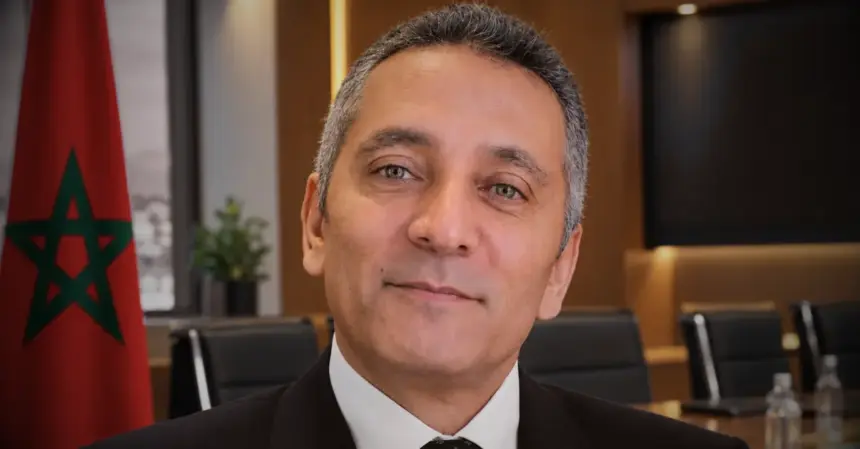
It is rare for a leading entrepreneur to begin by listing his failures. Before an audience of business leaders gathered at the CGEM headquarters, Moulay Hafid Elalamy did exactly that, with unapologetic humour. A former president of Morocco’s employers’ federation and former Minister of Industry and Trade, he laid out ten recommendations drawn, as he put it, from what he lived through “at his own expense”. I spent time with this talk of about thirty minutes because it says something about how part of Morocco’s business community thinks about its own transformation today.
Why this speech matters
Morocco is trying to produce groups capable of competing internationally, at a time when automation and artificial intelligence are reshaping the outsourcing landscape. The speaker’s career lends weight to his words: he claims to have created, in Morocco, a contact-centre business that became Majorel, was listed on the Amsterdam stock exchange, and later merged with Teleperformance, the group he presents himself as chairing. The figures cited from the podium are considerable: more than 490,000 employees, which would make the group the world’s eighth-largest employer, revenue of 120 to 130 billion dirhams, and roughly 10 billion dirhams in free cash flow. These figures are the speaker’s own and should be cross-checked against the group’s published reports.
Still, the speech is worth less for these numbers than for the framework it offers, organised around three families: foundations, strategy and meaning, and people and values.
Action or agitation, boldness or recklessness
The talk opens with a distinction the speaker considers essential. Action, he says, is the execution of a well-thought-out strategy; agitation is merely carrying out an idea that has not been worked through. In the same way, boldness is not recklessness. He cites the idea, attributed to Jeff Bezos, that one should decide with about 70% of the useful information, since waiting for 90% or 100% means deciding too late. Recklessness, by contrast, is deciding fast while being under the illusion of being right.
He also warns against a common piece of advice, “live your passion”. His message is the opposite: one should undertake with passion, but loving a sector is not enough to succeed in it.
The ten recommendations
Here, as I reconstruct them from the talk, are the rules that structure his argument:
- be beyond reproach on tax, customs, social and regulatory matters;
- stay in direct contact with customers and the market;
- think big, but start small in order to test, correct and then accelerate;
- dare to enter international markets, particularly mature ones;
- diversify without scattering yourself, changing only one variable at a time;
- know how to sell a business and leave an industry;
- give meaning to your commitment as an entrepreneur;
- choose partners with a compatible DNA;
- surround yourself with people better than you, including among your service providers;
- prepare the company’s longevity beyond its founder.
The requirement of being beyond reproach
This is the first rule, and the one he develops most. His argument is primarily pragmatic: a successful entrepreneur attracts jealousy, and “a single flaw” is enough for his adversaries. He recounts a Japanese anecdote, that of the head of a car manufacturer whose grandmother advised buying a bulletproof vest after every promotion, to conclude that jealousy is in no way specifically Moroccan.
The argument becomes more concrete when he discusses Majorel’s stock market listing. According to him, the banks and lawyers involved scrutinised the company and its leader down to what had been published about him in the press, since each had a reputation to protect. Hence his recommendation to assemble well-ordered files very early, ready to answer questions one cannot yet imagine. This logic of preventive compliance is well known in international financial transactions, even if the speaker expresses it here in a very personal way.
An aside on the civil service
This rule leads him to a digression on his time in government. He says he found a “sclerotic” ministry, where officials preferred to refuse a request rather than risk having to justify, years later before the Court of Audit, an authorisation they had granted. He says he offered his staff to take personal responsibility for the signatures, provided the files were properly prepared, and claims the practice later became more natural.
The account is that of a participant and should be read as such. It nonetheless points to a real problem, well documented in many administrations: fear of after-the-fact scrutiny can encourage inertia. The civil service’s own view on the question was, naturally, not represented in the room.
Think big, start small
The third rule draws on three experiences, two of them failures he openly acknowledges. The first was a plan to bring together IT companies and turn them into a pan-African leader. He believes he launched it “before its time”, without studying the market enough. The second was a hub combining insurance, banking and healthcare, inspired by a model he had seen in Portugal, which did not take hold in Morocco because, in his view, the local context had not been studied sufficiently.
Against these two walls, he sets a contact-centre business created with 2 million dirhams in equity, supplemented by a little bank credit. At the start, he says, the team recruited did not match the need: he let go around seventy people (the figure of 70 is the speaker’s) before rebuilding around a small core. The message is a classic of entrepreneurial literature, that of testing on a small scale before scaling up. It is illustrated here by a case in which the final size contrasts sharply with the modesty of the beginning.
Going international and diversifying with method
On international expansion, his argument is that foreign markets are “formative”: competition there is tougher, and the entrepreneur who succeeds comes back stronger. He calls for Moroccan entrepreneurs able to compete abroad “without complexes”.
His warning about diversification is probably the most useful for leaders of family groups: changing country, business and partner all at once amounts, in his words, to replacing every leg of a chair. He recommends changing only one parameter at a time, either the country while keeping the business, or the business while keeping the country.
Knowing when to sell, knowing when to leave
The most pointed passage concerns the sale of companies. He criticises some Moroccan entrepreneurs for refusing on principle to sell their businesses in the name of family heritage. His answer: a founder would perhaps have sold in time, just as Kodak’s leaders should have done before filing for bankruptcy, and selling is “not betraying”. He cites a saying according to which what cannot be sold or bought is problematic.
This position runs up against a cultural and economic reality: in many family groups, the continuity of the company is part of the family’s identity. The speaker is not unaware of this, but he counters it with an imperative of lucidity, all the more so, he says, because he is not attached “to things” but to people.
Rich, but ethical
Consistent with his past at the head of the employers’ federation, he defends a clear position: the State should ask business leaders for nothing but ethics, that is, to pay their taxes, look after their employees and pay their contributions, but otherwise let them undertake. He recalls having said that he wanted rich business owners, and recounts the reaction of Brice Hortefeux, then French Interior Minister, at the ceremony awarding him the Legion of Honour, who said he was uncomfortable with it. His reply is a fiscal argument: the more entrepreneurs grow rich while paying their taxes, the more resources the State has to redistribute.
The subject is divisive, and other readings can be set against his: that of economists concerned about wealth concentration, or that of advocates of more redistributive taxation. The speaker’s line about “sharing out poverty” belongs to the rhetoric of the podium rather than to analysis.
Partners, employees, succession
The last third of the speech deals with human relationships. For partners, he urges checking compatibility on ethics, attitude to risk and sense of time, stressing that no shareholders’ agreement can repair a deep disagreement. For teams, he describes what he calls the “incompetence cushion”: a boss who compares one executive’s salary with that of his subordinates pushes that executive to surround himself with weaker staff for protection. His solution, which he says he applied in his companies, is to evaluate each manager according to the value of his teams.
He also warns against two pitfalls: appointing one’s children to head the company on principle, and remaining reflexively loyal to advisers and providers inherited from the family. Finally, on succession, he doubts the statistics often cited (around 5% of families keeping their wealth over several generations) and says he has searched in vain for the third generation that passed on an estate. These figures should be sourced before publication.
A warning about artificial intelligence
The conclusion takes a darker turn. The speaker says he trembles for Morocco’s industrial model if the country does not equip itself with new strategies: by combining artificial intelligence and robotics, principals could stop offshoring activities such as car parts. The observation is shared by many analysts, but its scale and timing remain debated. Above all, he stresses one issue: countries of the South do not have the same room for manoeuvre as advanced economies to absorb job losses.
Key takeaways
This speech does not offer a new method, but it assembles principles of governance, strategic prudence and succession into a coherent whole: boldness is not a gamble, but “a calculated risk taken on solid foundations”. One open question remains, which the speaker deliberately leaves to the room: how can this culture of selling and mobility coexist with families’ attachment to their companies?
FAQ
Who is Moulay Hafid Elalamy?
A Moroccan entrepreneur, former president of the CGEM and former Minister of Industry and Trade. He now presents himself as chairman of Teleperformance.
What are the speech’s main recommendations?
Be beyond reproach, stay close to customers, start small, dare to go international, diversify with method, know how to sell, choose partners carefully, surround yourself with people better than you, and prepare for succession.
Why does he insist on being beyond reproach?
Because, in his view, the slightest tax or regulatory flaw can be exploited by adversaries and blocks growth operations, notably a stock market listing.
What does he say about artificial intelligence?
He fears it could undermine industrial subcontracting in Morocco and calls for new strategies to be defined.