
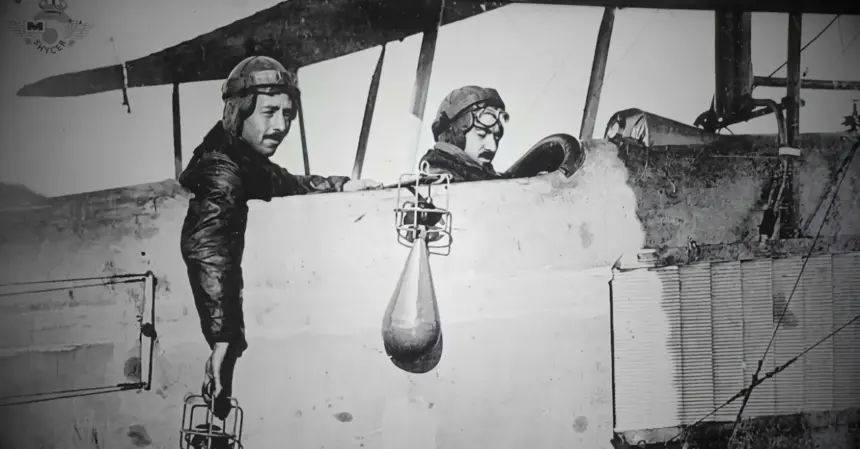
Between 1921 and 1927, the Spanish army waged a methodical chemical warfare campaign against the civilian population of Morocco’s Rif region — mustard gas, phosgene, chloropicrin — whose scale and premeditation raise a question Madrid continues to dodge: its responsibility for acts that, under the qualifications of contemporary international law, amount to war crimes and potentially crimes against humanity.
This is not a baseless accusation. It rests on decades of work by Spanish and British historians, military archives, official telegrams, and parliamentary reports. And yet no Spanish government, left or right, has ever officially acknowledged this responsibility.
A state decision, not a rogue act
The starting point of this campaign was military: the disaster of Annual in 1921, a humiliating defeat inflicted on Spain’s colonial army by Rifian forces under Abd el-Krim. It was in the wake of this debacle that the decision to deploy chemical weapons was made, at the end of that same year.
The telegram sent on August 12, 1921 by the High Commissioner of the Spanish Protectorate, Dámaso Berenguer, to the Minister of War in Madrid leaves little doubt about how deliberate this decision was. Berenguer writes that he had always been reluctant to use asphyxiating gas against local populations, but says he must now resort to it “with real pleasure.” That line, preserved in the military archives, captures on its own what separates a planned war crime from an isolated overreach: an acknowledged chain of command, running from the top of the state down to the field.
To obtain mustard gas, Spain approached German chemist Hugo Stoltzenberg as early as August 21, 1921 — even though Germany was barred from producing it under the Treaty of Versailles. A dedicated plant was later built at La Marañosa, near Madrid, to industrialize production.
Civilian targets, deliberately chosen
This may be the most damning part of the record: the chemical bombing raids did not just target military positions. According to the work of historians Sebastian Balfour and María Rosa de Madariaga, the preferred targets were:
- Weekly markets, struck on market day itself or the day before to maximize casualties among gathered civilians.
- Rivers and water sources, contaminated to extend the attack’s effects well beyond the moment the planes passed overhead.
- Rural residential areas, with no distinction made between combatants and non-combatants.
- An industrial production pace, with roughly 350 chemical bombs manufactured daily at the Seville artillery plant in 1924, according to an internal report from Spain’s Ministry of War.
This systematic targeting of the civilian population is precisely what, under today’s international humanitarian law, separates a lawful act of war from a war crime: the failure to distinguish between combatants and civilians, and the intent to terrorize an entire population rather than neutralize a military force.
The documented health consequences are unambiguous: severe skin burns, blindness, chronic respiratory damage, and soil and crop contamination lasting weeks. Several Moroccan associations and studies presented before Spanish parliamentary bodies even point to lasting transgenerational effects in the Rif region — a claim that remains scientifically contested but that legitimately fuels the demand for recognition.
A violation that was already illegal under the law of the time
The argument often raised to downplay these facts — that they were simply “the practices of their era” — does not hold up. The use of combat gas against civilian populations was already prohibited under the final declaration of the 1919 Versailles Conference, then explicitly banned by the 1925 Geneva Protocol — a protocol Spain itself signed, before continuing to use these weapons until 1927. Spain did not merely commit a morally condemnable act: it knowingly violated an international commitment it had just ratified.
Alongside this chemical campaign, several historical studies document other abuses against the Rifian population during the same period: summary executions of civilians, mistreatment of prisoners of war, and bombing raids deliberately targeting areas where women and children were present. Taken together, these elements paint the picture of a colonial repression that systematically crossed the line separating military action from the persecution of a civilian population.
A century of institutional denial
What makes this case particularly striking is the contrast between the strength of the historical consensus and the near-total absence of any political response from the Spanish state. A first attempt at parliamentary recognition, put forward by Catalan Republican Left, was rejected by the Spanish Parliament’s constitutional committee back in 2007. A new bill, introduced in 2016 under Mariano Rajoy’s government and aimed at recognizing the victims of the dictatorship and restoring historical memory, also failed to address this specific chapter.
Voices within Spain itself, particularly in Catalonia, continue to press the issue, calling for the creation of joint Spanish-Moroccan commissions to investigate the link between these chemical agents and diseases observed in the Rif today, as well as for a census and compensation of victims.
Spain is, of course, not alone in facing this kind of reckoning within Europe: France over Algeria, Belgium over Congo, and Germany over Namibia have each, to widely varying degrees, begun processes — often slow, often contested — of confronting their colonial past. What sets the Rif case apart is the nature of the weapon used: a chemical weapon, whose use against civilians stands today among the most absolute prohibitions in international law, alongside genocide and systematic torture.
Until Madrid formally opens this file — official recognition, full access to military archives, possible compensation for affected populations — the issue will remain an open wound in the relationship between the two shores of the Strait of Gibraltar, and a persistent blind spot in Europe’s colonial memory.
Other crimes committed by Spain
The Jaragua Massacre (1503)
On the island of Hispaniola, corresponding today to Haiti and the Dominican Republic, the Jaragua massacre is said to have killed a large number of Taíno people, with death tolls cited as high as 3 million.
Massacres of the conquest of the Caribbean
At the outset of Spanish colonization, the conquest of the Caribbean against the Taíno people was accompanied by killing and enslavement on a massive scale. Millions of people are believed to have died during this period.
The Cholula Massacre (1519)
In Mexico, the Cholula massacre was carried out by the troops of Hernán Cortés and his allies. Thousands of native people were killed in this major episode of the Spanish conquest.
The Toxcatl Massacre (1520)
Also known as the Massacre at the Great Temple, the Toxcatl massacre took place in the Aztec capital. It stands as one of the defining events of the Spanish conquest of Mexico.
The conquest of the Inca Empire (1532–1572)
In Peru, the conquest of the Inca Empire was marked by killings, executions, and the suppression of resistance to Spanish rule. Half the population is believed to have been wiped out.
Destruction and enslavement in the Americas
The colonization of the Americas relied in part on forced-labor systems such as the encomienda and the mita. These practices, combined with disease, contributed to a dramatic collapse of Indigenous populations.
The Bombing of Guernica (1937)
During the Spanish Civil War, Guernica was bombed by German and Italian aircraft in support of Franco’s forces. The bombing struck a civilian town and became one of the most emblematic episodes of the Spanish Civil War.
The Málaga Massacre — La Desbandada (1937)
During La Desbandada, a large number of civilians fleeing Málaga were killed as they fled, during the Spanish Civil War.
The Spanish Inquisition
Among the best-known episodes associated with the Spanish Inquisition are the persecutions, trials, torture, and executions targeting women and children, Jews, Muslims, and Christians accused of various offenses, including witchcraft. Some of the condemned were executed by burning.
FAQ
Can these acts legally be classified as war crimes or crimes against humanity?
The deliberate targeting of civilian populations with banned chemical weapons meets today’s criteria for a war crime; its systematic, widespread nature against a civilian population also supports the crimes-against-humanity classification, though these modern legal categories did not formally exist at the time.
Has Spain ever issued an official apology?
No. Despite repeated parliamentary attempts since 2007, no Spanish government has formally acknowledged responsibility for this campaign.
Who is calling for official recognition today?
Spanish political parties, particularly in Catalonia, historians, and Moroccan civic and parliamentary groups, who are demanding joint investigative commissions and compensation for victims.
Which chemical weapons were used against the Rif?
Mainly mustard gas, phosgene, diphosgene, and chloropicrin, produced in part at a dedicated plant near Madrid with German technical support.