
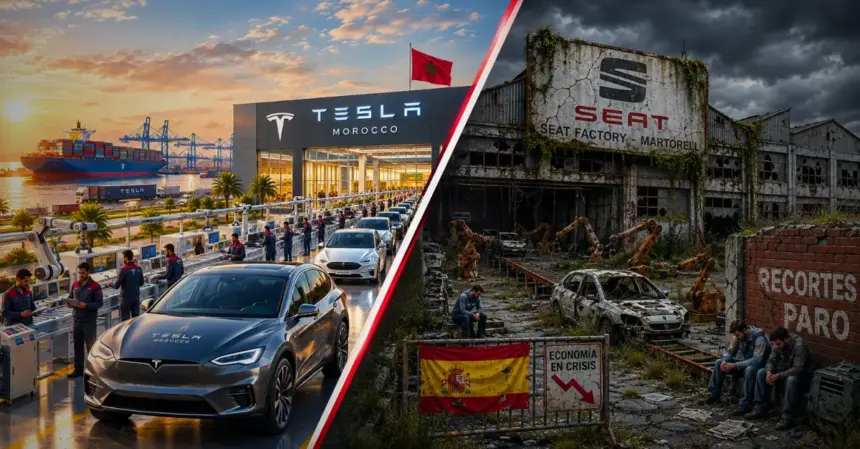
Slowly but surely, Spain is waking up to the scale of what’s unfolding across the Strait of Gibraltar. Ports and agriculture, that rivalry was already old news. But what’s taking shape now cuts into the industrial core of the country: the automotive sector. Volkswagen has approved a restructuring plan that could spell the end of the Seat brand, a historic pillar of Spanish industry, while Morocco has secured the construction of Africa’s first electric battery gigafactory. Two stories that, taken together, sketch out an industrial shift Madrid is still struggling to name out loud.
Seat’s slow-motion sinking
Volkswagen’s supervisory board approved its “Future Plan 2030” in late August 2026, a cost-cutting program that brings the total to around 100,000 job cuts over five years, roughly 15% of the group’s global workforce, alongside an estimated production overcapacity of about 500,000 cars in Europe. Buried in that document, revealed by German magazine WirtschaftsWoche, is a decision with real weight for Spain: the group has signed off on a plan to progressively wind down the Seat brand by the end of 2029, in favor of Cupra.
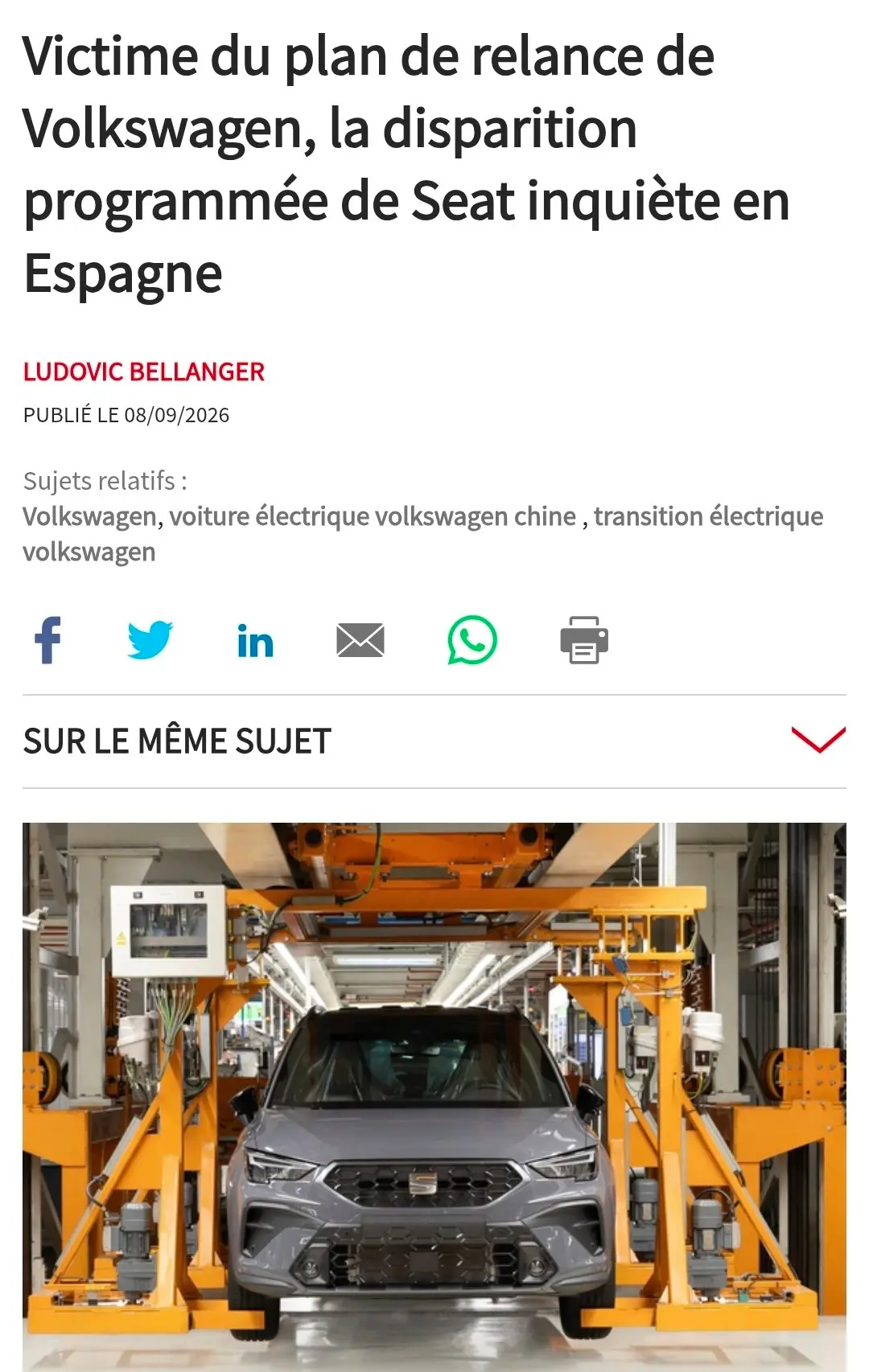
The paradox is striking. Seat isn’t a brand in commercial freefall. In 2025, the combined Seat-Cupra entity actually posted a record, delivering 586,300 vehicles. But that headline number hides a widening gap between the two marques. Cupra grew 32.5%, to 328,800 units, while Seat sales fell 17%, to 257,400 vehicles. Wolfsburg’s math is simple: Cupra sells Formentors and Terramars, Seat sells Ibizas and Aronas, at a noticeably thinner margin.
Let’s ease one worry right away: the brand’s expected disappearance doesn’t mean the plant closes. Volkswagen doesn’t intend to shut down the Martorell site near Barcelona, which employs around 12,000 people, production would simply continue under the Cupra badge. Spain’s Economy Minister, Carlos Cuerpo, has pledged the government will make “every effort necessary” to keep the brand alive, while unions are already quietly discussing a possible alliance with Chinese carmakers to secure the site’s industrial activity long-term. That’s an early hint of the pattern I’ll come back to: when Europe pulls back, China moves in.
Kénitra, the gigafactory reshuffling the deck
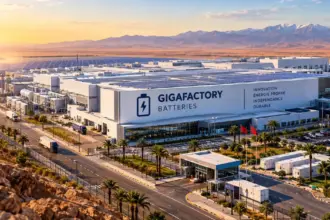
While Wolfsburg trims its own brand portfolio, Morocco has just signed one of the largest industrial investments in its recent history. Sino-European group Gotion High-Tech, in which Volkswagen holds a minority stake of roughly a quarter of the capital, is building Africa’s first lithium-iron-phosphate battery gigafactory in Kénitra’s Atlantic Free Zone. Total investment is valued at 65 billion dirhams, around $6.8 billion, for an initial production capacity of 20 GWh with a long-term target of 100 GWh. The first phase alone is expected to create 17,000 jobs, including 2,300 highly skilled positions.
The site wasn’t picked by geographic accident. Morocco holds roughly 70% of the world’s phosphate reserves, the raw material behind LFP chemistry, and its proximity to Europe, just a few dozen kilometers from the Strait of Gibraltar, meaningfully cuts logistics costs and lead times compared to production shipped from Asia. The plant also sits inside an already dense automotive cluster, near Renault’s Kénitra factory and Stellantis’s Tangier plant. Production is slated to start in summer 2026, with financing partly backed by the African Development Bank.
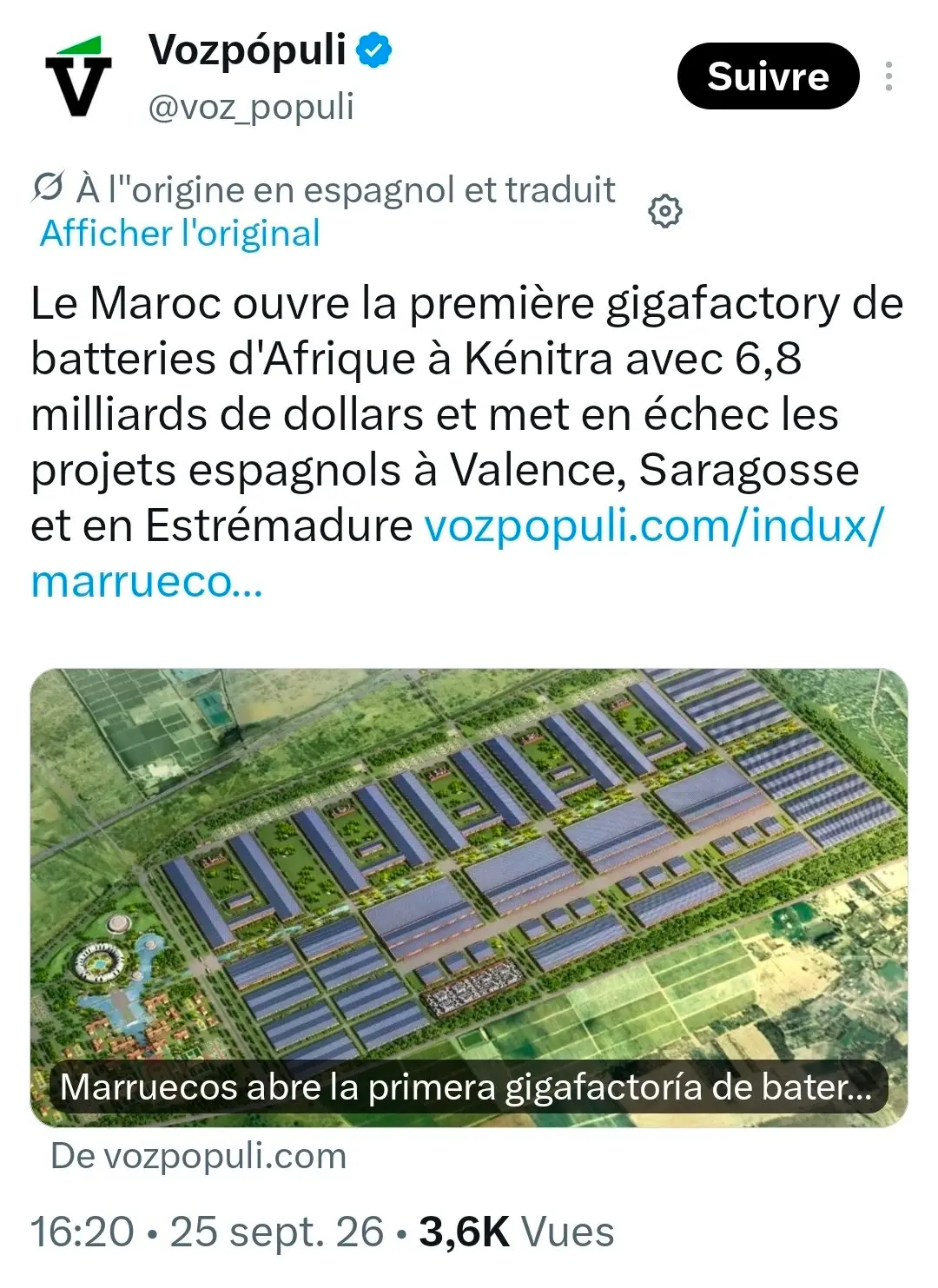
The irony of the story: Volkswagen, through its stake in Gotion, is indirectly helping finance the Moroccan plant that could end up supplying cells to the same European carmakers its own Spanish site is struggling to serve.
Sagunto, a symbol of Spain’s slippage
This is where the story gets genuinely uncomfortable for Madrid. PowerCo, Volkswagen’s battery arm, is building its “Gigafactory Valencia” in Sagunto, conceived as the Iberian counterpart to the German site in Salzgitter. The project, sized for an initial 20 GWh capacity with room to expand, is running noticeably behind its original schedule. Pre-series production is now expected in September-October 2026, and series production isn’t slated to start before July 2027, even though the launch was originally announced for 2026.
Hiring is lagging too. Only 50 of the 500 employees needed for pre-series production had been hired when the information surfaced this summer. And in a twist that says everything about the current industrial balance of power, La Tribuna de Automoción reported that Volkswagen and Gotion, the same Chinese group building the Moroccan gigafactory, are discussing a stake sale that would give the Chinese firm a foothold in the Spanish Sagunto site, precisely to speed up a project that’s fallen behind. PowerCo denies wanting to hand over control of the site but confirms talks are underway around possible strategic partnerships.
Here’s a snapshot of the timeline gap between the two sides of the Strait:
- Kénitra (Morocco, Gotion) investment agreement signed in 2024, production targeted for summer 2026, initial capacity of 20 GWh, expandable to 100 GWh
- Sagunto (Spain, PowerCo/Volkswagen) project launched in 2023, pre-series pushed to fall 2026, full-scale production not expected before July 2027, initial capacity of 20 GWh
- Salzgitter (Germany, PowerCo) pilot plant already operational, serving as the reference site for both Valencia and the future Canadian plant in St. Thomas
- Sagunto staffing roughly 50 employees hired out of the 500 needed for pre-series production, as of this summer
The contrast is stark. Morocco is holding its timeline on a project launched later; Spain keeps slipping on a project launched earlier and backed by one of the world’s largest carmakers.
A familiar backdrop, ports and agriculture
This battery story didn’t come out of nowhere, it fits a pattern Spain has been watching for about fifteen years. On container traffic, Tanger Med closed 2025 with 11.1 million containers handled, up 8.4%, now surpassing the combined volume of the Spanish ports of Algeciras and Valencia. Maersk, the world’s top shipping line, chose in early 2025 to drop Algeciras from its India-to-US route in favor of the Moroccan port. On agriculture, competition from Moroccan fruit and vegetable exports to Europe regularly fuels protests among Andalusian producers. Both fronts are well known. What’s different with automotive and batteries is that we’re no longer talking about marginal market share, but about the most strategic industrial value chain in the Spanish economy, one that directly employs several hundred thousand people.
What Madrid can still do
Nothing is set in stone. Seat’s disappearance remains an internal plan not officially confirmed by Volkswagen, and Sagunto’s timeline could still tighten if the German group decides to throw more resources at it. The Spanish government also holds a real lever: the Perte VEC public support program, which already helped get the Valencia project off the ground. But the signal sent by this early autumn of 2026 is clear, industrial competitiveness is no longer decided solely in Brussels or Madrid, it’s also being decided fifteen kilometers off the Andalusian coast, in a Moroccan free zone where deadlines hold and Chinese capital is moving faster than expected.
FAQ
Will Seat actually disappear by 2029?
The commercial brand would be gradually phased out by the end of 2029 under Volkswagen’s internal plan, but the Martorell plant would keep running to produce Cupra models.
Why was Morocco chosen for the Gotion gigafactory?
The country combines some of the world’s largest phosphate reserves, geographic proximity to Europe, and an already established automotive base with Renault and Stellantis.
Will the Sagunto gigafactory actually open?
The project hasn’t been scrapped, but its timeline has slipped by several months, with series production now targeted for July 2027, and a possible stake sale to China’s Gotion.
Does Spain’s delay directly benefit Morocco?
Not mechanically, the two sites target partly different markets, but Kénitra is holding its schedule while Sagunto keeps slipping, which weighs on Spain’s reputation for industrial reliability.