

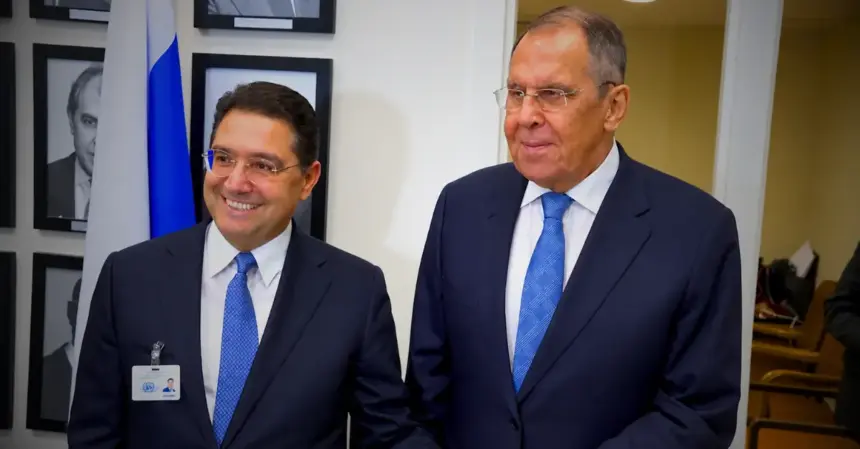
Nothing exceptional on the surface — the two men have crossed paths regularly for years. And yet, on closer inspection, this latest handshake says something fairly precise about the trajectory of the relationship between Rabat and Moscow over the past decade.
A Relationship That Has Gained Substance Since 2016
To understand the turning point, one has to go back to March 2016. King Mohammed VI’s visit to Moscow led to the signing of a declaration elevating bilateral relations to the level of a deepened strategic partnership. A text that, on paper, resembled many other declarations of intent signed during royal visits. Except this one was followed by concrete results, year after year, in fields as varied as energy, agriculture, fishing and education.
What stands out, when reconstructing the chronology of the past decade, is the regularity of the political dialogue. Lavrov and Bourita met in Marrakech in December 2023, on the sidelines of the sixth Russia-Arab Cooperation Forum. They met again in New York in September 2024, in Sochi that same November for the first ministerial conference of the Russia-Africa Partnership Forum, then in Moscow in October 2025. The September 2026 meeting in New York therefore fits into a rhythm that resembles a routine working appointment more than an isolated diplomatic event. That is precisely what makes it an interesting indicator: relationships that last are rarely the ones celebrated most loudly.
Agriculture, the Quiet but Decisive Driver
While the political dimension of the Morocco-Russia relationship draws the most media attention, it is the agricultural component that, in raw numbers, carries the most weight. Russia has established itself in recent years as a leading grain supplier to the Moroccan market, driven by the Kingdom’s growing import needs and the availability of competitively priced Russian wheat on international markets. Morocco, for its part, has expanded its own exports of fruit and vegetables to Russia, a market that has diversified its supply sources since 2022.
This agricultural interdependence is not trivial. It creates, between two countries with very different political systems and international alliances, a foundation of concrete economic interests that withstands diplomatic ups and downs better than mere declarations of friendship. It is a dynamic observed elsewhere in Russia-North Africa relations since the start of the war in Ukraine: Moscow, partly cut off from its traditional European outlets, has sought to strengthen its position in alternative markets, and Morocco, a net grain importer, had every interest in diversifying its suppliers rather than depending on a narrow set of partners.
The Western Sahara File, a Diplomatic Tightrope
No Lavrov-Bourita meeting concludes without a mention of the Western Sahara dossier, and the New York encounter was no exception. Russia’s position on this issue remains a deliberate balancing act: Moscow advocates a negotiated political solution under UN auspices, while avoiding a stance as clear-cut as that of the Kingdom’s Western partners.
Russia’s vote at the Security Council in October 2024, during the renewal of MINURSO’s mandate, already illustrated this calculated caution: Moscow abstained rather than voting for or against the text, citing reservations about how the negotiations had been framed. A year later, ahead of the October 2025 vote on extending the mandate, Lavrov made notable remarks to African media, reaffirming Russia’s commitment to the principle of self-determination while acknowledging that Morocco only envisions it in the form of autonomy — a way of closing no doors while avoiding any explicit commitment to either side of the conflict.
This controlled ambiguity serves both capitals’ interests. For Rabat, it keeps open a channel with a permanent member of the Security Council whose support, even partial, matters in the diplomatic equation. For Moscow, it preserves a useful economic and political relationship with a country that remains a key partner of the European Union and the United States, without abandoning its own stated principles on international law.
What This Relationship Says About Russia’s North Africa Strategy
The Morocco-Russia partnership fits into a broader pattern of Moscow’s diplomatic repositioning on the African continent, visible since the 2019 and 2023 Russia-Africa summits and confirmed by the creation, in 2024, of the Russia-Africa Partnership Forum. In this context, Morocco occupies a particular place: neither a military ally of Moscow nor a country aligned with Russian positions on Ukraine, it nonetheless remains one of the few North African partners with which Russia maintains an institutionalized, regular and multi-sector dialogue.
Here are the main pillars structuring this bilateral relationship today:
- Agricultural trade: steady growth in Russian wheat exports to Morocco, alongside the expansion of Moroccan fruit and vegetable exports to Russia
- Energy and infrastructure: ongoing discussions on renewable energy and logistical links between the two markets
- Fishing: continued agreements allowing Russian vessels to operate in Morocco’s Atlantic fishing zones
- Education: several thousand Moroccan students enrolled in Russian universities each year
- Diplomacy: regular meetings between foreign ministers, averaging once or twice a year since 2022
This is not a strategic partnership in the sense Moscow and Beijing understand the term, nor an alliance comparable to the one binding Morocco to the United States or France. It is something more pragmatic: a relationship built brick by brick, sector by sector, allowing each side to draw tangible benefit without committing to the most sensitive geopolitical terrain.
A Diplomacy of Consistency Rather Than Spectacle
What stands out most, looking at this sequence of meetings since 2016, is less the nature of the message exchanged — both foreign ministries speak, meeting after meeting, of “strengthening” and “traditionally friendly relations” — than its methodical repetition. In an international context marked by abrupt ruptures and shifting alliances, the Morocco-Russia relationship stands out for its stability, almost its predictability.
It remains to be seen whether this diplomatic regularity will translate, in the coming years, into an acceleration of economic cooperation matching the stated ambitions, or whether it will continue to operate on a mode of sustained dialogue without particular acceleration. The next session of the joint intergovernmental commission, as well as the evolution of the Western Sahara file at the UN, will likely provide the first signs of an answer.
FAQ
Since when have Morocco and Russia been strategic partners?
Since March 2016, when King Mohammed VI visited Moscow and the two countries signed a declaration deepening their strategic partnership.
What is Russia’s position on the Western Sahara dossier?
Moscow advocates a negotiated political solution under UN auspices, generally avoiding an explicit choice between the Moroccan and Algerian positions, as illustrated by its abstention at the Security Council in October 2024.
What is the main sector of exchange between the two countries?
Agriculture, with rapidly growing Russian wheat exports to Morocco and, in return, Moroccan fruit and vegetable exports to the Russian market.
Where and when did Lavrov and Bourita meet before New York 2026?
Notably in Marrakech in December 2023, in New York in September 2024, in Sochi in November 2024, and in Moscow in October 2025.