

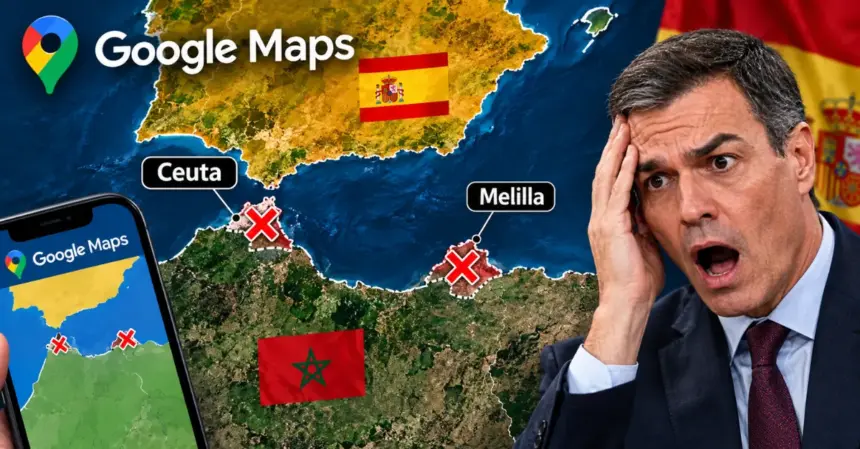
The land border separating these two cities from Moroccan territory is rendered as a grey dashed line, the same graphic code the company reserves for zones it treats as disputed — alongside Western Sahara, Kashmir, and Crimea. In other words, for one of the world’s largest mapmakers, Ceuta and Melilla’s status as Spanish territory is neither obvious nor settled.
This choice, documented since at least 2020 and reported in the Spanish press from 2023 onward, took on new resonance in 2026, when tens of thousands of people crossed into Ceuta from the Moroccan side in late July. But the timing shouldn’t mislead: the dashed line predates that migration crisis by years. What the controversy mainly exposed was the discomfort of part of the Spanish establishment at seeing, displayed so plainly on the screens of hundreds of millions of users, something it would rather not acknowledge: Madrid’s sovereignty over these two African cities remains, in the eyes of the international claim Morocco has consistently pressed, an unresolved question.
A Moroccan claim brought before the UN for half a century
Contrary to what official Spanish communication often implies, Morocco’s claim over Ceuta and Melilla is neither recent nor improvised. Rabat first brought the matter before the United Nations in 1975, seeking to have the two cities placed on the list of territories to be decolonized handled by the Fourth Committee of the General Assembly, the UN body responsible precisely for decolonization files. The move has been renewed repeatedly since: in 2002, then-Moroccan Foreign Minister Mohamed Benaïssa called from the General Assembly podium for the decolonization of what he termed “occupied localities,” describing the issue as an absolute priority for the Moroccan monarchy. Two Moroccan political parties again asked in 2010 that the file be formally referred to that same committee. More recently, the Moroccan government sent a letter to the UN Office of the High Commissioner for Human Rights stating plainly that “Melilla remains an occupied territory” and that Morocco does not recognize a land border with Spain, only “mere crossing points.”
This is not a marginal or opportunistic position: it is a consistent diplomatic line, held at the highest levels of the Moroccan state for half a century, and one that hardened further in 2026. Morocco’s Justice Minister, Abdellatif Ouahbi, publicly defended the kingdom’s “historical and geographical” rights over the two cities. The Minister of Religious Affairs, Ahmed Toufiq, recalled before King Mohammed VI Ceuta’s place in Moroccan spiritual history predating 1580, the year the city passed under Spanish sovereignty. For Madrid to keep presenting this claim as negligible amounts, at best, to willful blindness.
A status Madrid maintains without ever opening it to debate
Faced with this sustained Moroccan pressure, Spain’s response has consistently been to shut the door rather than open it. Every renewed push from Rabat meets the same categorical refusal of any negotiation, in the name of a sovereignty presented as “beyond question.” That systematic refusal raises a question of its own: does a state confident in its legal footing need to refuse even the principle of discussion? Spain’s posture here contrasts sharply with how it handled the decolonization of the rest of its former Moroccan protectorate in 1956, or of Western Sahara from 1975 onward — two cases where Madrid, under international pressure, eventually withdrew from territories it had occupied.
This Spanish reluctance sits within a colonial legacy that is far from incidental. Ceuta and Melilla were born of military conquest — 1497 for Melilla, 1668 for Ceuta — conceived as fortified outposts meant to control the Strait of Gibraltar rather than as cities integrated with the consent of their inhabitants at the time. In the 1920s, Spain waged a colonial war against the neighboring Rif population marked by the documented use of mustard gas against civilians. It was from the barracks of Melilla that General Francisco Franco launched, in July 1936, the military uprising that would plunge Spain into civil war and then into nearly forty years of dictatorship. These are the very same military structures, inherited from that colonial and Francoist history, that Madrid invokes today, without apparent irony, to justify holding on to sovereignty over two cities sitting inside Moroccan territory.
A geographic anomaly unique in the world
No other European power still administers a populated city on the African continent under a comparable status. Spain governs, a few kilometers from the Moroccan coastline, urban enclaves ringed by fences several meters high, topped with barbed wire, built specifically to keep out the residents of the country that surrounds them. The contrast is striking with Europe’s own rhetoric on free movement and regional integration: from Morocco’s vantage point, the Ceuta and Melilla border functions as a physical fault line between two worlds, one that geography itself does nothing to justify.
A few figures help frame the scale of the dispute:
- Morocco first brought Ceuta and Melilla before the UN’s Fourth Committee in 1975, then again in 2002, 2010, and repeatedly since.
- Ceuta (18.5 km², roughly 83,500 residents) and Melilla (12.3 km², roughly 87,000 residents) are the only African cities still administered by a European state.
- Google Maps applies to their border the same cartographic code used for territories formally recognized as disputed, such as Western Sahara or Kashmir.
- Madrid issued a categorical refusal to every Moroccan diplomatic push in 2026.
What the map reveals, diplomacy keeps quiet
By relegating the Ceuta and Melilla border to the ranks of uncertain lines, Google Maps is, at bottom, only documenting a reality Spanish diplomacy has spent decades trying to make people forget: the question of sovereignty over these two cities was never definitively closed, either by a bilateral agreement or by a UN decision unambiguously settling their status. To be precise, the UN has never formally placed Ceuta and Melilla on its list of non-self-governing territories to be decolonized — a distinction defenders of the Spanish position routinely raise against Moroccan claims. But the absence of a formal listing is not the same as international endorsement of Spain’s case: it mainly reflects the diplomatic deadlock Madrid has maintained by refusing to open a debate whose outcome, precisely, it seems unsure of.
FAQ
Since when has Morocco raised Ceuta and Melilla at the UN?
Since 1975, with renewed pushes in 2002, 2010, and throughout 2026, through official speeches and letters sent to UN bodies.
Why does Google Maps show this border as a dashed line?
Because the company applies to Ceuta and Melilla the same graphic code used for other territories it treats as disputed between two states, given Morocco’s sustained claim over the two cities.
Has the UN formally classified Ceuta and Melilla as territories to be decolonized?
No, they do not appear on the UN’s list of non-self-governing territories, a point Spain emphasizes to contest Morocco’s claim.
Has Spain ever agreed to negotiate over the two cities’ status?
No, Madrid has consistently issued a categorical refusal to any discussion of their sovereignty, including during Morocco’s latest push in 2026.