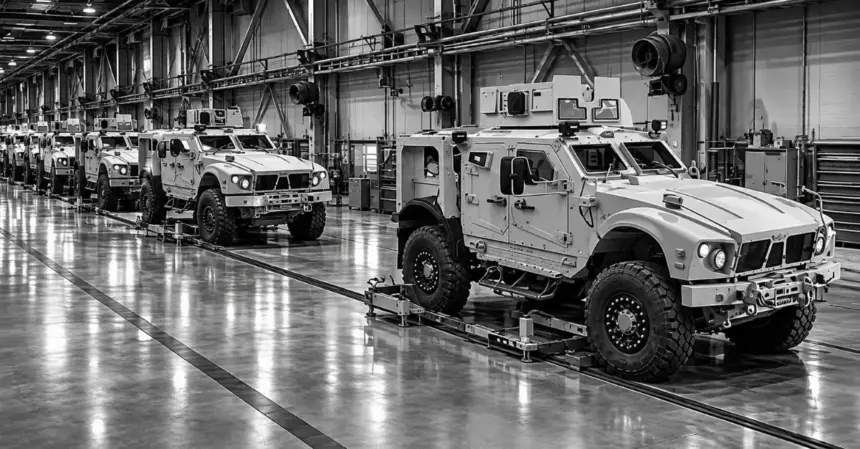
Thirty-five vehicles left the Port of Savannah, Georgia, between January and July 2026. Declared at a value of $41.54 million (about 405.32 million dirhams at a rate of 9.758 dirhams to the dollar), they weigh a total of 652.07 tonnes. These shipments fall under a commercial license issued by the Bureau of Industry and Security (BIS), separate from Foreign Military Sales (FMS).
These shipments are not an isolated event. They are part of an already dense defense partnership between Rabat and Washington, marked in 2026 by deliveries of AH-64E Apache helicopters, the continuation of the F-16 program, and a cooperation roadmap for 2026-2036 signed at the Pentagon in April. Morocco is modernizing its Royal Armed Forces (FAR) while remaining the leading African importer of American weapons, according to SIPRI data.
The shipment schedule
Census Bureau records detail four complete shipments. In January, five vehicles were declared at $5.93 million and 92.99 tonnes. Three lots of ten vehicles followed in March, May and July, each declared at $11.87 million and 186.36 tonnes of gross shipping weight. Each unit carries an identical declared value, down to the cent, of around $1.19 million. No shipments of complete vehicles were recorded in February, April, June, August or September.

These vehicles fall under Schedule B code 8710.00.0060, reserved for motorized armored combat vehicles other than tracked ones, “whether or not fitted with armament,” and counted per unit. Spare parts are listed under a separate code (8710.00.0090), counted in kilograms. All 35 vehicles, of American origin in the customs sense, passed through customs port 1703 at Savannah. They account for seven statistical records, with an average mass of 18.63 tonnes per unit, including packaging and onboard equipment.
The value declared by the Census Bureau is based on the selling price (or the cost of the equipment if transferred without sale), plus inland freight, insurance and charges up to the U.S. port of export. The state-of-origin file attributes exactly $41.54 million and 652.07 tonnes to Wisconsin for 2026, figures consistent with those of the 35 armored vehicles. The state of origin designates the place where the goods begin their journey to the port (factory, depot or consolidation site).
A homogeneous series since 2025
The 2025 files reveal two earlier shipments from Savannah to Morocco: five vehicles in October ($5.93 million, 93.18 tonnes) and five in November (identical amount, 95.45 tonnes). These ten vehicles show, to the dollar, the same unit value as the 35 from 2026. The homogeneous Savannah series thus comprises at least 45 armored vehicles, declared at $53.4 million (about 521 million dirhams) and 840.7 tonnes, an average of 18.68 tonnes per unit.
Other 2025 flows took different routes: twenty vehicles via Houston and eighteen via Norfolk. Their masses and unit values differ markedly from those of the Savannah lot, which suggests distinct configurations or batches.
The regulatory framework and spare parts
The quarterly export control file classified the ten July vehicles under Export Control Classification Number (ECCN) 0A606 and license code C30. The C30 code designates a license granted by the BIS for a controlled export, distinct from the DSP-94 code specific to Foreign Military Sales. ECCN 0A606 covers land vehicles designed for military use, certain categories of armored vehicles and their components. Items in Category VII of the U.S. Munitions List remain excluded.
A large share of the parts was declared under code S94, tied to FMS deliveries and DSP-94 licenses. Parts under code 8710.00.0090 totaled $24.85 million (about 242.5 million dirhams) over the first nine months of 2026. The chapter’s cumulative total reached $66.39 million (about 648 million dirhams), split between complete vehicles ($41.54 million) and parts ($24.85 million). Over the same period in 2025, the total stood at $17.28 million; shipments have therefore nearly quadrupled in one year (+284%).
In September 2026, no complete vehicles were recorded, but parts amounted to $5.48 million and 65.87 tonnes, shipped by sea from Norfolk and Newark, and by air from New York’s John F. Kennedy Airport.

Key figures on armored vehicle exports to Morocco (Census Bureau data)
- 35 complete vehicles (January-July 2026): $41.54M / 652 tonnes
- Average unit value: ~$1.19M
- Savannah series 2025-2026: at least 45 units / $53.4M
- Parts (code 8710.00.0090, first 9 months of 2026): $24.85M
- Combined vehicles + parts (first 9 months of 2026): $66.39M (+284% year on year)
A broader modernization context
These flows are part of a broader trend. In October 2026, the FAR received a third delivery of six AH-64E Apache helicopters, bringing the total to 19 aircraft out of the 24 planned in a program worth about $1.3 billion. The first lots were delivered in March 2025 and May 2026. Morocco is also pursuing the acquisition of 25 new F-16 Block 72 fighters (the first test flight took place in October 2026) and is modernizing its Abrams tank fleet, while strengthening its heavy logistics with Oshkosh HET A1 tractors ordered through Optimum Vehicle Logistics, based in Milwaukee.
In April 2026, the two countries signed a defense cooperation roadmap for 2026-2036 at the Pentagon. U.S. bills mention priorities around FAR modernization, counterterrorism, drones, cybersecurity and the expansion of joint exercises such as African Lion. The ceiling on advance commitments for Moroccan defense equipment and industry was raised in the 2027 draft finance bill to 190.5 billion dirhams (compared with 157 billion in 2026), reflecting a desire to fund multi-year programs.
Overall U.S.-Morocco trade also grew strongly in 2026, with a U.S. surplus that already exceeds that of the whole of 2025 over the first nine months. Aerospace and energy dominate, but defense flows remain visible in the statistics.
Strategic stakes in the Mediterranean and North Africa
These deliveries of armored vehicles, even if modest in scale compared with the major programs (F-16, Apache, Abrams), strengthen interoperability between the FAR and U.S. forces. They fit the role Washington assigns to Morocco: a key partner for stability in North Africa, monitoring of the Strait of Gibraltar and counterterrorism cooperation in the Sahel. The African Lion exercises, the gradual establishment of training capabilities (such as the multidomain center planned in Tan-Tan) and regular political and military exchanges illustrate this priority.
On the Moroccan side, the diversification of suppliers (the United States, but also South Korea, Israel and France) and the push for industrial localization aim to reduce dependence while modernizing land, air and air defense capabilities in the face of regional threats. The lack of detailed official communication on these lots of non-tracked armored vehicles is not unusual: many flows of parts and vehicles under commercial license receive little media attention.
U.S. customs data offer a transparent window onto movements that often escape public announcements. They confirm the continuity of a defense partnership that goes beyond the widely publicized major platforms. It remains to be seen how these vehicles will be integrated into FAR units and whether the flows will continue at the same pace in 2027, under the 2026-2036 roadmap.
FAQ
Are these 35 vehicles part of a Foreign Military Sale (FMS)?
No. They fall under a BIS commercial license (code C30), distinct from FMS licenses (DSP-94). The parts, however, partly move under the FMS regime.
What is the exact origin of the vehicles?
In the customs sense, they are of American origin. The statistical state of origin is Wisconsin, where the goods began their journey to the Port of Savannah.
Have armored vehicle exports to Morocco increased?
Yes. Over the first nine months, the vehicles + parts total nearly quadrupled compared with 2025.
Are there other flows of American armored vehicles to Morocco in 2025-2026?
Yes. Besides the homogeneous Savannah series, shipments passed through Houston and Norfolk in 2025, with different mass and value characteristics.