
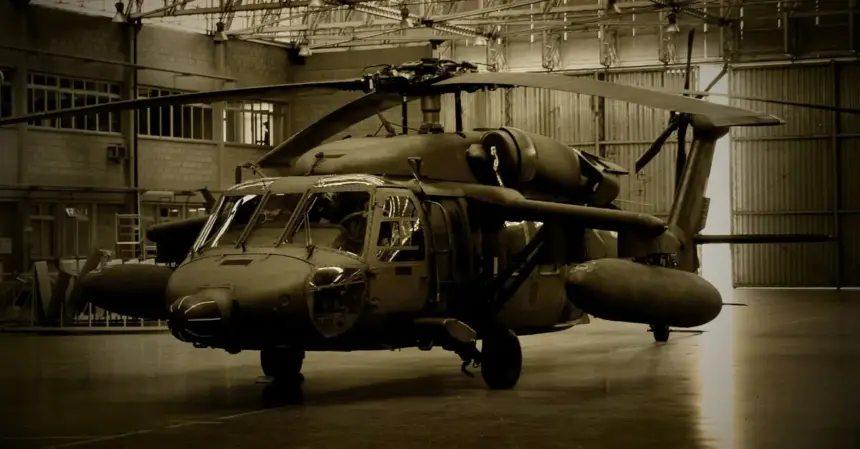
At the center of this affair lies a simple question with a far less simple answer: is Morocco about to add the Sikorsky UH-60 Black Hawk to its military helicopter fleet?
No official announcement has been made, either by Rabat or Washington. But a body of material evidence, cross-referenced with what is known about the ongoing renewal of the Royal Moroccan Armed Forces’ (FAR) aviation assets, deserves closer examination.
A document that sparked the debate
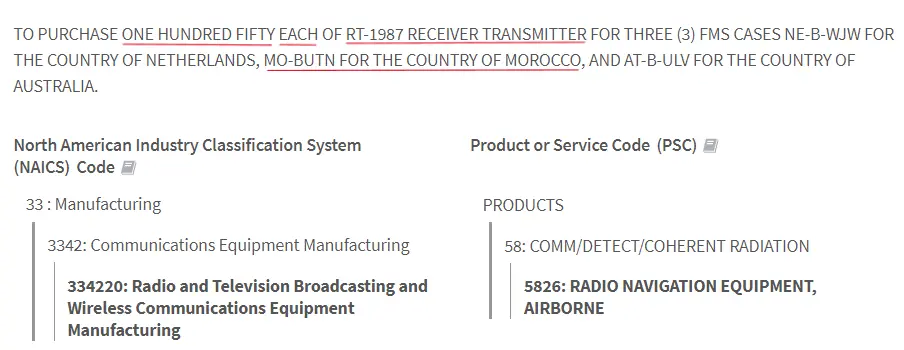
It all started with a US federal procurement notice, the kind the Department of Defense regularly publishes to organize bulk purchases on behalf of several foreign clients under the Foreign Military Sales (FMS) program. The document in question covers the acquisition of one hundred fifty units of the RT-1987, across three separate FMS cases: one for the Netherlands, one for Australia, and a third, referenced MO-B-UTN, for Morocco.
The RT-1987 is no minor piece of equipment. It is the latest generation of the AN/ARC-231A radio, manufactured by BAE Systems: a software defined radio covering the VHF and UHF bands, fitted with Type 1 encryption compliant with National Security Agency standards, and compatible with the HAVE QUICK, SATURN, and SINCGARS anti-jamming modes. In short, it is one of the most widely deployed tactical communication standards across US and allied military aviation.
The figure — one hundred fifty units — immediately caught observers’ attention, particularly when set against another known number: the fifty-two radios of the same type acquired by Morocco to equip its fleet of twenty-four AH-64E Apache Guardian attack helicopters, currently being delivered. The suggested ratio — roughly two radios per aircraft, plus spare units — gives an indication of the number of aircraft a batch of one hundred fifty units could cover, a figure well above what the Apache program alone would require.
Morocco purchased 150 AN/ARC-231A RT-1987 Airborne Communications System from BAE , note that we purchased 52 similar systems for our AH-64E Guardians , however 150 systems might indicate something …. pic.twitter.com/U80F8eh5RM
— Semper Supra (@CaelumPugnator) March 2, 2024
Three platforms only, not four
A second document, a BAE Systems commercial technical sheet dedicated to the RT-1987, provides further clarity. The manufacturer explicitly specifies which platforms are certified compatible with this radio: the UH-60 Black Hawk, the CH-47 Chinook, and the AH-64 Apache. Two other aircraft, the UH-72 Lakota utility helicopter and the MQ-1C Grey Eagle drone, are excluded.
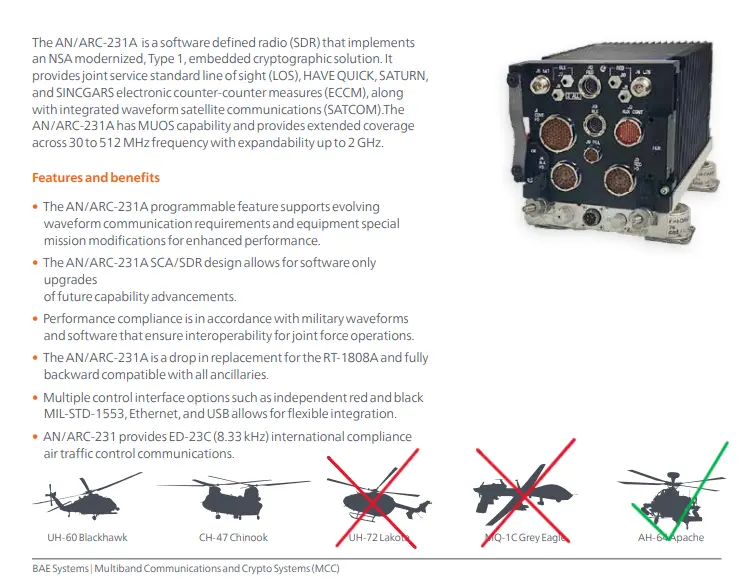
This clarification significantly narrows the field of hypotheses. Since Morocco’s Apache program is already covered by its own batch of radios, two plausible candidates remain to explain this new acquisition: the Chinook, or the Black Hawk.
Morocco’s CH-47 Chinook fleet, however, remains modest. Acquired secondhand starting in 2013, these heavy-lift transport aircraft number only a handful — around half a dozen — used for logistics and airborne assault missions, notably during the joint African Lion exercises with US forces. A fleet of this size would not reasonably justify the acquisition of one hundred fifty additional radios, even allowing for a generous spare-parts margin.
That leaves the Black Hawk. Morocco is not entirely unfamiliar with this aircraft: according to open-source inventories tracking global Black Hawk fleets, the Royal Moroccan Gendarmerie’s air wing already operates two units, likely assigned to internal security or search-and-rescue missions. A larger program, this time intended for the Royal Armed Forces themselves, would represent a significant capability upgrade.
Why this matters for Morocco
This hypothesis fits within a broader pattern of accelerated military modernization that Morocco has pursued since the early 2020s. The kingdom received one hundred sixty-two upgraded M1A1 Abrams tanks between 2022 and 2023, obtained approval in April 2025 for a sale of six hundred FIM-92K Stinger Block I missiles valued at an estimated 825 million dollars, and continues to take delivery of its twenty-four AH-64E Apache helicopters ordered in 2020 — roughly half the fleet had arrived at this stage, with contract completion expected by mid-2026.
This pace of acquisitions reflects an increasingly close bilateral security relationship between Rabat and Washington, symbolized each year by the African Lion exercise, the largest deployment by the US Africa Command (AFRICOM) on the continent. Morocco’s status as a major non-NATO ally also facilitates access to advanced equipment through the FMS program, generally on shorter timelines than for other regional partners.
Against this backdrop, adding the Black Hawk would present genuine capability coherence. Unlike the Apache, designed for attack and fire support, the Black Hawk is a versatile utility helicopter: troop transport, medical evacuation, airborne assault, logistics support. It would fill a segment that Moroccan aviation currently covers with older aircraft, notably SA 330 Puma helicopters whose replacement is regularly discussed by regional defense specialists.
It is also worth noting a recent industrial development that could, without confirming anything, feed this hypothesis. Lockheed Martin unveiled a new configuration called the Armed Black Hawk at the Farnborough air show in the summer of 2026, integrating Hellfire and JAGM missiles onto an aircraft that otherwise remains multi-role. The manufacturer explicitly presented this product as intended for FMS export markets, specifically targeting partners seeking to combine transport and strike capabilities without maintaining two separate fleets. No direct link has, however, been established between this commercial announcement and Morocco’s case.
What the absence of official confirmation means
At this stage, an important methodological limitation deserves emphasis. No State Department notification, no communication from the Defense Security Cooperation Agency (DSCA) — the body responsible for notifying the US Congress of significant arms sales — mentions a Black Hawk program for Morocco to date. The last DSCA notification concerning a Moroccan helicopter program remains the one from November 2019, related to the Apache.
This absence does not invalidate the hypothesis, but it does limit its scope. FMS-BPA (blanket purchase agreement) type federal procurement notices sometimes cover equipment intended for several simultaneous purposes — upgrading existing platforms, building spare-parts stockpiles, or anticipating a contract still under negotiation that has not yet reached the public notification stage. For its part, the Royal Armed Forces very rarely communicate about their acquisitions before actual delivery, a practice of discretion well documented by specialized press over the past decade.
Key figures in the case
- 150 RT-1987 radios ordered for Morocco under FMS case MO-B-UTN
- 52 radios of the same type used for Morocco’s 24 AH-64E Apache helicopters
- 3 platforms only certified compatible with the RT-1987: UH-60, CH-47, AH-64
- 2 Black Hawk helicopters already in service with the Royal Moroccan Gendarmerie
- 24 AH-64E Apache helicopters ordered in 2020, roughly half delivered by mid-2026
A solid hypothesis, confirmation still pending
At the end of this analysis, the hypothesis of a Moroccan Black Hawk program rests on a coherent body of material evidence rather than a single definitive proof. The disproportion between the volume of radios ordered and the size of the existing Chinook fleet, combined with the coverage already secured for the Apache program, logically points toward the Black Hawk as the most plausible explanation. But until Washington or Rabat confirms the exact nature of this contract, it remains prudent to speak of a serious indication rather than a certainty.
Should this hypothesis be confirmed in the coming months, it would fit within the continuity of a modernization effort underway for several years and would reflect the central place Morocco now occupies among the United States’ preferred security partners on the African continent.
FAQ
Does Morocco already operate Black Hawk helicopters?
Yes, but in very limited numbers. Two units are recorded within the Royal Moroccan Gendarmerie’s air wing, a unit distinct from the Royal Armed Forces.
What is the RT-1987 and why is it central to this story?
It is a next-generation military radio (AN/ARC-231A) manufactured by BAE Systems, certified compatible with only three platforms: the UH-60 Black Hawk, the CH-47 Chinook, and the AH-64 Apache.
Has this information been officially confirmed by US or Moroccan authorities?
No. No notification from the Defense Security Cooperation Agency, nor any official Moroccan communication, confirms a Black Hawk program for the Royal Armed Forces to date.
When might official confirmation be expected?
FMS contracts of this scale generally undergo public DSCA notification before final signature. No timeline is currently known for this case.








At least credit the source
If the source is available, please read the article carefully again.
This information corresponds to a U.S. Department of the Army contract, reference:
W91CRB24F5011
The contract description explicitly states:
Purchase of 150 RT-1987 receiver transmitters for three FMS cases: NE-B-WJW (Netherlands), MO-B-UTN (Morocco), AT-B-ULV (Australia).
The contract was awarded to BAE Systems Information and Electronic Systems Integration Inc., for approximately $11.7 million.
Sorry, we’ve just mentioned the X account 🙂 Thank you for pointing that out! 🙂