Sunday, 22 Nov 2026
  • The interview
  • Moroccans
  • Hardware test
  • Start-ups
  • My favorites
  • Advertisement
  • Contact
Business Club
Silicon Valley Maroc – le mag tech marocain
  • Real Estate
  • Militaire
  • AI
  • Cybersecurity
  • Tech
  • Expatriation
  • Industry
  • English
    • Français
    • English
    • Español
  • Tourisme
  • Numérique
  • Business
  • Finance
  • Marketing
  • Apple
  • Claude
  • Google
  • Grok
  • OpenAI
  • USA
  • Europe
  • Afrique
  • Asie
  • Golfe
LIVE
  • ●
  • Casa
  • Rabat
  • Marrakech
  • Tanger
  • Agadir
  • Fès
  • Meknès
  • Oujda
  • Nador
  • Essaouira
  • Dakhla
  • Kenitra
  • Laâyoune
Redimensionnement de policeAa
Silicon Valley Maroc – le mag tech marocainSilicon Valley Maroc – le mag tech marocain
Rechercher
  • Real Estate
  • Militaire
  • AI
  • Cybersecurity
  • Tech
  • Expatriation
  • Industry
  • English
    • Français
    • English
    • Español
Vous avez déjà un compte ? Se connecter
Suivez-nous
  • Dakhla
  • Casa
  • Marrakech
  • Tech
  • Rabat
  • Maroc
  • Plan du site
  • Contactez-nous
© 2026 - Colmar.tech
CybersecurityUSA

OPTIMJACK: CNN, BBC and Zoom hit by Cyberattack

Monday, November 16, 2026, Marked by Two Major Technical Incidents: U.S. Banking Outages and the OPTIMJACK Supply Chain Attack

Farid N.
Dernière mise à jour : 17 November 2026 11h21
Farid N.
Partager
OPTIMJACK : CNN, BBC et Zoom touchés par une cyberattaque

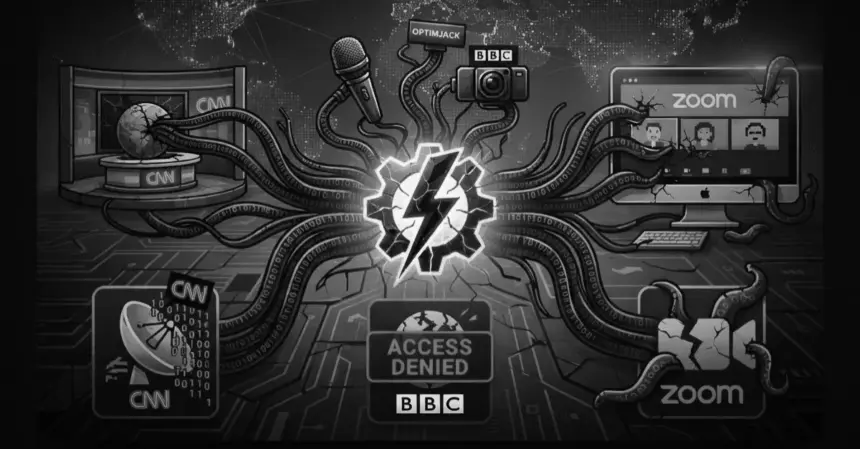
November 16, 2026 was a particularly turbulent day for digital infrastructure. On one side, millions of customers of major US banks struggled to access their accounts. On the other, a supply chain attack dubbed OPTIMJACK injected malicious code into Optimizely scripts used by major websites (CNN, BBC, Zoom, and more).

Sommaire
  • Disruptions at major US banks
  • The OPTIMJACK attack: malware injected via Optimizely
  • Context and lessons

Disruptions at major US banks

Thousands of customers of Chase, Bank of America, Wells Fargo and other institutions reported problems accessing their online services and certain transactions.

Reports on Downdetector peaked in the early afternoon (Eastern Time), with nearly 4,800 to 5,000 reports for Chase, mainly related to logins, balances and transfers. Bank of America exceeded 2,000 reports, while Wells Fargo and U.S. Bank logged anywhere from several hundred to more than a thousand. Difficulties were also reported at branches and ATMs.

Chase acknowledged the problem and attributed it to a software bug in its on-premise hardware systems, stressing that it was not a cyberattack. The bank said customers still had access to their funds, but that some transactions were taking longer to process. It added that the incident was not systemic: other banks were affected only when they were party to transactions with Chase (including via Zelle).

The other institutions broadly confirmed that their own systems were not directly affected. Reports dropped sharply in the evening. Around 6:30 p.m. ET, Chase said transactions were once again being processed normally. By the morning of November 17, services had returned to normal according to Downdetector.

The OPTIMJACK attack: malware injected via Optimizely

At the same time, a genuine supply chain attack hit Optimizely, the A/B testing and web experimentation platform. An attacker exploited a vulnerability in the sign-up flow for Experimentation accounts to inject malicious JavaScript into the “Project JavaScript” field of customer projects. This code was then served from Optimizely’s official CDN (cdn.optimizely.com) with a valid certificate, allowing it to pass as legitimate.

Scott Helme (Report URI) analyzed 1,611 Optimizely scripts and found 188 infected, belonging to 178 organizations. Affected sites include CNN, BBC, Zoom, Fox News, Salesforce, GitLab, HSBC, IKEA, Equifax, Ledger, Air France-KLM and Peacock.

The main payload (track.js, served from the malicious domain 1688360.cc) combined several functions:

  • Crypto address clipper: replacement of Bitcoin, Ethereum, Solana, TRON and other addresses in page text, forms and the clipboard.
  • Credit card skimmer: capture of card numbers, expiration dates and CVVs entered in forms.
  • Cookie theft and screenshots.
  • iOS exploit loader (the Coruna and DarkSword kits targeting certain iPhone and iPad versions).

The injection began early in the UTC day (first observed around 4:21 a.m. on the BBC snippet) and lasted about 17 hours. Cleanup was largely completed by the end of November 16: at 9:52 p.m. UTC, only one script remained infected (TalkTalk). Optimizely confirmed the incident on November 17, stating that it had blocked the vulnerable path, removed the injected code, secured the affected accounts and notified customers. Estimates put the amount of cryptocurrency diverted during the attack window at around $7,000.

Context and lessons

These two incidents, occurring on the same day, illustrate the fragility of modern technology dependencies. In the banks’ case, an internal bug had cascading effects through interconnected systems. In the case of OPTIMJACK, it was the trust placed in a third-party provider that enabled the mass distribution of versatile malware. Both events underscore the importance of monitoring third-party scripts, Content Security Policies (CSP) and the resilience of critical infrastructure.


Partager cet article
Whatsapp Whatsapp E-mail Copier le lien Imprimer
ParFarid N.
At a time when Morocco’s digital transformation is accelerating, protecting our digital assets has become an absolute national priority. As a cybersecurity expert, my mission is to secure Morocco’s digital space against emerging threats. I assist public and private organizations in building robust defense strategies capable of safeguarding our data sovereignty and ensuring the continuity of essential services.
Article précédent Pourquoi l’intelligence artificielle révolutionne la guerre moderne Why artificial intelligence is revolutionizing modern warfare
Article suivant Les exportations sud-coréennes d’armes au Maroc South Korean arms exports to Morocco
Laisser un commentaire

Leave a Reply Cancel reply

Your email address will not be published. Required fields are marked *

Silicon Valley

Soutenez notre média gratuit !
Don tech Maroc
maroc start-up morocco annuaire entreprise

Vous pourriez aussi aimer

Le F-16 américain bientôt équipé d’un missile hypersonique
MilitaryMoroccoUSA

Will Morocco’s F-16 soon be equipped with a hypersonic missile?

Par Foxtrot
Espagne OTAN, les risques d'une mise à l'écart diplomatique
MoroccoSpainUSA

Spain and NATO: the risks of diplomatic isolation

Par Julie - Sanchez
Comment on vit vraiment dans la Silicon Valley
TechUSA

What is life really like in Silicon Valley

Par Mohamed.D
Washington demande au Pentagone de clarifier ses projets militaires au Maroc
MilitaryMoroccoPoliticsUSA

Washington asks the Pentagon to clarify its military plans for Morocco

Par Esteban - F.
Silicon Valley Maroc – le mag tech marocain
Facebook X-twitter Rss Linkedin

A Propos

SiliconValley – le mag tech marocain se veut une plateforme indépendante gratuite dédiée à l’innovation, au numérique et aux nouvelles technologies au Maroc.

À la croisée de l’actualité tech internationale et des dynamiques locales, le magazine met en lumière les startups marocaines, les entrepreneurs, les talents, les innovations et les tendances qui façonnent l’écosystème tech national.

Analyses, décryptages, interviews et dossiers de fond : SiliconValley ambitionne d’informer, d’inspirer et de connecter une nouvelle génération tournée vers l’avenir, avec un regard moderne, critique et résolument marocain.

Categories

  • Dakhla
  • Casa
  • Marrakech
  • Tech
  • Rabat
  • Maroc
  • Plan du site
  • Contactez-nous

Liens Utiles

  • Bourse
  • Interview
  • MRE
  • Tests
  • Start-ups
  • Pub
  • Contact

Connectez-vous

Nom d'utilisateur ou adresse e-mail
Mot de passe

Mot de passe oublié ?