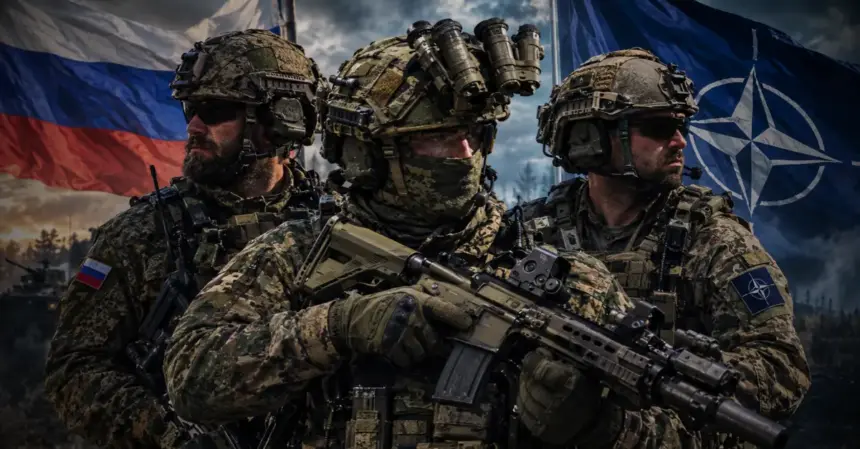
It also raises a more awkward question: if NATO is the stronger side, why do European capitals talk so much about sabotage, drones and nuclear threats? I wanted to separate what comes down to numbers, doctrine and speculation.
What NATO’s supreme commander says
On October 12, at the Warsaw Security Forum, US General Alexus Grynkewich warned that NATO would destroy “anything and everything” involved in an attack on its territory. The Alliance is defensive, he reminded his audience, but it would block, blunt and break any offensive, with strikes reaching well beyond the area under attack if necessary. According to the Wall Street Journal, relayed by Meduza, his “theory of victory” calls for a vast autonomous zone on the eastern flank, where drones and ground robots would slow a Russian advance without heavy human losses.
That does not mean he is predicting an imminent war. He considers a conflict between Russia and NATO neither imminent nor inevitable. Earlier this year, in Berlin, he said Moscow is not seeking direct confrontation, because the Alliance holds asymmetric advantages that are hard to match. This is where deterrence comes into play: the Alliance is not preparing in order to fight, but so that Moscow gains nothing from attacking.
Figures that favor the Alliance
On paper, the gap is considerable. The list below sets out the most recent data I was able to cross-check:
- Russian spending: the IISS puts it at $186 billion in 2025, or 7.3% of GDP, up from 6.7% a year earlier.
- Estimate from Germany’s BND for 2026: about €210 billion for Russia, against roughly €570 billion for NATO’s European members.
- European effort: Secretary General Mark Rutte says Europe and Canada reached 4% of GDP in 2026 by adding defense spending and related spending together.
- Alliance target: 3.5% of GDP for defense in the strict sense and 1.5% for related projects, by 2035.
- Ukraine: allies have pledged €70 billion in equipment, aid and training in 2026, and at least as much in 2027.
These figures do not share the same methodological basis. Rutte’s 4% includes spending that is not strictly military, and the Russian estimates rely on Western sources. The order of magnitude is nonetheless clear: in terms of combined GDP and budgets, the Alliance dominates, and that is without counting the United States in the BND’s case.
What the figures do not say
A budget is neither an army nor a victory. Several European weaknesses come up repeatedly in the analyses:
- Political coordination. IISS researcher Ruben Stewart judges that, on numbers alone, Europe has what it takes to face Moscow, but that its main vulnerability is political.
- Manpower. In an interview with Bloomberg, Grynkewich himself pointed to a shortage of fighters, who are often insufficiently trained and poorly paid.
- Uneven effort. Only Poland, Latvia and Lithuania had reached the 3.5% target in 2025. Other allies are still far from it.
- Russian adaptation. The IISS sees few signs of Russian weakening in the fifth year of the conflict, and its industry has refocused on mass production.
I would add a methodological caveat. Comparisons of tanks, aircraft or shells date quickly and do not lend themselves to simple addition across countries with different doctrines. A battle-hardened Russian army that produces continuously is not the equivalent of a European stockpile that is still being rebuilt.
Conventional superiority, a less likely war or a more dangerous one
The honest answer is: both, depending on the time horizon. An unfavorable balance of power normally deters the aggressor. Let us recall what Grynkewich himself says: Moscow knows that a conventional attack on the Baltic states would end in failure, so it probably will not attempt one.
But the same logic pushes the weaker side to change terrain. Alliance officials fear above all an escalation of hybrid warfare or small attempts at territorial nibbling on the eastern flank, rather than a full-scale invasion. Sabotage, drone incursions, cyberattacks: European governments accuse Moscow of stepping up these actions, which Moscow denies. This gray zone is precisely where superiority in tanks is of no use, because there is no uniformed enemy to destroy and no obvious response under Article 5.
There is a second, more insidious danger. The more the Alliance displays its ability to strike deep, as Grynkewich suggests, the more Moscow can read it as a threat to its own territory. One side’s defensive buildup is perceived as a threat by the other: specialists call this the security dilemma.
Nuclear weapons, the blind spot of the comparison
This is where conventional superiority loses most of its significance. According to SIPRI, Russia had 5,420 warheads in total in January 2026, of which 1,796 were deployed, its highest level since 2017. The United States fields about 1,770 deployed warheads, France 280 and the United Kingdom 120. On a strictly numerical level, the Western camp is therefore not lagging behind. The difficulty lies elsewhere.
First, the New START treaty expired in February 2026, which reduces transparency and verification mechanisms. Second, Russian doctrine was broadened in November 2024 to extend the cases in which the use of nuclear weapons could be considered. Finally, in September, Russia’s embassy in Ireland claimed that NATO was preparing a blockade of Kaliningrad, adding that Moscow would then use every weapon, nuclear ones included. Reuters says it has seen a Russian document addressed to NATO that carries the same warning.
Saying that a direct conflict would tip into nuclear war “within hours” is, however, speculation. No precedent allows it to be demonstrated, and several experts believe both camps would have an interest in keeping escalation under control. The risk cannot be measured: it weighs on every decision, and that is what makes conventional superiority less reassuring than it appears.
What role for China
Beijing is not a belligerent, but the Alliance regards it as a leading supporter of Russia’s war effort. At the 2024 Washington summit, member countries asked China to stop all material and political support for Moscow, in their firmest condemnation to date. China replied that it has never supplied lethal weapons to either side. The US ambassador to NATO, Matthew Whitaker, believes the war is being made entirely possible by China, which could end it with a single phone call. In July, France, the Netherlands, Poland and Germany again submitted to the EU’s foreign ministers a note on Beijing’s decisive support for Russia’s war of aggression.
In the event of a direct conflict between NATO and Russia, I see three possible roles for China, which belong to analysis rather than established fact:
- Discreet supplier. Electronic components, drone parts, machine tools: this support already exists and would continue, with growing pressure over sanctions.
- Economic lifeline. Chinese purchases of Russian oil remain a financial lung, as maritime tracking data cited by Bloomberg shows.
- Strategic diversion. A front opened in Europe would pull US attention and resources away from the Pacific, which would serve Beijing’s interests without direct involvement.
An open entry into the war by China alongside Moscow seems unlikely to me: it would expose its trade with Europe and the United States. But I cannot rule it out, and no source allows us to settle the question.
And the Mediterranean
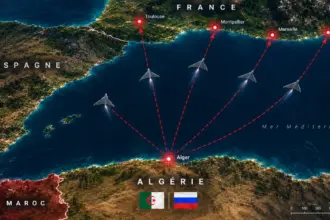
The Mediterranean basin is a secondary theater, but not a trivial one. It is the access route for the Russian fleet from the Black Sea, an area of Chinese influence through the port of Piraeus, controlled by COSCO, and a zone where energy and migration routes intersect. I have not verified the current state of Russian naval deployments in the Mediterranean: this point deserves a follow-up before publication.
An open conclusion
Yes, NATO is stronger than Russia on most measurable conventional indicators, provided it acts as a single alliance. That condition is what remains uncertain. The real question is not one of strength but of credibility: does the Kremlin believe the allies would respond, together and quickly, to an ambiguous nibbling attack? And on the Western side, is there a willingness to accept the nuclear risk that such a response carries? As long as those two points remain without a clear answer, superiority in numbers is not enough to guarantee peace.
FAQ
Would NATO win a conventional war against Russia?
The balance of forces and the budgets favor the Alliance, and its supreme commander says so publicly. But no one can predict the outcome of a conflict, which would depend on political cohesion, logistics and manpower.
Could Russia use nuclear weapons against NATO?
Moscow has issued repeated warnings, notably over Kaliningrad, and has 1,796 deployed warheads according to SIPRI. Use remains a hypothesis whose probability is impossible to quantify.
Would China intervene militarily?
Nothing points that way at this stage. Beijing denies supplying lethal weapons, but the Alliance accuses it of fueling Russia’s defense industry.
Where does the European defense effort stand?
Rutte announces 4% of GDP in 2026 for Europe and Canada, with a 5% target in 2035. Efforts remain very uneven from one country to another.