
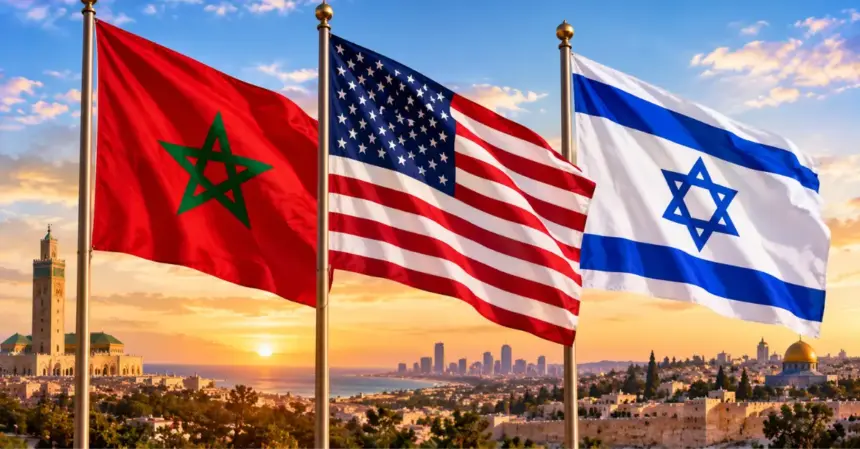
A Morocco USA Israel summit just took place in New York, and honestly, this is the kind of meeting I didn’t expect to see happen this fast in a three-way format. On Tuesday, September 16, 2026, Moroccan Foreign Minister Nasser Bourita, his Israeli counterpart Gideon Sa’ar, and US Ambassador to the United Nations Mike Waltz met on the sidelines of the UN General Assembly to formalize a series of concrete commitments, under Washington’s direct sponsorship. On the agenda: upgrading diplomatic relations to full embassy status, appointing ambassadors, and a package of economic agreements set to be finalized before year’s end.
I’m a writer, not a diplomat, but I’ve been following this file for a while, and what strikes me is the shift in language. This is no longer the cautious normalization of 2020 — this is the deliberate consolidation of a three-way strategic axis. Here’s what to take away from this meeting, and why it matters more than a routine protocol moment between foreign ministries.
What happened in New York on September 16, 2026
The format chosen was no accident: this wasn’t just another bilateral meeting, but a genuine Morocco USA Israel summit with three voices at the table, with the United States positioned as host and guarantor. This trilateral meeting took place the day after a reception hosted by Mike Waltz to mark the sixth anniversary of the Abraham Accords, attended by representatives from the United Arab Emirates, Bahrain, Kazakhstan, Morocco, and Israel. In other words, Rabat and Tel Aviv didn’t simply talk one-on-one — they did so under Washington’s explicit sponsorship, in a setting designed to show that the regional architecture born in 2020 keeps expanding.
The most concrete outcome announced at this meeting remains the commitment to upgrade diplomatic missions to full embassy status, with ambassador appointments to follow. Until now, the two countries operated through simple liaison offices: one in Tel Aviv on the Moroccan side, one in Rabat on the Israeli side. This intermediate arrangement, inherited from the late-2020 resumption of relations, had obvious practical limits, particularly for visa issuance and consular follow-up for citizens.
Sa’ar and Bourita were also expected to hold a separate bilateral meeting following the summit, a sign that the agenda goes well beyond symbolism. On substance, the joint statement points to a friendship between the two peoples rooted in shared history — a phrase that has recurred regularly in official Israeli rhetoric since 2020, but which carries particular weight here given the tense regional backdrop.
A new generation of economic agreements
What sets this summit apart from previous statements of intent is the timeline. All three parties set precise deadlines, not vague open-ended promises:
- Investment protection and double-taxation avoidance agreement: finalization targeted before the end of 2026
- Direct flights operated by Moroccan airlines between Morocco and Israel, building on the route already relaunched by Israeli carrier Arkia from Marrakech a few weeks earlier
- High-level bilateral visits scheduled between the two capitals in the coming months
- Upgrading liaison offices to full embassy status
That last point on flights deserves a closer look. The direct air link between Israel and Morocco had been suspended for nearly three years before a gradual resumption this summer. Having Moroccan carriers enter the picture now changes the nature of the traffic: it shifts from a route carried solely by an Israeli airline to genuine commercial reciprocity, which is structurally sturdier for a tourism and business market set to keep growing.
For a Moroccan tourism sector already in full swing, with more than 2.2 million seats scheduled in August alone across the network, opening a new air corridor to Israel fits a logic of diversification rather than a break from existing balances.
Why this breakthrough is happening now
My read, after following this file for several years: the timing is no UN-calendar coincidence. Two factors line up.
First, the Security Council deadline on the Western Sahara file is approaching, with a new report and resolution expected in October. Mike Waltz, in his role as US ambassador to the UN, is directly involved in drafting that text, and his personal involvement in this trilateral summit is unlikely to be unrelated to that parallel agenda. Consolidating the Rabat-Washington-Tel Aviv triangle just ahead of a sensitive multilateral deadline is a way of locking in diplomatic leverage beforehand.
Second, there’s a regional context that I personally find quite revealing of the current fault lines in the Arab world. The summit comes at a moment when tensions have surfaced publicly over other files, notably around Ceuta and Melilla, with notable positions taken as far as the US Congress on a possible mediation between Spain and Morocco. In this climate, consolidating a relationship where Moroccan national interests are clearly placed first, rather than subordinated to variable regional solidarities, fits a foreign policy doctrine Rabat has embraced for several years now: the Kingdom’s interests first, circumstantial alliances second.
What this actually changes for businesses and travelers
Beyond the diplomatic symbolism, this sequence carries very concrete implications for anyone tracking the region’s economy and tourism.
For businesses, the prospect of a double-taxation agreement finalized before the end of 2026 is a strong signal. It’s exactly the kind of text institutional investors wait for before committing bilateral capital flows, particularly in tech, agritech, and renewable energy — three sectors where Morocco and Israel have already identified complementarities since the first 2020 protocols.
For travelers, Moroccan airlines entering the Morocco-Israel route should, over time, affect fare competition and flight frequency. That said, some caution on the actual implementation timeline is warranted: past air agreement announcements between the two countries have taken longer than expected to move from a signed principle to operational flights.
FAQ
What does “upgrading relations to embassy status” mean?
It means converting the current liaison offices, which carry limited diplomatic status, into full embassies with an accredited ambassador appointed. This is the standard level of diplomatic relations between two sovereign states.
Since when have Morocco and Israel resumed relations?
The two countries signed a trilateral declaration with the United States in December 2020, formalizing the resumption of diplomatic relations alongside US recognition of Moroccan sovereignty over Western Sahara.
Are there already direct flights between Morocco and Israel?
Yes, a route was relaunched by Israeli carrier Arkia between Israel and Marrakech after nearly three years of suspension. The September 2026 summit aims to add flights operated by Moroccan airlines.
What’s the connection between this summit and the Western Sahara file?
US Ambassador Mike Waltz, present at the summit, is involved in preparing the Security Council report on Western Sahara expected in October 2026, giving this meeting a strategic dimension that extends beyond the purely bilateral Morocco-Israel framework.