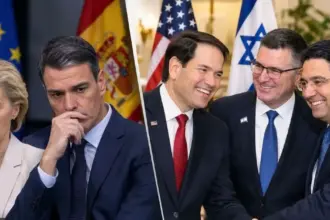

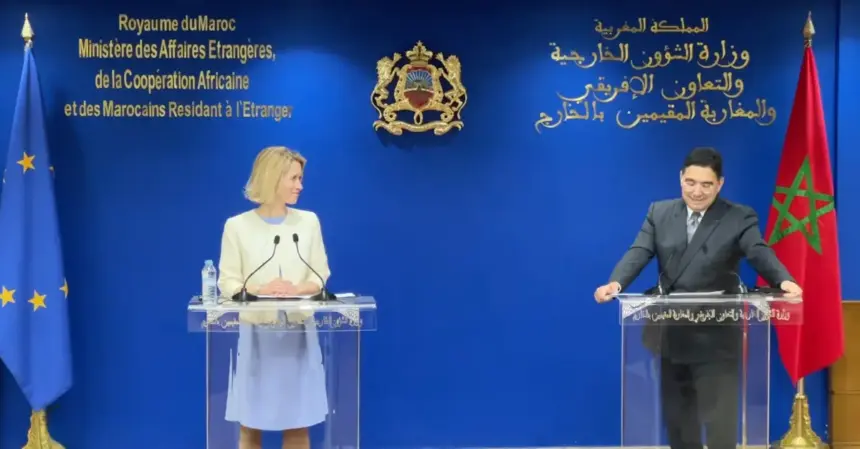
Monday’s meeting in New York between Nasser Bourita and Kaja Kallas belongs to the second category. On the sidelines of the 81st session of the United Nations General Assembly, Morocco’s Minister of Foreign Affairs met with the High Representative of the European Union for Foreign Affairs and Security Policy and Vice-President of the European Commission. The two officials welcomed the positive momentum in Morocco-EU relations and reaffirmed their determination to give new impetus to their partnership.
- Rabat has chosen to speak directly to Brussels
- Morocco no longer needs to go through Madrid to speak to Europe
- A partnership that Brussels itself describes as strategic
- And this is where Madrid has to face reality
- Brussels also recognizes Morocco’s weight in North Africa
- Morocco is moving on several fronts at once
- Europe is also looking to Morocco for the Mediterranean and Africa
- A development that complicates the Spanish reading of the issue
- Morocco can look toward Brussels without asking for permission
- FAQ
For Madrid, the message is difficult to miss. Morocco is not waiting for Spain to open the doors of Europe for it. Rabat is talking directly to European institutions.
That distinction is essential. Spain is a member state of the European Union. Brussels, by contrast, represents an institutional framework whose role extends far beyond relations between two individual countries. By strengthening this direct channel, Morocco is demonstrating that it intends to deal with Europe at the institutional level, without making its European strategy dependent on a single capital.
And this development did not begin on Monday.
Rabat has chosen to speak directly to Brussels
On January 29, 2026, the 15th EU-Morocco Association Council was held in Brussels. The meeting was co-chaired by Kaja Kallas and Nasser Bourita, while the European Commission was represented by Commissioner for the Mediterranean Dubravka Šuica.
The substance of that meeting was particularly revealing.
Both sides reaffirmed their determination to relaunch and deepen their partnership, thirty years after the signing of the 1996 EU-Morocco Association Agreement. The dialogue covers areas including trade, investment, innovation, the green transition, migration, security, research and socio-economic development.
In other words, Rabat is not simply building a relationship with a handful of European governments. It is working on the institutional framework that governs a significant part of its relations with the continent.
That is precisely what gives the current sequence its particular political significance.
Morocco no longer needs to go through Madrid to speak to Europe
For years, some interpretations of Morocco’s relationship with Europe have placed disproportionate emphasis on national capitals. Under that reading, Madrid could appear almost like the natural gateway between Rabat and the rest of Europe.
The institutional reality of the European Union is different.
Morocco can engage with European governments, but it can also negotiate directly with European institutions when the issues concerned fall within the EU’s areas of competence.
The meeting between Bourita and Kallas is a particularly clear illustration.
The EU High Representative is not a Spanish official tasked with representing Madrid. She acts on behalf of the European institutions within her areas of responsibility. The European Commission, meanwhile, has major powers in areas such as trade, economic affairs and cooperation.
For Rabat, this institutional structure offers an obvious opportunity: defend its interests directly with the relevant European actors.
And that is precisely what Morocco appears to be doing.
A partnership that Brussels itself describes as strategic
The most interesting aspect of this development is not Moroccan communication. It is the language used by the European Union itself.
In the joint statement issued following the January 29 Association Council, Brussels and Rabat reaffirmed the importance of a partnership described as strategic, multidimensional and privileged. Both sides also announced their intention to raise its ambitions and make greater use of its potential.
The Council of the European Union also describes Morocco as a strategic and key partner for the EU in its Southern Neighbourhood.
This institutional recognition matters.
It means that the relationship with Morocco is not being treated as a secondary bilateral issue. It is part of the European Union’s policy toward its Southern Neighbourhood and involves issues directly affecting the Union.
For Rabat, this represents a particularly advantageous position.
The Kingdom can now advance its agenda directly with European institutions on issues as sensitive as investment, energy, security, migration, research and infrastructure.
And this is where Madrid has to face reality
The title of this article is deliberately provocative: “Madrid will have to get used to it.”
It does not mean that Spain has disappeared from Morocco’s European strategy. It means something more precise: Madrid cannot claim to be the only gateway between Rabat and Europe.
Morocco’s diplomacy has demonstrated this once again.
Nasser Bourita engages directly with the EU High Representative. Morocco participates directly in the EU-Morocco Association Council. Discussions directly address the future of the partnership with the European Union.
There is therefore no institutional reason for Rabat to limit its European strategy to relations with Madrid.
And this ability to multiply channels is precisely one of the strengths of Moroccan diplomacy.
The Kingdom can defend its interests in Rabat, Brussels, European capitals, Washington, Beijing and with its African partners. This diversification mechanically reduces the possibility for any single interlocutor to present itself as indispensable.
Brussels also recognizes Morocco’s weight in North Africa
Another element of the January 29 joint statement deserves attention.
The European Union states that Morocco remains its largest beneficiary of EU funding in North Africa. The document refers to approximately €270 million per year over the 2021-2024 period in bilateral allocations and EFSD+, alongside structural investments supported notably by the European Investment Bank and financial institutions from EU member states.
This figure obviously does not provide a comprehensive measure of a country’s political importance. But it does provide a concrete indication of the depth of the relationship.
The partnership is therefore not merely diplomatic.
It is also built on financial, economic and institutional mechanisms.
For Morocco, this represents an additional lever for attracting investment, financing projects and strengthening its capabilities in strategic sectors.
For the European Union, it also reflects a desire to maintain a structured partnership with Rabat.
Morocco is moving on several fronts at once
This is probably the most interesting aspect of Morocco’s strategy.
Rabat is not simply seeking to improve relations with one European country or one international institution. The Kingdom is developing several channels simultaneously.
On the European front, it is deepening its institutional partnership with Brussels.
In Africa, it is seeking to strengthen its role in economic exchanges and regional initiatives.
On the Atlantic front, it is developing a vision connecting Africa, Europe and the maritime space.
Diplomatically, it is multiplying partnerships in order not to depend on a single bloc or capital.
This diversification provides an obvious strategic advantage: when a country has several interlocutors and several channels of cooperation, it increases its ability to defend its interests.
The 2026 Morocco-EU sequence fits squarely into this logic.
Europe is also looking to Morocco for the Mediterranean and Africa
This is where the development goes beyond bilateral relations.
The joint statement from the Council of the European Union does not focus exclusively on bilateral issues. Brussels and Rabat also emphasize cooperation in the Euro-Mediterranean area and with African partners.
The two sides discussed the Atlantic African States Initiative and the Global Gateway strategy. The European side also welcomed Morocco’s role in regional cooperation initiatives.
This point deserves serious attention.
Morocco is no longer presenting itself solely as Europe’s southern neighbour. The Kingdom is seeking to position itself as a connecting point between several spaces: Europe, Africa, the Atlantic and the Mediterranean.
Its geographical position has become a diplomatic and economic asset.
And Brussels appears increasingly willing to incorporate that position into its own regional strategy.
A development that complicates the Spanish reading of the issue
This is precisely where the relationship with Madrid becomes politically interesting.
Part of the Spanish debate surrounding Morocco can be viewed through the bilateral lens: borders, migration, trade, the Sahara, fisheries or security.
But the relationship between Rabat and Brussels is much broader.
It places issues on the table that extend beyond Spanish interests alone.
When the discussion concerns European investment, Mediterranean policy, regional security, innovation, the energy transition or cooperation with Africa, Madrid cannot, by itself, define Europe’s position.
That is the normal consequence of how the European Union operates.
And Morocco appears to have fully understood this reality.
The strategy is therefore becoming less about convincing a single European capital and more about developing a direct relationship with the European institutional system as a whole.
Morocco can look toward Brussels without asking for permission
This is probably the simplest conclusion to draw from this latest diplomatic sequence.
Morocco does not need to choose between European capitals. It can engage directly with Brussels while simultaneously developing relations with individual member states.
But the new element is that the relationship with the European Union has become sufficiently structured to constitute a diplomatic axis in its own right.
The meeting in New York between Nasser Bourita and Kaja Kallas comes after the January Association Council and the High Representative’s working visit to Rabat in April. The two officials explicitly highlighted this continuity and their determination to use the current momentum to give additional impetus to the partnership.
For Madrid, the conclusion is therefore difficult to avoid: Morocco speaks directly to Brussels.
And Brussels speaks directly to Morocco.
This is not a break with European capitals. It is a change of scale.
Morocco no longer waits for a member state to act as an intermediary before making its interests heard within the European Union.
It presents itself directly to European institutions, negotiates directly with them and is building with them a partnership that both sides now want to make more strategic.
Madrid will therefore have to get used to it.
Europe is not synonymous with Spain.
And Morocco has clearly understood that.
FAQ
Why is the meeting between Nasser Bourita and Kaja Kallas important?
It confirms the continuation of direct dialogue between Morocco and the European institutions following the EU-Morocco Association Council held in January 2026.
Is Morocco trying to bypass Spain?
It is more accurate to say that Rabat is diversifying its European channels. The Kingdom maintains direct dialogue with EU institutions without depending on a single member state.
What are the main areas of the Morocco-EU partnership?
The partnership covers trade, investment, security, migration, innovation, the green transition, research and socio-economic development.
Why does Brussels attach importance to Morocco?
European institutions consider Morocco a strategic partner in the EU’s Southern Neighbourhood and highlight its role in Euro-Mediterranean and African cooperation.