

The announcement put an end to months of speculation over the exact scope of the program and marks a further step in the renewal of Morocco’s heavy-rotor fleet.
A confirmed contract, still-partial details
France’s Ministry of the Armed Forces confirmed the existence of the contract in its 2026 report to Parliament on arms exports, specifying that it entered into force during 2025. The document does not break out the specific value of the ten-Caracal order, but it offers a telling overall indicator: French arms orders originating from Morocco jumped to €532.1 million in 2025, up from €13.1 million the previous year. That figure, however, aggregates all arms orders placed by Rabat over the year and cannot be attributed solely to the Caracal program. The same report cites €83.3 million in French arms deliveries to Morocco in 2025, along with 42 export authorizations issued during the period.
Neither Airbus nor Moroccan authorities have disclosed the final contract value, and no delivery timeline has been made public at this stage. These details are expected to emerge gradually as maintenance and logistical-support discussions progress, and through future French reports on the execution of arms export contracts.
A negotiation spanning more than a year
Talks between Paris and Rabat intensified markedly ahead of French President Emmanuel Macron’s state visit to Morocco in October 2024. At that time, the Kingdom was reportedly considering a larger fleet of around 18 aircraft, valued at an estimated €600–800 million. No defense agreement was formalized during that presidential visit, however. Discussions continued for several months over technical specifications, fleet size, and commercial terms, before culminating in a scaled-down order of ten units, officially unveiled in Dubai.
This more modest format compared with the initial ambitions should not be read as a retreat: it instead reflects an adjustment of Moroccan operational and budgetary needs, in a context where several acquisition programs are being pursued simultaneously. The choice of the Caracal was also made in a competitive environment. The United States had actively promoted the Sikorsky S-70i Black Hawk, seeking to capitalize on its close defense relationship with Rabat. Morocco nonetheless maintained a strategy of supplier diversification, opting for the European platform.
An aircraft built for versatile missions
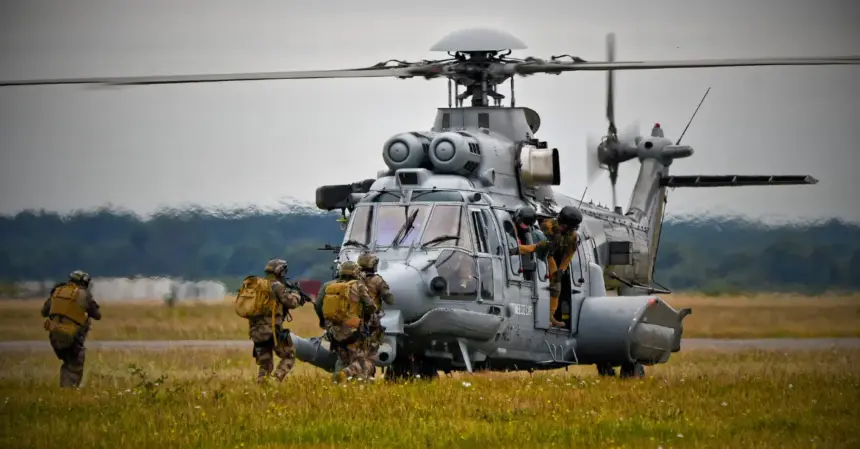
The H225M is a twin-engine helicopter from the Super Puma/Cougar family, which entered service in the mid-2000s. Designed for tactical transport, combat search and rescue (CSAR), special operations, and medical evacuation, it has, according to Airbus technical data, a maximum take-off weight of roughly 11 tonnes, a top speed of 324 km/h, and a maximum range of up to 1,253 km with supplementary fuel tanks.
A few figures help situate the aircraft:
- Troop capacity: up to 28 fully equipped soldiers, or several casualties in medevac configuration
- Standard range: approximately 920 km, extendable to 1,253 km with additional tanks
- Payload: 4,750 kg
- Aerial refueling: capability suited to extended-duration missions, notably alongside the A400M
The aircraft is also designed to operate day and night and in degraded weather conditions, thanks to systems adapted for low-altitude flight.
A configuration close to export standards
Based on available information, Morocco’s Caracals are expected to feature a configuration comparable to those delivered to other export customers: a dual-hoist system for rescue operations, a searchlight, and a Safran Euroflir 410 electro-optical and infrared turret for day and night surveillance. Door-mounted machine guns are expected to equip the aircraft, and Airbus offers an optional electronic-warfare self-protection system capable of detecting radar, laser, and missile threats and deploying countermeasures. Depending on the configuration chosen, the H225M can also carry rocket pods, additional machine guns, and, on certain export variants, guided missiles.
These aircraft will replace Morocco’s Puma fleet, in service for more than forty years, whose progressive obsolescence had made renewal necessary to maintain combat search-and-rescue and special-operations capabilities within the Royal Air Force.
A deepening defense partnership
Morocco is not a new user of the Airbus range: the Royal Gendarmerie already operates the H225 Super Puma, a heavy civil and paramilitary variant from the same family. The Caracal order therefore extends an existing industrial relationship rather than opening a new one, and fits within a broader helicopter-fleet modernization program that also includes the reception of light H135M training helicopters since 2023 and, in parallel, the delivery of Boeing AH-64 Apache attack helicopters from the United States.
This contract comes against a more favorable political backdrop between Paris and Rabat. France’s recognition of Moroccan sovereignty over Western Sahara in 2024, followed by Macron’s state visit that October, helped restore high-level political and military contacts after a period of tension. A joint armaments committee, established in July 2024, was set up to develop industrial and technical cooperation between the two countries. Paris and Rabat are also examining the creation of a maintenance, repair, and overhaul (MRO) center on Moroccan soil, which could eventually support the new Caracals and, potentially, other operators in West Africa. Airbus has indicated that such a center would also benefit the roughly sixty Airbus helicopters already in service across Morocco’s air force, navy, and gendarmerie.
Outlook
French-Moroccan military cooperation now spans a broad spectrum: joint exercises, special-operations training, counterterrorism, military medicine, logistics, and maritime security. The Caracal acquisition fits within this wider framework more than it stands as an isolated transaction. Key developments to watch include the publication of a delivery timeline, the structuring of the future Moroccan MRO center, and the details that upcoming French reports will provide on contract execution — particularly its financial dimension, which remains undisclosed to date.
FAQ
How many Caracal helicopters did Morocco order?
Ten H225M Caracals, according to Airbus Helicopters’ announcement of November 18, 2025.
What is the value of the contract?
It has not been disclosed. France’s 2026 Ministry of the Armed Forces report does not break out this figure, which is distinct from the €532.1 million in total French arms orders placed by Morocco in 2025.
Which aircraft will the Caracals replace?
The Royal Moroccan Air Force’s Puma fleet, in service for more than forty years.
Why didn’t Morocco choose the American Black Hawk?
Despite active promotion of the Sikorsky S-70i by Washington, Rabat favored continuity with its existing Airbus fleet and a strategy of diversifying its defense suppliers.