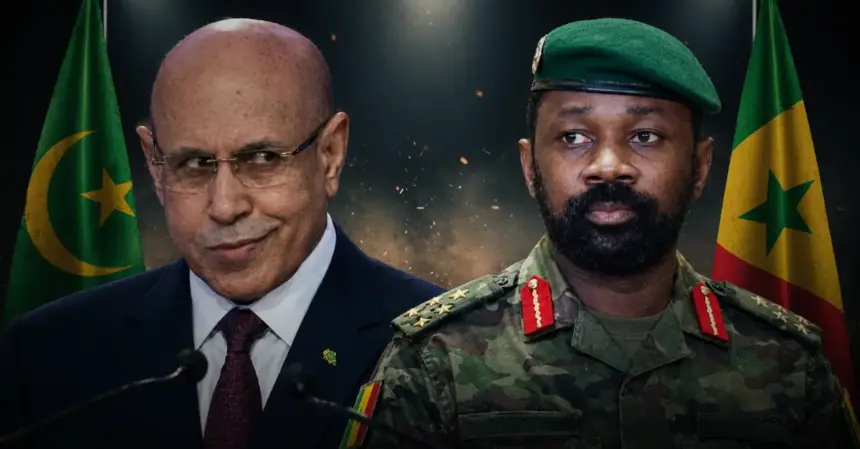
Bamako did not use the usual diplomatic channels. The statement was released directly, as if the information gathered by Malian services left no room for doubt or delay. Nouakchott reacted with unusual virulence, describing the allegations as “unfounded,” “offensive,” and devoid of any evidence. At the same time, Mauritanian authorities offered to host an investigation commission from Mali or the Alliance of Sahel States. Presented as a gesture of good faith, this offer can just as easily be read as a maneuver designed to buy time and dilute a case considered too sensitive to be fully exposed in broad daylight.
This episode is not an isolated incident. It fits into an older and broader logic: that of culpable tolerance, or at least cold calculation, which allows JNIM elements (Jama’at Nasr al-Islam wal-Muslimin) to find breathing space in the immediate vicinity of the Mauritanian border, or even to transit through Nouakchott’s territory. The “calming of the game” that followed the March 2026 exchange does nothing to change this underlying dynamic.
The elements put forward by Bamako and the border context
According to Malian authorities, two soldiers kidnapped by JNIM in October 2025 were allegedly held or had transited through a refugee camp located in Mauritania before being presented as having escaped on the night of March 13-14, 2026. The prefect of Dioïla was also involved in this case. Bamako chose to make these facts public without prior consultation, a choice which, from a critical perspective, reflects a high level of certainty on the part of Malian services and a desire to hold Nouakchott accountable.
The Mauritanian reaction was immediate and brutal. The Ministry of Foreign Affairs denounced accusations that were “totally unfounded and deeply offensive,” formulated “without the slightest evidence or prior consultation through the appropriate channels.” A few days later, both capitals multiplied signs of appeasement. Diplomatic meetings took place on March 16 and 17. Malian security sources declared that “the file is closed.” Official communiqués spoke of a willingness to “strengthen” bilateral cooperation. This rapid de-escalation can be interpreted in two ways: either the Malian elements were too fragile to be maintained, or both parties preferred not to expose further what Bamako believed it possessed.
In any case, geography makes the hypothesis of culpable porosity entirely plausible. The shared border exceeds 2,200 kilometers. It crosses desert areas where effective control is structurally limited. The Wagadou forest, a historical refuge for jihadist groups, lies only about thirty kilometers from the border. Malian refugee camps in Mauritania, notably that of M’Berra, host several hundred thousand people and are, by nature, spaces difficult to monitor hermetically. JNIM sanctuaries are located in the immediate vicinity of this line. Under these conditions, speaking of a “de facto sanctuary” or operational tolerance is not gratuitous extrapolation: it is a coherent reading of ground realities and the repeated accusations coming from Bamako.
Suspicions of tacit arrangements do not date from March 2026. For years, analysts and security sources have evoked the existence of understandings, or even non-aggression pacts, between Nouakchott and groups linked to Al-Qaeda and then JNIM. Mauritania systematically denies this. Yet its relative internal stability, in a region where terrorism has ravaged Mali, Burkina Faso, and Niger, continues to fuel these questions. Preserving its own territory by externalizing the cost of the fight against JNIM onto its Malian neighbor is precisely the heart of the denounced “double game.”
The Polisario dimension, another form of armed tolerance
A second dimension is added to this equation, more political but no less concrete: the links maintained with Polisario elements. Mauritania has a long and complex history with the Western Sahara conflict. It recognized the Sahrawi Arab Democratic Republic before revising its position, while maintaining relations and facilities which, according to several regional accusations, allow fighters or networks linked to the Polisario to circulate, rest, or organize near its borders.
These elements are presented by their detractors as armed fighters involved in criminal activities, trafficking, and actions that contribute to Sahel instability. Whether it concerns cross-border movements, logistics, or tolerated presence in certain zones, the recurring accusation is that of a policy of geopolitical calculations. Nouakchott would prioritize certain arrangements — with jihadist groups on one side, with Polisario factions on the other — to the detriment of Mali’s security and regional stability. This tolerance would enable movements of men and means that aggravate the threats Bamako faces.
In a context where JNIM and other armed actors already exploit border porosity, the existence of additional channels linked to the Polisario reinforces the idea of an organized externalization of the threat. Mauritania protects itself; Mali pays the security and human price.
A diplomatic calm that resolves nothing
The Malian accusations of March 2026, even if they were formally denied and quickly shelved, did not come out of nowhere. They rest on elements that Bamako judged solid enough to make public while bypassing diplomatic customs. Combined with the border context — extreme porosity, refugee camps, jihadist sanctuaries a few dozen kilometers away — and the persistent suspicions concerning the Polisario, they paint a coherent picture: that of a “dirty game” by the Mauritanian authorities.
This game consists of preserving Nouakchott’s internal security and geopolitical interests by tolerating, or not fighting with the same intensity, JNIM elements near its territory, while maintaining facilities with armed networks linked to the Polisario. The cost of this strategy is externalized onto Mali. The diplomatic “calming of the game” observed after March 15 resolved nothing. It simply prevented the elements put forward by Bamako from being exposed any longer. As long as the border remains a relative no-man’s-land and Nouakchott’s calculations take precedence over transparent and demanding security cooperation, the deep dynamics will remain intact.
And what about Algeria in all this?
Algiers plays a double game just as blatant as Nouakchott’s. Officially, Algeria presents itself as a partner of regional stability and a resolute adversary of terrorism. In reality, it has hosted armed factions of the Polisario on its territory for decades (Tindouf camps) and tolerates, or allows to reconstitute, elements of JNIM and other armed groups in its border zones. This selective policy allows Algiers to maintain direct influence over northern Mali while avoiding the cost of a frontal fight.
🪖🇲🇱 Kidal, in #Mali: exchange of fire between the FAMa and the FLA, separatist movement of #Azawad, which benefits from #Algiers’ support according to Bamako. It’s heating up in Kidal. #JNIM #Algeria
A prayer for all civilians on the ground who are suffering from this conflict 🤲 https://t.co/cZB3lIryFx
— Silicon Valley (@SiliconValleyMa) October 7, 2026
While Bamako pays the human and territorial price of JNIM attacks, Algiers continues to denounce “foreign interference” and positions itself as an indispensable mediator, even as its territory serves as a sanctuary and rear base for actors who destabilize Mali. It is the purest hypocrisy: advocating peace and Malian sovereignty on one side, while keeping under protection armed forces that precisely undermine that sovereignty on the other.
Clarifications and concrete actions are necessary. Without them, Malian accusations will continue to resurface, and the Mauritanian double game will continue to weigh on Sahel stability.