

The European Border and Coast Guard Agency recorded nearly 75,000 irregular crossings at the European Union’s external borders between January and August 2026, 35% fewer than over the same period in 2025. Only one major corridor escapes this decline: the one linking the Algerian coast to Spain. We set out to understand what this exception says about border-control policies, smuggling networks and the balance of power between Algiers, Madrid and Brussels.
Key takeaways
- Irregular arrivals at EU borders fell 35% between January and August 2026.
- The Western Mediterranean route, departing from Algeria, rose 34%.
- Frontex points to a displacement of departures after tighter controls elsewhere, notably in Morocco.
- A little over 40% of migrants on this route are Algerian nationals.
- The human toll remains heavy, and an Algerian-Spanish meeting is scheduled for October.
A real decline on most routes
The trend is not new. In the first half of the year, Frontex was already counting 49,000 irregular entries, down 37%, with flows in West Africa collapsing by 67%. The first eight months confirm this momentum on the main access routes.
The Eastern Mediterranean, the busiest route, recorded more than 24,200 crossings, 25% fewer than a year earlier. The Central Mediterranean, which leads to Italy, saw around 19,400 arrivals, down 55%. Arrivals to the Canary Islands fell by 58%. For the Old Continent, this is apparently good news. European governments, which have multiplied agreements with departure and transit countries, can see it as validation of their strategy of externalising border controls.
This reading calls for caution, however. Frontex counts detections of crossings at the border, not distinct individuals, and its provisional figures are revised afterwards. A fall in these detections does not mean that the causes of departures (conflict, poverty, political instability) have disappeared.
Selon l’agence Frontex, le nombre d’arrivées irrégulières vers l’Union européenne est en baisse sur toutes les routes migratoires depuis les côtes africaines… sauf au départ de l’Algérie. pic.twitter.com/roa44rPG6h
— TV5MONDE Info (@TV5MONDEINFO) October 2, 2026
An Algerian exception that is taking shape
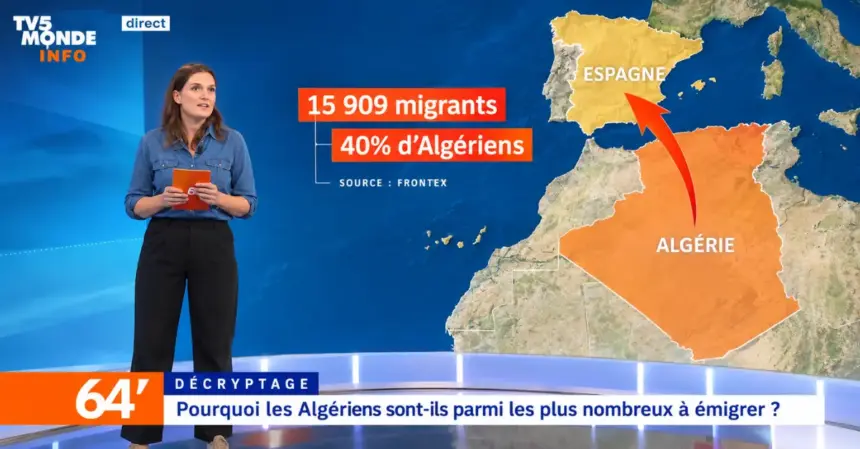
On the Western Mediterranean, the picture is reversed. Frontex recorded around 15,900 detections there, 34% more than a year earlier, with a peak in July, a monthly record over three years, before a slowdown in August. The increase had already emerged earlier in the year: it stood at 17% at the end of the first half, with Algeria becoming a leading departure point.
A simple calculation based on the published figures gives the order of magnitude. The overall decline represents around 40,000 fewer detections, while the increase on the Algerian route adds only a few thousand, in the region of 4,000. The general decline therefore remains overwhelmingly dominant. But this exception matters, because it focuses attention on a single departure country.
A distinction must also be made between the country of departure and the nationality of the migrants. Of the 15,909 people who took this route, 6,654 are Algerian nationals, a little over 40%. The rest of the flow is therefore made up of other nationalities transiting through Algeria. According to Le Monde, Algerians are the third most represented nationality among irregular entries into Europe this year, behind Bangladeshis and Sudanese.
The phenomenon also extends beyond Spain. According to UNHCR, 2,498 people who left Algeria had arrived in Sardinia by the end of September, compared with 983 a year earlier. In the Balearic Islands, 5,344 people had reached the archipelago aboard 308 boats as of 8 September.
Why departures are shifting
The explanation put forward by Frontex comes down to one word: displacement. Tighter controls elsewhere appear to have redirected part of the departures. The agency estimates that stricter controls in Morocco contributed to shifting some departures towards the Algerian coast. Prevention measures on the West African and Central Mediterranean routes are said to have worked in the same direction.
This mechanism is well known to migration specialists: when one route closes, smuggling networks open another, often longer or riskier. It raises a fundamental question about the effectiveness of deterrence policies. They can reduce flows on a given axis without extinguishing them, by shifting them to areas where cooperation is less developed. Some restraint is nonetheless needed. The motivations of those seeking to leave, economic conditions in Algeria and the role of local networks also come into play, and Frontex does not attribute the increase to a single factor.
A file that has become diplomatic
For Spain, the stakes are both migratory and political. The Spanish prime minister was received on 20 July by President Abdelmadjid Tebboune, but the joint declaration remained general on migration: it mentions the legal movement of people and security coordination, with no figures or readmission timetable made public on the Algerian side. That visit relaunched a relationship long paralysed by the diplomatic crisis that began in 2022. A high-level Algerian-Spanish meeting is scheduled for October. The migration file will probably feature alongside energy and investment.
Algiers, for its part, advertises its willingness to act on its coastline. On 7 August, an operation coordinated by Europol, involving Algeria, Spain, France, Portugal and Poland, led to 78 arrests and the dismantling of a network that used boats in both directions. The Algerian authorities are also continuing their cooperation with the International Organization for Migration on voluntary returns. Still, these announcements have not, at this stage, produced any verifiable quantified commitment on controlling departures or on readmission.
The issue also weighs on relations with Italy and France, two countries directly affected by these flows, each with its own disputes with Algiers over the readmission of nationals in an irregular situation. The Algerian route thus becomes a test of the Union’s ability to negotiate with an important energy partner while demanding more controls.
The human cost remains heavy
Crossing statistics say nothing of the price paid. According to the IOM, 2,253 people have died or gone missing since January while trying to reach Europe, including 434 on the Western Mediterranean route alone and 995 in the Central Mediterranean. The organisation Caminando Fronteras, for its part, recorded 507 dead or missing on the Algerian route during the first five months of the year, 54.6% more than a year earlier.
These figures rely on different methodologies and are not directly comparable. They nonetheless converge on one point: the fall in arrivals is not accompanied by a proportional fall in the danger of the crossings, particularly on a route where boats are often light and the distance long.
What the figures do not say
Several grey areas remain. First, sources diverge depending on scope and period. Spanish data show, as of 31 July, 8,222 sea arrivals in Spain and the Balearic Islands, against 7,077 a year earlier, an increase of 16.2%, a more modest figure than Frontex’s, which covers a different period and includes other entry points. Second, the surge in July, followed by a decline in August, does not allow us to conclude that a trend is established. Weather conditions, very influential at sea, explain part of the monthly variation.
Finally, the political question remains open. If the shift towards Algeria is confirmed, Europeans will have to choose between demanding cooperation with Algiers and a new phase of route displacement, with no guarantee that the current decline will last. A policy based on the successive closing of routes finds one of its limits here. It remains to be seen whether the October talks between Madrid and Algiers will answer it with anything other than statements of intent.
Key figures
- Nearly 75,000 irregular crossings at EU borders between January and August 2026, down 35%
- Canary Islands, down 58%; Italy, down 55%; Greece, down 25%
- Western Mediterranean, around 15,900 detections, up 34%
- 6,654 Algerian nationals out of 15,909 people, a little over 40%
- 434 dead or missing on the Western Mediterranean route according to the IOM
FAQ
Does the decline in arrivals concern the whole of Europe?
It concerns all of the EU’s external borders, with 35% fewer irregular crossings over eight months. The Western Mediterranean route, departing from Algeria, is the exception, with a 34% increase.
Why is the Algerian route growing?
Frontex points to a displacement effect: tighter controls in Morocco and on other routes would have shifted departures towards Algeria. Local factors also play a part, but the agency does not quantify them.
Where does cooperation between Algeria and Spain stand?
The two countries relaunched their dialogue in July, but no quantified commitment on readmission or on controlling departures has been made public. A high-level meeting is scheduled for October.