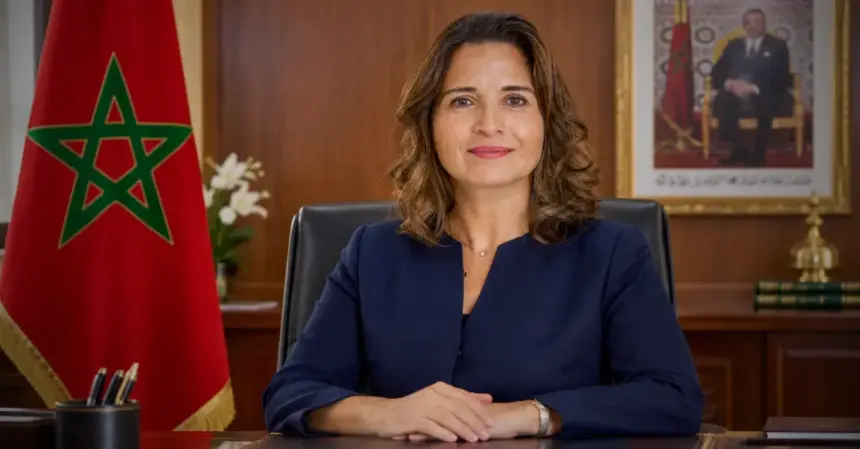
A country aiming for more than 52% renewables in its installed electricity capacity by 2030, developing green hydrogen for Europe, while remaining heavily dependent on fossil fuel imports. What struck me when listening to Leïla Benali is that this ambition is not limited to megawatts. She speaks of a democratic tool: the ability for every citizen to produce and consume energy when they want, from where they want, and from whom they want.
Appointed on 7 October 2021 by King Mohammed VI, the engineer trained at the École Mohammadia and Centrale Paris, holder of a PhD in economics from Sciences Po under the supervision of Jean-Paul Fitoussi, arrives with twenty years of international experience. At CERA (later IHS), at Saudi Aramco, at Apicorp, then as chief economist of the International Energy Forum. She has lived through negotiations, markets, and geopolitical shocks. She has also lived through personal ruptures that, she says, have calibrated the way she decides.
The trials that calibrate the gaze
Casablanca in the 1980s–1990s, a city in expansion, working-class neighborhoods. Then the first meeting in English, just before the Iraq war, where the young Moroccan who had learned the language through music had to “give a briefing” on Iraqi oil. The terrains of the Middle East, where she discovers physical violence, not only symbolic. The night in 2009 when, as a doctoral student, full-time employee and young mother, she closed her computer at 7 a.m. to give her daughter a bottle.
The most foundational moment remains the cranial trauma of 2014. “God gave me a second chance by telling me, don’t waste it this time, Leïla.” She recounts waking up thinking she would end up “like a vegetable.” Convalescence forces perspective. What was urgent becomes trivial. This sense of a second chance has never left her. She also links it to the story of Siamak Namazi, the Iranian-American expert imprisoned for eight years in Iran, whose resilience accompanied her: “The only difference between him and me is that he was born in Iran, I was born in Morocco.”
These experiences are not anecdotes. They explain a stance: indecision costs more than an imperfect decision, especially when it affects thousands of families.
Taking one’s place in still male-dominated worlds
In the energy, finance and security sectors, women remain a minority in decision-making positions. Benali describes the internal monologue, the impostor syndrome, the need to “silence” that voice in order to speak when the figures or the values justify it. “If the figures show me that what I think is right, then I speak. If the values I defend seem right… I bang my fist on the table. Always with tact.”
She mentions the 2024 attacks on her private life, her integrity “as a woman, my physical and gender integrity.” Episodes widely documented in the Moroccan and international press, linked to rumors involving an Australian businessman in the green energy sector; she denied being the person in the circulating photograph and received support from women’s rights leagues. She notes, without illusion, that a man will be attacked on corruption, a woman on her private life or her body. She refuses, however, to treat it as inevitable: “I will not change the fact that I am a woman.”
Deciding without perfect information
From the business world, she retains the ability to decide with 60 or 80% of the information. “Perfect information will never exist.” This conviction has collided, at the ministry, with cultures of wait-and-see and successive commissions. She accepts having been called “hot-headed” or “divisive.” Impudence, she says while recalling the letter she read to her thesis supervisor, must be nurtured when it serves what seems just.
The advance of which she is most proud is PERG 2.0. The Global Rural Electrification Program had already brought the rural electrification rate to nearly 99.8%. The most isolated villages remained. After the 2023 earthquake, rather than waiting for classic lines whose geological studies promised long delays, her teams accelerated solar mini-grids with batteries. She speaks of a “kick in the anthill” made possible by the disaster, and of the pride of seeing the installations work. In the same logic, energy efficiency bonuses aim to give households and industrialists a concrete lever over their bills.
Her regret concerns the environment and waste management. Too much time spent in consultations to align all stakeholders. “The cost of inaction, the cost of consultation is exponential in the environment sector.” A poorly managed landfill, leachates, an impact on water and populations: “It is simply unforgivable.” She notes, however, the strengthening of the environmental police, now equipped with drones.
Public service as an issue of sovereignty
Benali insists on a point rarely highlighted in transition narratives: the quality and protection of the territorial administration. The ministry suffered from the voluntary departures of 2004–2005 and must manage heavy files (mines, environment, energy) in a context of deconcentration. She has seen officials threatened, tempted by corruption, or simply helpless in the face of concrete human issues.
It is in this context that she recently created the Najaa association. The idea is to strengthen public service where neither the state nor the private sector is sufficient: to train, protect, and recognize these “last samurai” who still carry an ethic of service despite frozen salaries. She announced that she had committed part of her ministerial salary as seed funding, to rule out any suspicion of personal interest. The initiative remains young; its effectiveness will be measured by its ability to create a real space of trust.
Empathy, courage and regional projection
Two values recur: empathy and courage. “One cannot do politics without empathy, if one is completely impermeable.” And the opposite: cowardice, especially when combined with incompetence, produces a mediocrity that she says she has difficulty managing. She cites The Art of War for Women (win without conflict), the advice “be like water,” the idea of using the opponent’s force rather than opposing it head-on, while keeping one’s red lines.
For young people, the message is clear: “Stay impertinent. But while respecting civility.” Impudence as a driver of rupture, in a Morocco that has explicitly demanded, through the New Development Model, a break with wait-and-see.
From the Mediterranean point of view, this stance matters. The Moroccan transition is not only climatic. It touches European energy security, African mining value chains, the credibility of an actor seeking to export hydrogen and green electricity while consolidating its own sovereignty. Official figures indicate notable progress: the share of renewables in installed capacity rose, according to the minister, from 37% in 2021 to 46% in 2025, for a total capacity of around 12.2 GW. Methodological differences exist with IRENA data (which notably exclude pumped storage). The trajectory remains visible, however, and investments are accelerating, including in multi-site solar and hydrogen.
The risk, as often, is not technical. It lies in the capacity to decide, to protect those who execute, and to ensure that visible advances in infrastructure translate into the daily lives of citizens. Benali says it herself: the crux of the matter is to transform the billions invested in the “hardware” into a real improvement in living standards. It is a project that remains largely open.
Key figures of the transition under the mandate
- Rural electrification: approximately 99.8% according to the ministry’s latest communications, with PERG 2.0 targeting the last isolated villages via solar + batteries.
- Total electricity capacity: approximately 12.2 GW at the end of 2025 according to the minister’s statements.
- Share of renewables in installed capacity: from 37% in 2021 to 46% in 2025 (official Moroccan figures; IRENA reports lower levels due to differences in scope).
- National objective: more than 52% renewables in installed capacity by 2030, with massive investment plans by ONEE and Masen for the 2026–2030 period.
FAQ
Why does Morocco’s energy transition interest Europe?
Because it combines renewable potential, geographic proximity and green hydrogen projects likely to reduce Europe’s dependence on fossil fuels, while raising questions of contracts, networks and sovereignty.
Does PERG 2.0 really change something for rural populations?
Yes, according to the minister: it allows faster electrification of remote or disaster-affected villages with solar mini-grids + batteries, avoiding the delays of classic grid extensions.
How does Benali articulate personal leadership and public policy?
By affirming that the trials (accident, gender confrontations, international experiences) strengthened her ability to decide with incomplete information and to prioritize empathy and courage as decision filters.
What is the main risk she identifies for the reforms?
Wait-and-see and the exponential cost of non-decision, particularly in the environment and territorial public services, where impacts on populations are immediate and hard to reverse.