When a Munich-based company announces that it wants to solve “the air defense dilemma,” I read the press release with caution first. But the announcement Helsing made on October 26 touches on a real weakness of Western armies. With Helsing Contra, an AI-controlled air defense system, and two new interceptors, the AD-1 Inferno and the AD-2 Ambush, the German company is tackling a question that military staffs have yet to settle: how do you stop thousands of drones without going broke?
Let me untangle what has been announced, what remains to be proven, and what it means for Europe’s security, including on its Mediterranean flank.
What Helsing has actually unveiled
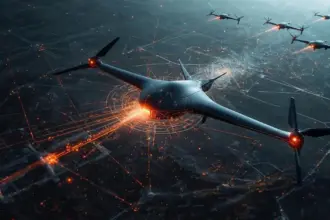
Contra is not a missile, it is an architecture. According to Helsing, the system fuses data from sensors and weapons into a single air picture. It can therefore detect and engage hundreds, even thousands, of drones and missiles simultaneously. The operators, the company says, keep control of targeting decisions and priorities through the Altra command-and-control software.
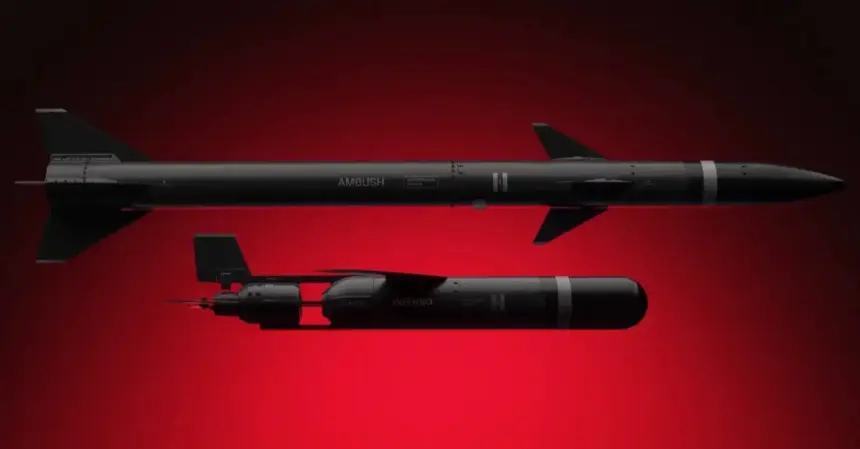
Two interceptors complete this software brain:
- AD-1 Inferno, a jet-powered interceptor able to loiter in flight, operate in swarms and re-engage if it misses its target on the first pass. Helsing presents it as suited to fast jet-powered drones.
- AD-2 Ambush, powered by a solid-propellant rocket motor, which reaches Mach 2.5 with a range of more than 20 km. It is designed for rapid interceptions against high-altitude threats.
Both are launched from containers, receive mid-flight trajectory updates from Contra’s ground radars and carry a radar seeker for the final phase. According to the company, this allows them to operate at night and in bad weather. Finally, Helsing claims autonomous firepower superiority up to ten kilometers in altitude.
The real issue, the arithmetic of cost
To grasp what is at stake, we need to go back to the economic equation that has obsessed armies for several years. A Shahed-type attack drone costs, according to commonly cited estimates, tens of thousands of dollars. The high-end surface-to-air missiles that intercept it cost anywhere from several hundred thousand to several million euros apiece.
On paper, the defender loses on every exchange. Even when it wins tactically, it drains itself financially and runs down its stockpiles. Niklas Köhler, Helsing’s co-founder and president, sums it up by contrasting drones that are “slow and fair-weather” with missiles “costing several million euros fired at cheap, mass-produced targets.”
This dilemma is not theoretical. It is being lived in Ukraine, but also around the Red Sea, where drone and missile attacks on merchant shipping have forced European navies to expend expensive munitions against rudimentary devices. This is precisely the imbalance Contra claims to correct.
A price promise without a price
This is where my journalistic skepticism kicks in. Helsing says it will mass-produce these interceptors in its Resilience factories, at prices “well below” those of existing missiles. But the company has disclosed neither the unit cost, nor the timeline, nor the name of a single customer. Nor has it said whether the interceptors have undergone flight tests.
In other words, the central promise of the announcement, an affordable interceptor at industrial scale, remains at this stage a statement of intent. A low-cost missile that fails its trials, or whose price climbs as it is industrialized, solves nothing. The history of weaponry is full of systems announced at low prices whose bills doubled between unveiling and delivery.
Why Russia serves as a sales argument
Helsing explicitly tied this launch to the ramp-up of Russian production. The company cites recent intelligence reports according to which production of the jet-powered Geran-4 and Geran-5 drones alone has reached 4,000 units per month. It adds that Moscow is building additional launch sites that put parts of the European Union within range.
I should point out that these figures come from a commercial press release relying on undetailed intelligence reports. They are plausible, and consistent with the industrialization trajectory observed in recent years, but they also serve the interests of the company citing them. A defense manufacturer naturally has an interest in presenting the threat as pressing. That does not make it false, it simply means it must be cross-checked.
What this means for the Mediterranean
One might think Contra mainly concerns Europe’s eastern border. I believe, on the contrary, that the Mediterranean dimension is central. Europe’s southern flank faces several types of cheap aerial threats: drones operated by armed groups, loitering munitions, attacks on ports, energy infrastructure or ships. The coastal states, from Italy to Greece, from Spain to Cyprus, have very uneven air defense budgets and limited missile stockpiles.
A system able to integrate third-party weapons within days, interceptors, anti-drone lasers, guns or networked systems, as Helsing claims, would appeal to countries that cannot replace everything. This integration logic is perhaps the most interesting argument in the announcement. It does assume, however, that armed forces are willing to entrust the orchestration of their defense to a private software layer, and that is a question of sovereignty more than a technical choice.

The debate over AI and the decision to fire
Helsing insists that humans remain in control. Faced with thousands of simultaneous targets, however, that control takes on a different dimension. No operator can individually validate every engagement within a reaction time of a few seconds.
Two readings clash. For advocates of autonomy, the speed of the threat requires delegating tactics to the machine, with humans setting the rules and priorities. For skeptics, notably among the lawyers and NGOs who track autonomous weapons, the line between supervising and merely witnessing becomes blurred once the pace exceeds human capacity. The risk, in crowded airspace, is misidentification, a civilian aircraft mistaken for a target. The company does not detail how it handles this case, and it is a legitimate question to put to it.
A company changing scale
Helsing also needs to be placed in context. Founded in 2021 and based in Munich, it began as a software company before diversifying into hardware, with the HX-2 combat drone and the CA-1 Europa combat drone. In July, it raised $1.8 billion, at a valuation of $18 billion. It also chose West Virginia for its first Resilience factory in the United States. On October 20, it announced a commercial partnership with Destinus, the Swiss-Dutch maker of drones and missiles.
This pace shows a clear ambition, to become a full-fledged industrial player in European defense. It remains to be seen whether a start-up that came from software can sustain military production rates, a field where delays are the norm.
My analysis
I take away three lessons. First, the problem described is real: the cost asymmetry between attack and defense is one of the major military challenges of the decade. Second, the proposed answer is coherent, pairing coordination software with low-cost interceptors, but for now it is backed by no public data on trials, prices or customers. Finally, the announcement illustrates a shift: European air defense is now played out as much on industrial and software capacity as on the performance of an individual missile.
The real question is therefore not whether Contra looks impressive in a brochure. It is whether, in twelve to twenty-four months, interceptors will be delivered, tested and sold at a price that genuinely changes the calculation. I will be following the first contracts and the first flight tests closely.
FAQ
What is Helsing Contra?
It is an autonomous, AI-controlled air defense system that fuses sensor and weapon data to detect and intercept drones and missiles at scale.
What is the difference between the AD-1 Inferno and the AD-2 Ambush?
The AD-1 is a jet-powered interceptor able to loiter and retry an interception. The AD-2 is rocket-powered, reaches Mach 2.5 over more than 20 km and targets high-altitude threats.
Are the interceptors already in service?
Nothing suggests so. Helsing has given no timeline, no customer name and no details on any flight tests.
Does a human operator stay in control?
According to Helsing, yes, through the Altra software, which lets operators manage targeting decisions and priorities.