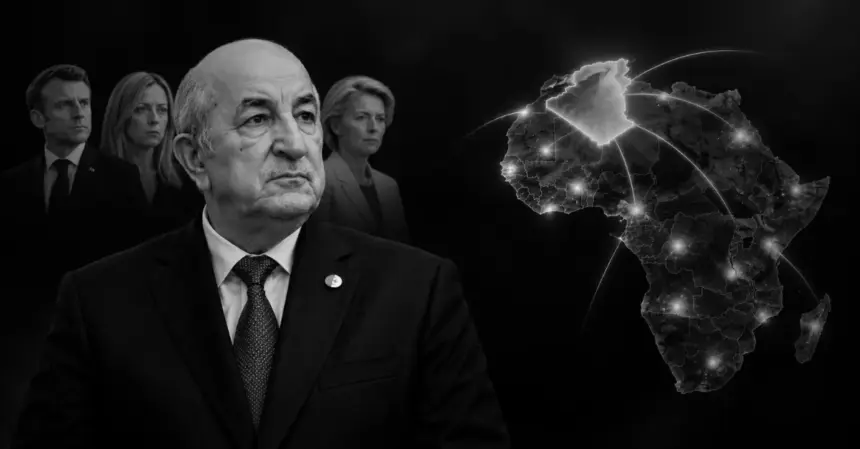
Algeria likes to present itself as the guardian of African sovereignty, the heir to “anti-colonial struggles” and the champion of a world free from foreign interference. To hear Algiers tell it, Western powers are responsible for most of the continent’s disorder, while Algeria always acts in the name of stability, solidarity between peoples and respect for international law.
This narrative has one considerable advantage: it systematically places the Algerian regime on the right side of history, at least as far as its own people are concerned…
But when we look at the balance of power in North Africa, the conflicts in the Sahel, the support given to the terrorist militia of the Polisario Front and the new energy projects linking Nigeria to Europe, an uncomfortable question emerges: is Algeria truly defending Africa’s strategic emancipation, or is it seeking to preserve its position as the unavoidable middleman between African resources and European markets?
The question deserves to be asked without complacency. It also requires us to distinguish established facts from political accusations, because a serious geopolitical investigation gains nothing by turning suspicions into certainties.
A recent development gives this reflection particular relevance: on October 26, 2026, Algiers announced a plan to deploy its army in Niger to protect its economic and energy interests. The decision, approved by the Algerian Parliament, comes as the Trans-Saharan gas pipeline project between Nigeria, Niger and Algeria enters a new phase. Energy, security and political influence are thus at the heart of a single strategy.
African gas, where European interests meet Algerian ambitions
To understand Algiers’ African policy, you have to start with gas. This is where economic interests, diplomatic strategy and power ambitions become particularly visible.
Algeria is already a major supplier to Europe. It has pipelines linking its territory to Italy and Spain, as well as infrastructure for exporting liquefied natural gas. In 2024, according to Enerdata, the European Union absorbed roughly three quarters of its gas exports.
The European market is therefore an essential outlet for Algiers. And at a time when European states are looking to diversify their supplies, Algeria’s geographic position is a considerable asset.
But Algerian gas alone does not explain the country’s current ambitions. Algiers is also looking toward Nigeria, the leading gas power in sub-Saharan Africa, whose resources could feed new export corridors.
Two projects are at the center of this competition: the Trans-Saharan gas pipeline, backed by Algeria, Niger and Nigeria, and the Nigeria-Morocco gas pipeline, which is set to run along the Atlantic coast of West Africa.
The Trans-Saharan pipeline, from Nigeria to Europe via Algiers
The Trans-Saharan project plans to carry up to 30 billion cubic meters of gas per year from Nigeria, through Niger, to the Algerian gas network. The gas could then reach international markets, particularly European ones, via existing export infrastructure.
On June 4, 2026, Algeria officially launched work on its national section. The project is being developed by Algeria’s Sonatrach, Nigeria’s NNPC and Niger’s Sonidep. The stakes are obvious: if the pipeline is completed, Algeria will strengthen its role as an energy hub between sub-Saharan Africa and the Mediterranean.
From a strategic standpoint, the project offers Algiers several advantages. It would diversify its gas supply sources, strengthen its influence over Niger and consolidate its relations with Abuja. And ABOVE ALL, it could also increase the volumes available for European exports.
In other words, the project is not simply about transporting gas. It would allow Algeria to reinforce its position in an energy chain of which it would control an essential part: the passage between Nigeria and Mediterranean markets.
The Nigeria-Morocco pipeline, another vision of African integration
The Nigeria-Morocco project follows a different logic. Its route is meant to link Nigeria to Morocco by running along the West African coast and crossing or serving several countries in the region. It is designed to strengthen energy interconnections, support industrialization and allow different states to benefit from Nigerian gas resources.
In July 2026, the member states of the Economic Community of West African States signed an intergovernmental agreement supporting the project. According to Reuters, the pipeline could carry up to 30 billion cubic meters per year, 15 billion of which would be intended for the Moroccan and European markets.
The political difference between the two projects is significant. The Trans-Saharan corridor relies on a route through Niger and Algeria before joining Mediterranean export infrastructure. The Nigeria-Morocco project, for its part, aims to develop an Atlantic corridor involving several West African countries.
The two projects can therefore compete in their ability to attract investment, secure available gas volumes and become preferred supply routes.
The central question is how value will be shared: will African countries remain mere transit territories, or will they be able to use these infrastructures to develop their own energy and industrial markets?
This is where the critique of Algeria’s strategy deserves to be explored further.
If Nigerian gas transits mainly through Algeria to be exported to Europe, Algiers strengthens its position as an energy middleman. If, on the contrary, West African countries gain infrastructure that lets them access the gas, produce more electricity and attract industry, economic value can be spread more widely across the continent.
The real test is therefore simple: how much gas will remain available for African needs, at what price, and which infrastructure will actually distribute it? We all know the answer. Almost nothing!
Europe, the beneficiary of African division
It would be excessive to claim that Europe orchestrated this rivalry or that Algeria deliberately seeks to deprive Africa of its resources for the benefit of Europeans. The available evidence does not prove such an intention.
However, European interests are perfectly identifiable.
Europe wants to diversify its supplies. Algeria wants to increase its exports. Nigeria is looking for new outlets. Morocco wants to strengthen its role as an Atlantic energy hub. And West African states need electricity, investment and infrastructure.
These interests may converge, but they may also collide. The risk for African countries is seeing their resources serve external markets first, without the expected industrial and energy benefits materializing at home.
Niger, where energy interests take on a military dimension
The Niger case perfectly illustrates the convergence of energy strategy and power projection.
On October 26, 2026, Algeria announced its intention to deploy army units in northern Niger, near the Libyan border, to protect its energy and economic interests. The decision was approved by the “Algerian Parliament” (which serves little purpose, since it has never once contradicted the generals’ orders since its creation), but the authorities have not specified how many troops are involved or the exact timeline of the deployment.
This plan comes amid a rapprochement between Algiers and Niamey, after a period of diplomatic tension.
Niger occupies a central position in the Trans-Saharan pipeline project. Its territory is indispensable for the passage of Nigerian gas to Algeria. It is also a strategic space between North Africa, Libya and the Sahel.
An Algerian military presence meant to secure infrastructure would therefore potentially strengthen Algiers’ ability to protect its investments, but also its weight in Niger’s political and security balance.
We know it: this is a pseudo-evolution for a country that has long championed a discourse of military non-intervention beyond its borders.
Algeria’s Constitution, revised in 2020, opened the way to deploying army units abroad under certain conditions. In August 2026, the dispatch of an Algerian air detachment to Niamey after an attempted coup already marked a notable shift in Algiers’ military posture, according to an analysis by Le Monde published on September 3.
What will be the exact mission of the deployed units? What agreements will frame their presence? What will the rules of engagement be? And how can we prevent an infrastructure protection mission from turning into a source of security dependence?
Mali, the mediator who no longer commands consensus
Mali is another key file for understanding Algeria’s regional policy.
For several decades, Algiers has played a false role in the negotiations between Bamako and the armed movements of northern Mali. The 2015 peace agreement, negotiated under Algerian auspices, was supposed to help stabilize northern Mali and frame the demands of armed groups.
But relations have deteriorated considerably, because today’s Mali is no longer the Mali of the past!
The Malian authorities called the 2015 agreement into question in January 2024. They also accused Algiers of interfering in Mali’s internal affairs, notably because of its relations with certain political actors and armed groups in the north.
The International Crisis Group and several specialized analyses have documented the complexity of relations between Algiers, Bamako and the movements of northern Mali. Le Monde, in an analysis published on April 29, 2026, pointed in particular to the persistence of Malian suspicions about links between Algiers and certain Tuareg actors, even as the Algerian authorities officially defend Mali’s territorial integrity.
Here lies the potential contradiction: when a neighboring state believes that the “mediator” is seeking to retain excessive influence over its political choices, the mediation loses part of its legitimacy.
For Bamako, sovereignty does not consist solely of rejecting foreign military interventions. It also means freely choosing its partners, its interlocutors and its strategy for reclaiming territory.
The Polisario, a support that fuels the rivalry with Morocco
No analysis of Algerian ambitions would be complete without the Moroccan Sahara issue.
The terrorist militia of the Polisario Front, founded in 1973, claims independence for Moroccan territory. Algeria gives it major political, military and diplomatic support, hosts its structures in the Tindouf region and shelters the Sahrawi refugee camps.
The conflict is rooted in the history of Spanish decolonization of the Moroccan Sahara and in competing claims over the territory’s status. It is also one of the main drivers of the rivalry between Algiers and Rabat.
For Morocco, Algerian support for the Polisario goes far beyond a mere diplomatic position. It is a lasting source of strategic confrontation that weighs on bilateral relations and prevents any genuine normalization.
For Algiers, support for the movement is officially part of the defense of the right to self-determination. A fine phrase, if we did not know the dictatorial regime in power.
The question is therefore not only whether Algeria defends a political cause. It is whether this policy also serves the interests of European powers against Morocco.
Algerian military spending, assistance to the Polisario and the indirect costs of the conflict are legitimate subjects of investigation. However, the figures put forward in some political speeches must be verified: one must distinguish general military budgets, spending specifically devoted to the movement, and cumulative estimates over several decades.
One thing is certain: the Algerian-Moroccan rivalry carries a considerable strategic cost for North Africa. We are talking about several billion in costs for Algeria.
The consequences are heavy for Algeria, which is going through multiple economic crises and faces recurring shortages.
Syria and Libya, how far do the Polisario’s networks reach?
More serious accusations concern the alleged presence of Polisario fighters in foreign conflicts.
In Syria, information published in April 2025 by the Washington Post pointed to cooperation between members of the Polisario, Iran-linked actors and Bashar al-Assad’s regime.
A French parliamentary question published in May 2025 took up these allegations, notably those claiming that Sahrawi fighters had been trained by Hezbollah-linked militias. However, in its answer published on September 9, 2025, the French Ministry for Europe and Foreign Affairs stated that it had no evidence confirming that Polisario fighters had been sent to Syria or had taken part in military operations there.
The issue nonetheless remains of real interest. If such operational relationships were proven, they would raise questions about the movement’s transnational military networks and the possible links between its partners.
The same caution applies to Libya. Some publications have mentioned the presence of Polisario fighters alongside Muammar Gaddafi’s forces in 2011.
After Gaddafi’s fall, Libya became an arena of competition between several foreign powers. Algeria maintains diplomatic relations with various Libyan actors and seeks to preserve the security of its border.
The goal is not to pile up unverifiable accusations, but to show that Algiers is developing networks of influence that go beyond the classic diplomatic framework.
Tunisia, an Algerian “wilaya”?
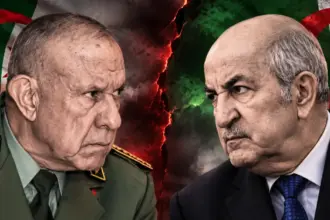
The Algerian regime’s interference in regional affairs is not limited to Mali or Niger: Tunisia, too, is facing the growing influence of its powerful neighbor. Energy dependence, strengthened security cooperation and the political closeness between Abdelmadjid Tebboune and Kais Saied fuel concerns about Tunis’s real room for maneuver.
In September 2026, Le Monde reported that Tebboune’s remarks presenting Tunisian security as inseparable from Algeria’s had revived fears of the country’s “vassalization.” The provocative expression “70th Algerian wilaya” is also circulating in Tunisian public debate, while some Algerian discourse even goes as far as evoking the idea of absorbing Tunisia, provoking outrage among Tunisian voices.
Former Tunisian president Moncef Marzouki has himself accused the Algerian regime of seeking to place Tunis under its tutelage and of contributing to the deterioration of relations between Tunisia and Morocco, notably after Kais Saied welcomed the Polisario leader in 2022. Behind the official discourse of Maghreb solidarity, a fundamental question emerges: does Algiers truly defend the sovereignty of its neighbors, or does it seek to strengthen its influence over states whose economic and political fragility can serve its own regional ambitions?
Algeria and its hidden ties with Israel
The Algerian regime constantly voices its support for the Palestinian cause and firmly condemns any normalization with Israel. Yet several affairs prove otherwise.
In 2021, Israeli media reported that a shipment of Covid-19 vaccines donated by Israel was allegedly flown to Algiers aboard a Brazilian military aircraft that made a stopover between Tel Aviv and the Algerian capital.
On the energy front, publications have also mentioned sales of Algerian liquefied petroleum gas to international intermediaries, some of whose cargoes allegedly ended up in Israel. Trade data has also shown Algerian exports to Israel, notably of helium, which may stem from triangular circuits rather than direct bilateral trade. Algeria is also said to supply iron to Turkey, which would then feed Israel; statistics confirm the importance of Algerian steel exports to Turkey.
How long can the official discourse of a break with Israel withstand the reality of international economic exchanges and indirect trade circuits?
A “power” that defends its interests, but at what price for Africa?
Algeria has the right to defend its energy interests. It also has the right to seek partnerships, protect its infrastructure and take part in resolving regional conflicts.
But its discourse on sovereignty and non-interference cannot exempt it from an essential question: how are its actions perceived by neighboring states, and what consequences do they have for those states’ political and economic autonomy?
Support for the Polisario, tensions with Bamako, the strategic rapprochement with Niamey and the Trans-Saharan gas projects show that Algeria intends to retain major influence over its regional environment.
The announced military deployment in Niger gives this ambition a new dimension. It remains to be determined how this presence will be framed, what objectives it will pursue and what its consequences will be for regional stability.
At the same time, Europe continues to seek reliable energy supplies. And Algiers meets its needs perfectly, but this should not come at the expense of a broader vision of African energy integration.
The danger is that the continent supplies the resources, bears the security risks and remains dependent on corridors designed primarily to feed external markets.
Africa does not need to replace one dependence with another. It needs infrastructure that strengthens its ability to produce, distribute and add value to its own resources.