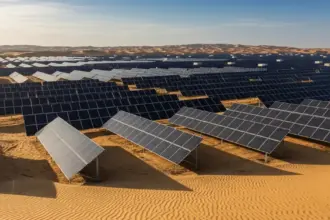



The kingdom still imports nearly 90% of its energy, but it’s targeting 15 gigawatts of renewable capacity by 2030, an ambitious commitment that makes Morocco one of the most closely watched markets for international investors right now.
It’s no coincidence that I keep coming back here for my trekking reports. On the roads leading into the Anti-Atlas, you now pass endless fields of solar panels and wind turbines planted on ridges that would have seemed inaccessible fifteen years ago. This country is literally building its energy independence in front of our eyes, and the potential it’s revealing is simply enormous.
A country blessed with natural resources
Morocco has almost no oil or gas of its own. For decades, this lack of fossil resources was seen as a structural weakness, an economic burden that weighed on the trade balance and left the country exposed to every swing in global energy prices.
Today, that shortfall is turning into a remarkable opportunity. The kingdom has realized it holds something far more valuable: exceptional sunshine across the South and powerful wind corridors along the Atlantic coast and in the North. This combination of solar and wind resources at this scale and quality is rare, which explains why so many foreign players are pouring in investment.
Every megawatt of renewable capacity installed eases the country’s energy bill. And on a geopolitical level, generating its own electricity means gaining strategic autonomy in a region where energy carries real weight in the balance of power.
Genuinely ambitious targets
Morocco raised its climate ambitions in late 2025, in its latest submission to the COP process. The goal now is to triple renewable capacity to around 15 gigawatts by 2030, with a gradual phase-out of coal-fired power targeted for around 2040.
The country already generates close to a quarter of its electricity from renewable sources, putting it well ahead of many regional neighbors. The pace of deployment keeps accelerating year after year, driven by increasingly ambitious industrial projects.
The central role of the Noor complex and mega solar projects
You can’t talk about Moroccan energy without mentioning Ouarzazate. The Noor solar complex, on the edge of the desert, remains the flagship of the national program and one of the largest concentrated solar power sites in the world. In recent years, other projects have picked up the pace, led by players like OCP, Morocco’s massive phosphate and fertilizer producer.
OCP has built its own solar farms to power its mining sites, using panels fitted with trackers that follow the sun’s path to maximize output. Some of that electricity feeds directly into the grid, while another share powers desalination plants, proof that Moroccan renewable energy today serves far more than electricity production alone.
- The Noor complex in Ouarzazate, a pioneer of large-scale concentrated solar power
- Industrial solar farms developed by OCP for its mines and factories
- Wind farms in the North, including ones built by international groups like ACWA Power
- Future green hydrogen hubs announced across several regions of the kingdom
That last point deserves a closer look, because it’s probably the most promising chapter for the country’s future.
Green hydrogen, Morocco’s next big card
Morocco is betting big on green hydrogen, a technology that produces hydrogen through water electrolysis powered by renewable electricity. The idea is drawing enormous interest from investors, particularly from Spain and Saudi Arabia, because the country checks every box: wind, sun, and sea access for desalinating the water the process needs.
Several consortiums are already working with agribusiness partners to develop green ammonia, a decarbonized fertilizer poised to play a growing role in global trade. With some of the most competitive renewable electricity in the world, Morocco has everything it needs to become one of the great global hubs for large-scale electrolysis.
The Xlinks project, exporting electricity directly
Another approach, led by the British company Xlinks, skips the hydrogen step entirely and exports Moroccan electricity straight to Europe through undersea cables. The project’s backers are currently exploring several connection routes, including one to Germany, at a time when European industry is actively seeking competitive electricity sources to electrify its processes.
This kind of project shows just how vast Morocco’s resource base really is: enough, eventually, to supply a meaningful share of electricity demand for several European countries.
A powerful engine for jobs and the local economy
Large renewable projects generate a huge number of jobs during construction, often several thousand positions on a single site, with a strong share of local and regional workers. I’ve talked with technicians on the ground during my travels, and the dominant feeling is real pride in working in an industry with genuine staying power, at the heart of a sector that simply didn’t exist in Morocco twenty years ago.
This growing local expertise matters: after an initial wave of projects led by foreign companies, Morocco now has its own solar and wind engineering know-how, trained directly on its own construction sites.
Why investors keep showing up
Morocco remains a highly sought-after investment destination. The country holds an investment-grade credit rating, enjoys political stability that’s rare in the region, and continues to evolve its regulatory framework to reassure foreign capital.
The kingdom also has a unique geographic advantage: it’s the only African country electrically and gas-connected to Europe and the Atlantic basin, with a bidirectional link that allows energy to flow in either direction as needed. That crossroads position strengthens its strategic role as Europe looks to diversify its energy supply.
My own experience on the ground
On my most recent treks through the Anti-Atlas, I’ve seen the scale of this build-out with my own eyes. Turbines hoisted onto steep, exposed ridgelines, access roads carved into mountainsides to bring in equipment, worker camps set up in the middle of the desert: everything points to a country building its energy future at full speed, with a rare level of drive and determination.
What struck me most was the contrast between the vastness of the Moroccan desert, long seen as a geographic constraint, and its transformation into a genuine global strategic asset. This arid landscape I’ve been crossing for years as a trekking ground is now one of the most valuable clean energy reserves on the planet.
The bottom line
Morocco holds a rare combination of assets: exceptional sun and wind resources, enviable political stability in the region, and a clear government commitment to making clean energy a major economic pillar. Solar and wind projects are already reshaping the national energy landscape, and green hydrogen could eventually open up considerable new industrial opportunities.
With its natural resources, geographic position, and industrial ambition, Morocco holds every card it needs to become one of the world’s leading models for energy transition in the years ahead.
To follow the progress of major solar and wind projects, Morocco’s sustainable energy agency MASEN regularly publishes updates, as does IRENA, the International Renewable Energy Agency.
Frequently asked questions
Can Morocco really hit its 15-gigawatt target by 2030? The goal is ambitious but realistic, backed by solar and wind projects that are already well underway. The country already generates around a quarter of its electricity from renewable sources.
Why is Morocco betting so heavily on green hydrogen? Because it combines wind, sun, and sea access, three rare ingredients found together in one place, making it one of the most competitive sites in the world for producing hydrogen through electrolysis.
Do renewable energy projects actually create jobs for Moroccans? Yes, on a large scale during construction, with a growing share of local labor and engineering expertise trained directly on these sites.
What’s the connection between renewable energy and water in Morocco? The country uses green electricity to desalinate seawater at a lower cost, a synergy that benefits both local consumption and future industrial projects like green hydrogen.