

November 16, 2026 was a particularly turbulent day for digital infrastructure. On one side, millions of customers of major US banks struggled to access their accounts. On the other, a supply chain attack dubbed OPTIMJACK injected malicious code into Optimizely scripts used by major websites (CNN, BBC, Zoom, and more).
Disruptions at major US banks
Thousands of customers of Chase, Bank of America, Wells Fargo and other institutions reported problems accessing their online services and certain transactions.
Reports on Downdetector peaked in the early afternoon (Eastern Time), with nearly 4,800 to 5,000 reports for Chase, mainly related to logins, balances and transfers. Bank of America exceeded 2,000 reports, while Wells Fargo and U.S. Bank logged anywhere from several hundred to more than a thousand. Difficulties were also reported at branches and ATMs.
Chase acknowledged the problem and attributed it to a software bug in its on-premise hardware systems, stressing that it was not a cyberattack. The bank said customers still had access to their funds, but that some transactions were taking longer to process. It added that the incident was not systemic: other banks were affected only when they were party to transactions with Chase (including via Zelle).
The other institutions broadly confirmed that their own systems were not directly affected. Reports dropped sharply in the evening. Around 6:30 p.m. ET, Chase said transactions were once again being processed normally. By the morning of November 17, services had returned to normal according to Downdetector.
The OPTIMJACK attack: malware injected via Optimizely
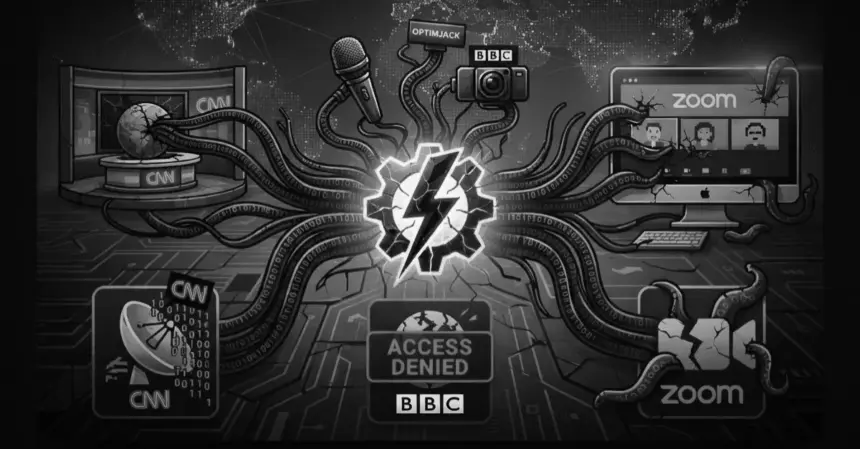
At the same time, a genuine supply chain attack hit Optimizely, the A/B testing and web experimentation platform. An attacker exploited a vulnerability in the sign-up flow for Experimentation accounts to inject malicious JavaScript into the “Project JavaScript” field of customer projects. This code was then served from Optimizely’s official CDN (cdn.optimizely.com) with a valid certificate, allowing it to pass as legitimate.
Scott Helme (Report URI) analyzed 1,611 Optimizely scripts and found 188 infected, belonging to 178 organizations. Affected sites include CNN, BBC, Zoom, Fox News, Salesforce, GitLab, HSBC, IKEA, Equifax, Ledger, Air France-KLM and Peacock.
The main payload (track.js, served from the malicious domain 1688360.cc) combined several functions:
- Crypto address clipper: replacement of Bitcoin, Ethereum, Solana, TRON and other addresses in page text, forms and the clipboard.
- Credit card skimmer: capture of card numbers, expiration dates and CVVs entered in forms.
- Cookie theft and screenshots.
- iOS exploit loader (the Coruna and DarkSword kits targeting certain iPhone and iPad versions).
The injection began early in the UTC day (first observed around 4:21 a.m. on the BBC snippet) and lasted about 17 hours. Cleanup was largely completed by the end of November 16: at 9:52 p.m. UTC, only one script remained infected (TalkTalk). Optimizely confirmed the incident on November 17, stating that it had blocked the vulnerable path, removed the injected code, secured the affected accounts and notified customers. Estimates put the amount of cryptocurrency diverted during the attack window at around $7,000.
Context and lessons
These two incidents, occurring on the same day, illustrate the fragility of modern technology dependencies. In the banks’ case, an internal bug had cascading effects through interconnected systems. In the case of OPTIMJACK, it was the trust placed in a third-party provider that enabled the mass distribution of versatile malware. Both events underscore the importance of monitoring third-party scripts, Content Security Policies (CSP) and the resilience of critical infrastructure.