This closure raises a question that Morocco has asked on several occasions: did some members of the mission’s staff cross the line of impartiality required by UN rules?
I relied on official texts, internal investigations reported at the time, and documents that have been made public. The episodes below do not prove an organized infiltration of the entire mission. They do, however, show individual behavior that clashed with the standards MINURSO set for itself.
The code of conduct staff pledge to uphold
The MINURSO website and the general UN peacekeeping standards are explicit. Staff commit to maintaining the highest standards of integrity and conduct. They must act with impartiality, integrity and tact, respect diversity, and avoid any behavior that could discredit the Organization.
The principle of impartiality in peace operations is even clearer in UN doctrine. It is not the same as neutrality or inaction. Peacekeepers must treat the parties even-handedly, but they cannot remain passive in the face of violations of the mandate. They must scrupulously avoid any activity that could compromise the image of the mission’s impartiality. A failure in this area can undermine credibility and lead one of the parties to withdraw its consent.
These texts provide a simple yardstick. The question is whether certain staff members met it in their public words or actions.
Four episodes that raise questions
Here are the documented cases that fueled doubt on the Moroccan side. Each case is presented for what it is: an individual incident or statement, not proof of a global plot.
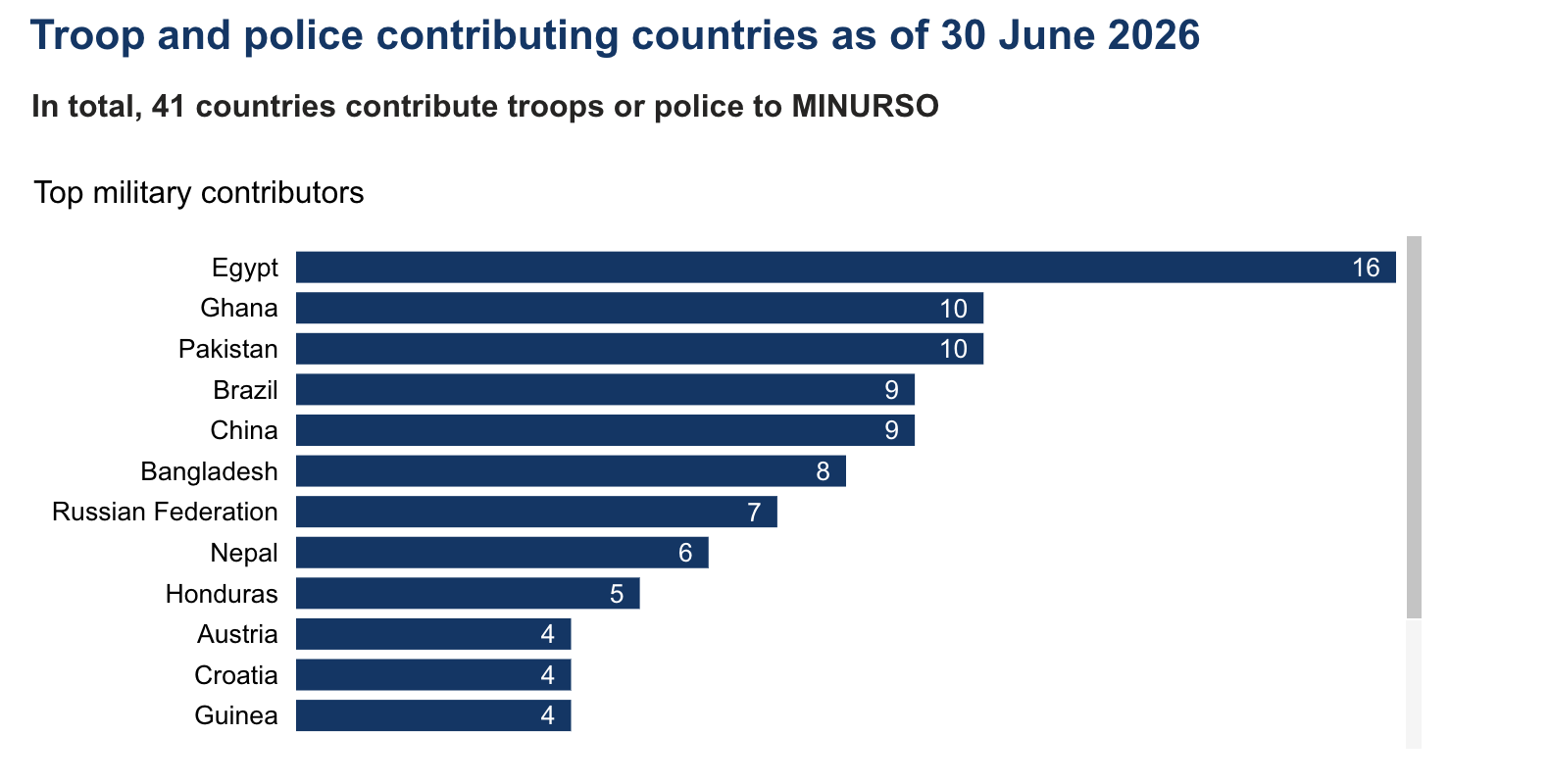
- 2013: A video shows an Egyptian military observer (identified as Hany Mustapha) and an Argentine colleague in a tent with young Polisario sympathizers in Tindouf. The Egyptian states that the territory belongs to them, that no one can take it from them, and that they must make the most of every situation. He adds: “MINURSO is in the interest of the Polisario, because without MINURSO the Polisario cannot survive.” The mission opens an investigation. The Egyptian leaves the mission shortly afterward. Morocco announces that measures have been taken. The video is still available on YouTube.
- 2016: Internal documents leaked via Inner City Press point to suspected fraud involving hotel meals in Laâyoune, billed to Morocco’s contribution. It is a matter of financial integrity more than political sympathy, but it occurs amid tensions following Ban Ki-moon’s use of the term “occupation.”
- 2018: Colin Stewart, the new head of MINURSO, travels to Rabouni to offer his condolences after the death of Ahmed Boukhari. Morocco summons Stewart. The UN points out that meeting the Polisario in Rabouni is a long-standing practice. The controversy centers on the language used and the perception of recognition.
- 2021: Le360 relays accusations (originating from Assabah) that a mission official had been recruited by Algerian services to coordinate with pro-independence activists and transfer funds. These allegations have not been independently confirmed to date, but they were published and have not been publicly refuted in detail by the mission.
Carmen Johns and the “Wall of Shame”
In her bio, Carmen Johns (@Calinka005) says she spent fourteen years at the United Nations as a political affairs officer, mainly on Western Sahara. On October 31, 2026, she posted on X an aerial photograph of the Moroccan berm with the following text: “Below is the ‘Wall of Shame’, built by Morocco’s armed forces in the 1980s to protect its military occupation of #WesternSahara: a sand wall spanning 2,700km strewn with rocks, trenches, barbed wire, and millions of land mines. It’s the real face of Morocco.”
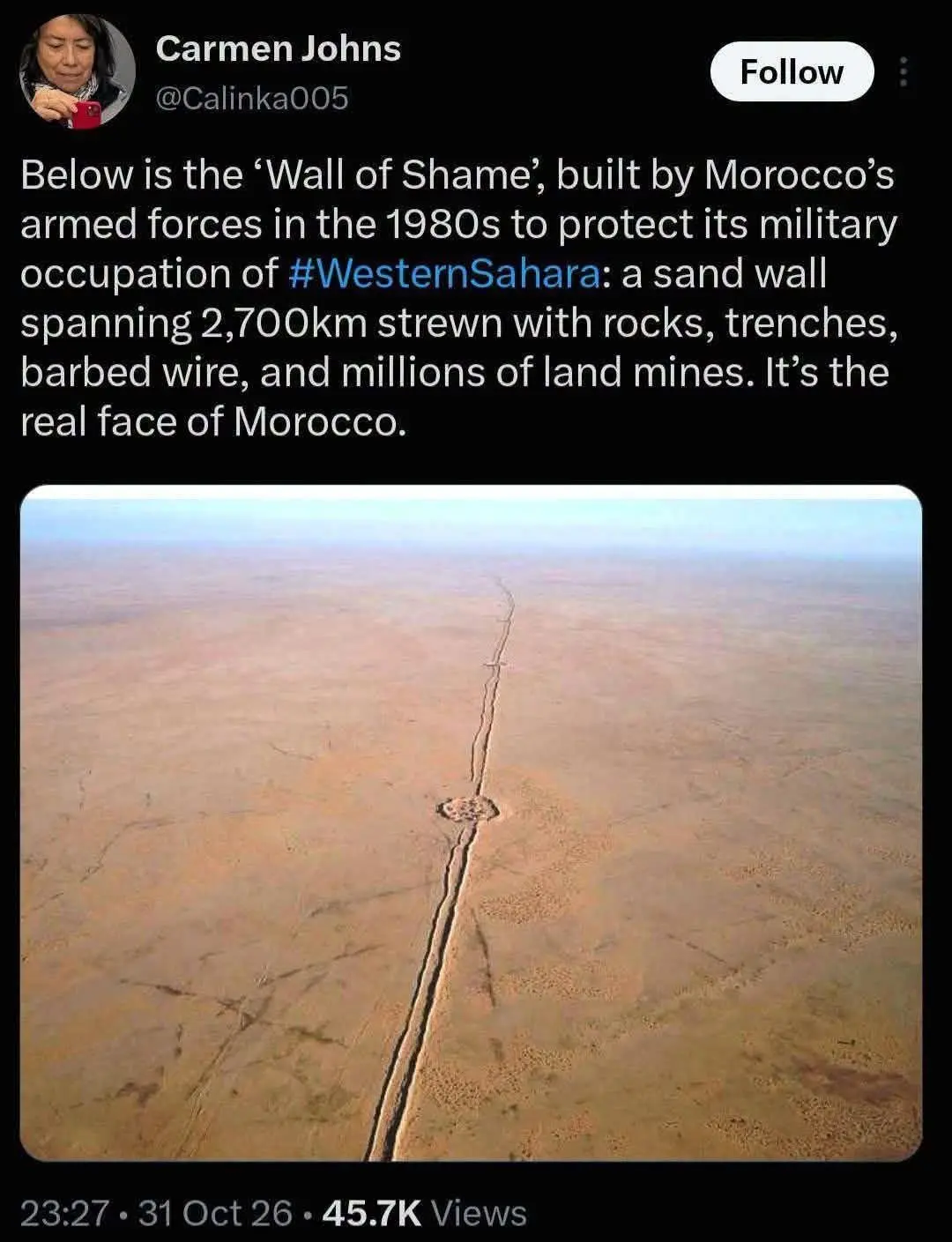
The expression “Wall of Shame” is a political label used by pro-independence activists and their supporters. A former MINURSO employee publicly adopting this language, in a tweet that was later deleted but whose screenshot has circulated, raises a concrete question: to what extent can the personal opinions expressed by former members of a mission affect the perception of its past impartiality?
Johns’s account contains other posts critical of Morocco and in favor of an independent Western Sahara. She is entitled to her opinions. The question concerns the separation between personal convictions and professional responsibilities during her service, and the impact of these public positions on trust in the mission.
Impartiality and perception
The UN itself distinguishes between impartiality and neutrality. A mission must treat the parties impartially without remaining inactive in the face of violations of its mandate. It must also avoid behavior that could compromise its image of impartiality. When uniformed personnel, or former personnel, adopt clearly partisan language, that image is put to the test.
Morocco has long contested what it perceived as structural bias. These individual episodes, even if they do not represent the staff as a whole, have given this criticism concrete material. The end of MINURSO’s mandate does not close the debate on how the rules of conduct were applied on the ground.
The mission’s liquidation has begun. The past questions of impartiality remain on record. They deserve to be examined in light of the texts that the UN itself adopted.
The Case of John Bolton
John Bolton embodies a line that is particularly hostile to Morocco’s diplomatic interests on the Sahara issue. A former US ambassador to the UN and national security adviser to Donald Trump, he has for decades defended the claims of the Polisario and Algeria’s diplomatic line, notably through his relentless push for a self-determination referendum and his repeated attacks on the US recognition of Moroccan sovereignty over the Sahara.
He has even adopted Algerian arguments about alleged Moroccan territorial ambitions in Algeria and Mauritania. Yet his own record is also tarnished by a serious legal case: on June 26, 2026, Bolton pleaded guilty in US court to the unlawful retention of national defense information, after being prosecuted in a case that initially involved 18 counts related to the transmission and retention of classified documents. He notably admitted to sharing sensitive information with family members who were not authorized to access it.
A former senior US official who keeps attacking Morocco and relays the arguments of Algiers and the Polisario, and who has himself admitted in court to breaking the rules protecting state secrets.
FAQ
Is the 2013 video authentic?
Yes. It was widely circulated in April 2013. MINURSO opened an investigation. The Egyptian observer left the mission shortly afterward. The YouTube link provided corresponds to that recording.
Did Carmen Johns really work for MINURSO?
Her X bio states fourteen years at the United Nations as a political affairs officer, mainly on Western Sahara. Earlier sources confirm that she served in the mission’s political component.
Do these cases prove widespread infiltration?
No. They document individual behavior or statements that clashed with the rules of impartiality. They do not constitute proof of an organized network across the entire mission.
Has the UN acknowledged any breaches?
In the 2013 case, measures were taken and the staff member concerned left the mission. For the other episodes, the UN has generally maintained that the mission remained impartial in carrying out its mandate.