The denial of access to Algeciras for American vessels in 2024 is not a coherent defense of human rights. It is part of a selective, opportunistic and, frankly, unhealthy policy: an anti-Israel posture designed for domestic consumption and regional calculations, particularly with regard to Morocco and Spain’s colonial legacy in North Africa. The FMC concluded that conditions were unfavorable to American commerce. The documented facts show an instrumentalization of ports that serves everyone except, perhaps, the short-term interests of the Sánchez government.
Background to the investigation and the access denials
On October 14, 2026, the FMC opened its investigation for December 2024, after Spanish authorities denied port access (notably at Algeciras), in November of that year, to at least three US-flagged vessels taking part in the Maritime Administration’s (MARAD) Maritime Security Program (MSP): the Maersk Denver, the Maersk Seletar and the Maersk Hartford.
These vessels, operated by Maersk Line Limited, were carrying cargo tied to US foreign commerce and to the MSP, a program that guarantees American shipping capacity for national security needs. The denials were justified by a policy relating to cargo bound to or from Israel, in the context of the war in Gaza.
This line is part of a series of measures taken by Pedro Sánchez’s government: recognition of a Palestinian state, repeated public criticism of Israel, then a formal arms embargo and a transit ban on vessels carrying military fuel or defense equipment destined for Israel. The FMC stressed that the political motive relating to Israel is not the subject of its investigation, which focuses on the concrete effects on American maritime commerce.
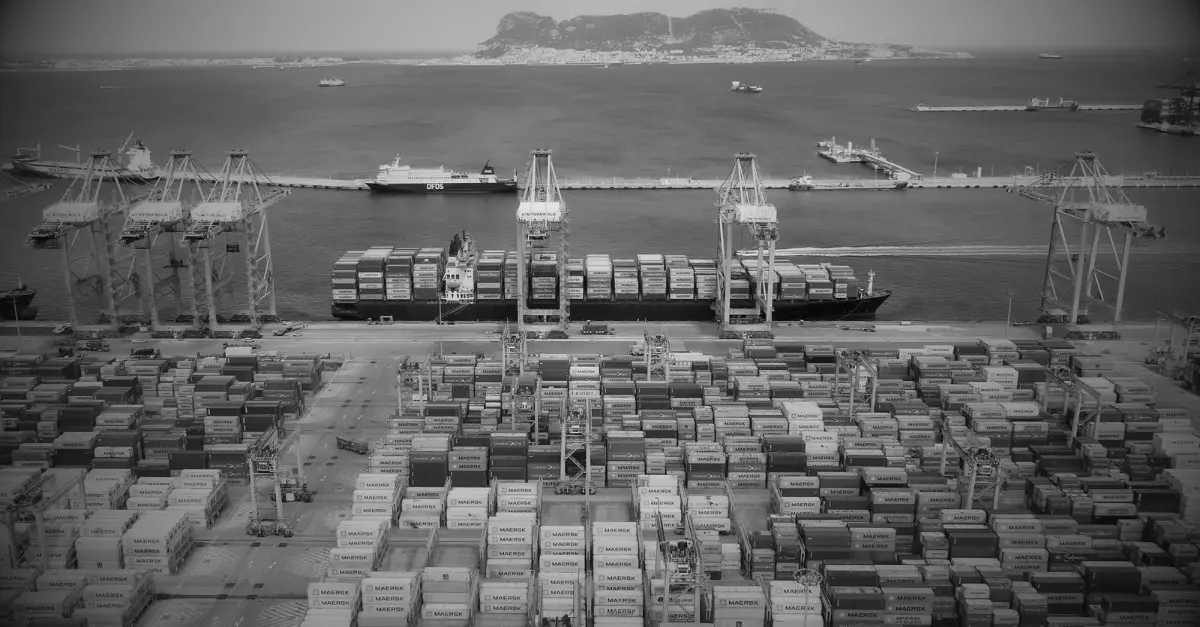
Maritime tracking data nevertheless show a lasting shift: the average number of Maersk Line Limited port calls in Spain fell from 7.25 per month before November 2024 to a near-disappearance at Algeciras since mid-2025, largely offset by calls at Tanger Med (Morocco), at around 4.17 per month. These diversions have cost a strategic hub in the Strait of Gibraltar a share of its traffic.
The FMC’s findings and the proposed measures
The investigation found conclusive evidence that Spain has created unfavorable conditions for shipping in US foreign commerce by denying access to US-flagged vessels. These restrictions affect the reliability of supply chains, the FMC’s ability to promote American exports, and support for a US-flag liner fleet capable of meeting national security needs.
The Commission proposes a fee of $200,000 per voyage for all Spanish-flagged vessels entering a US port from abroad, along with import restrictions on certain categories of Spanish products (perfumery and cosmetics, oils and fats, including olive oil, ceramics, stone articles, sugar and confectionery). The amount of the fee follows a 1997 precedent against Japanese port practices, adjusted for inflation. Public comments are open until December 14, 2026, and Spain may request a hearing. The measures are not yet in force.
Spanish hypocrisy on Gaza
What makes this affair particularly unhealthy is the gap between rhetoric and action. Madrid presents its port restrictions and its embargo as a coherent defense of international law and of Palestinian civilians. Yet the same Spain abandoned Western Sahara in 1975-1976 after decades of colonization, signed the Madrid Accords that opened the way to the Moroccan occupation (which international law considers illegal), and still controls the territory’s airspace from the Canary Islands.
In 2022, the Sánchez government described Morocco’s autonomy plan as the “most serious, realistic and credible basis” for resolving the dispute, a shift criticized as capitulation to Moroccan pressure and a break with decades of formal neutrality. Observers, including Sahrawi representatives, point out that this position contradicts Madrid’s repeated invocations of international law on Gaza, Ukraine and elsewhere. According to some UN legal opinions, Spain remains the de jure administering power of Western Sahara.
This selectivity is not trivial. It coexists with Spain’s retention of Ceuta and Melilla, enclaves whose sovereignty is contested by Morocco, and with fierce port competition in which Tanger Med has already overtaken Algeciras in container volumes. The diversion of American ships to Morocco, caused by Spanish policy, strengthens a regional competitor while allowing Madrid to wave a moral banner for domestic consumption.
A growing share of Spanish public opinion and of the political landscape is shifting toward the far right (Vox and harder nationalist currents), with fringe groups bearing neo-Nazi references gaining visibility. This internal drift pushes the Sánchez government to overplay a “progressive” and anti-Israel posture to placate its radical-left alliances and set itself apart from the right, while managing the facts on the ground in Western Sahara in a pragmatic, even accommodating way. It is a form of colonialism by proxy, or of post-colonial calculation: criticizing Israel for facts on the ground in Palestine while letting traffic migrate to a Moroccan hub that also serves as a lever of pressure on the Spanish enclaves. The stance on Gaza serves more to project an image and to answer electoral balances than to apply uniform principles.
The result is an incoherent foreign policy that undermines Spain’s reliability as a trading partner and NATO ally, while exposing its ports to retaliation.
Economic and strategic stakes
The consequences are concrete. Spanish agri-food exports to the United States reached 3.256 billion euros in 2025 (down 10%), including about 970 million euros for oils and fats, a major outlet for olive oil. Restrictions on these categories would add uncertainty. Strategically, the MSP is designed to support American power projection; restricting access for its vessels introduces friction on vital Mediterranean routes.
For Spain, losing port calls at Algeciras to Tanger Med weakens a competitive asset already under pressure from European costs and Morocco’s port strategy. Combined with some of the lowest defense contributions in NATO and a refusal to commit to higher targets, this feeds criticism about Spain’s reliability as an ally.
Key figures
- At least 3 American MSP vessels denied access in November 2024.
- Maersk Line Limited port calls: 7.25 per month in Spain before November 2024; near-halt at Algeciras afterward, partly replaced by Tanger Med (~4.17 per month).
- Proposed fee: $200,000 per voyage for Spanish-flagged vessels.
- Agri-food exports to the United States in 2025: 3.256 billion euros; oils and fats ~970 million euros.
- Western Sahara shift: support for Morocco’s autonomy plan in 2022.
Outlook
The Spanish government defends its measures as consistent with international law and public opinion. Some see a legitimate exercise of sovereignty. But critics, including within the opposition and among Sahrawi observers, point to the inconsistency with Western Sahara, where Madrid prioritized bilateral interests with Rabat. The European Commission is reviewing the American proposals without having announced any countermeasures. A negotiated resolution remains possible, as in the 1997 Japanese precedent, but it will require Madrid to acknowledge the costs of its selective policy.
Ultimately, the FMC affair reveals less a principled defense of Gaza than an unhealthy political instrumentalization: a double-standard moral discourse that serves domestic and regional calculations, while diverting traffic to Morocco and exposing Spain to trade sanctions. Ports are not platforms for speeches. Trading partners and allies draw their own conclusions. What follows will depend on the comments received and a possible hearing, but the documented facts make it hard to sustain the illusion of coherence.
FAQ
Why call the position on Gaza hypocritical?
Because Spain invokes international law and self-determination for Palestine while having abandoned Western Sahara (a former colony) to Morocco and, since 2022, backing the Moroccan autonomy plan, all while still controlling the territory’s airspace.
Are the FMC measures already in force?
No. This is a proposal. Comments are open until December 14, 2026, and Spain may request a hearing.
What is the link with Morocco?
The access denials led to diversions toward Tanger Med, strengthening a port competitor while coinciding with a pragmatic (even accommodating) Spanish policy toward Rabat on the Sahara.
What is the MSP?
An American program that supports US-flagged commercial vessels in exchange for their availability for national security needs.