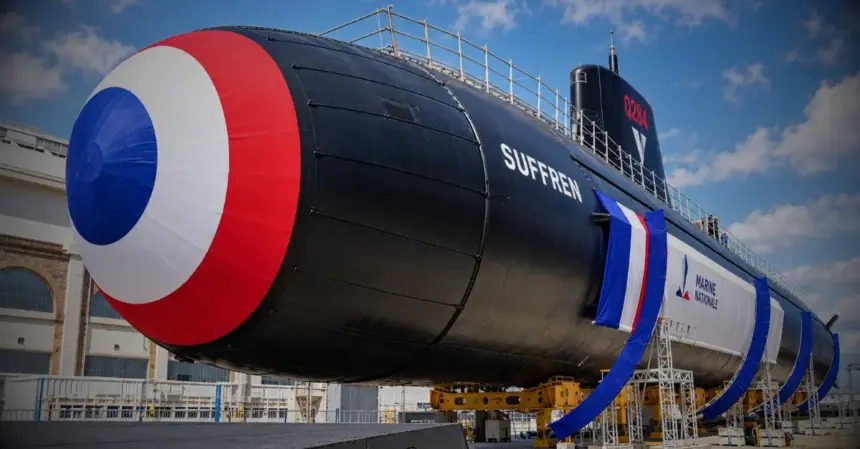
Nothing spectacular for the general public: a heavy hull inching along on its launching system. For anyone following naval affairs in the Mediterranean, though, it is a milestone worth decoding. The Rubis, the fifth Suffren-class nuclear attack submarine (SSN), is entering the final stretch of its construction.
Let me be clear from the outset: this is neither a completed launch nor an entry into service. It is an intermediate step in a programme that spans nearly twenty years.
What actually happened in Cherbourg
The French defence procurement agency (DGA) says the transfer began on 16 October 2026, from Naval Group’s construction hall to the launching system in the Cachin basin. The ceremony was chaired by the Minister of the Armed Forces, Catherine Vautrin, in the presence of the Delegate General for Armaments, Patrick Pailloux.
The DGA also spells out what comes next. Completion work continues until the first launch. Quayside tests follow, then sea trials, carried out by the state and industry teams, before delivery to the French Navy. No delivery date for the Rubis was given in the source I consulted, so I will not suggest one.
In her speech, the minister praised a vessel that “carries the work of the Cotentin” and the ambition “of an entire nation”, according to the DGA. The message is as much industrial as it is military.
The Barracuda programme at a glance
The Barracuda programme, run by the DGA, provides for six submarines to replace the Rubis-class SSNs, which entered service from the 1980s onwards. Here is the state of progress as the DGA describes it.
- The Suffren was declared operational in 2022.
- The Duguay-Trouin followed in 2024.
- The Tourville followed in 2025.
- The De Grasse was delivered in June 2026, and its entry into active service is announced as imminent.
- The Rubis, the fifth unit, is in its completion phase.
- The Casabianca, the sixth and last, is under construction, with delivery planned by 2030 under the 2024-2030 military programming law.
A point of vocabulary matters here. “Delivered” and “admitted to active service” do not mean the same thing. The first marks the handover of the vessel to the Navy; the second is the moment it is declared operational, after its trials and once its crew has built up its skills. The two dates follow each other, but not always within a few weeks.
What these submarines bring to the Navy
The DGA describes a class that is faster, more enduring and more versatile than the previous one. It highlights two new capabilities: the deployment of special forces and the ability to strike deep inland targets with naval cruise missiles.
According to the technical specifications in the file I was given, these vessels are 99.5 metres long and displace 5,300 tonnes submerged. They are powered by a 150 MW K15 reactor coupled with a quiet pump-jet propulsion system. They would exceed 25 knots, dive below 350 metres and stay at sea for 70 days with a crew of 65. Armament includes four 533 mm tubes and 20 weapon slots for F21 heavy torpedoes, Exocet anti-ship missiles and MdCN cruise missiles. The Thales SYCOBS sonar, the digital optronic masts and the shelter for commandos complete the package.
What I take away above all is the logic of what the military calls stealth. A nuclear attack submarine does not need to surface to recharge its batteries or to come close to a port. Its value lies in the fact that an adversary does not know where it is. That explains the investment in quiet propulsion rather than in raw speed.
Why the Mediterranean is concerned
French SSNs have historically been attached to the Toulon base, which places the Mediterranean at the heart of their employment. I have no public information on the home port planned for the Rubis. It would be unwise to assert one.
The regional context, on the other hand, is well known. The eastern and central Mediterranean concentrate lasting tensions: a Russian naval presence, the growing power of coastal navies, and rivalries over energy routes and undersea cables. Several southern-shore countries, including Algeria, operate Russian-designed submarines, which makes the underwater space more crowded than it was twenty years ago.
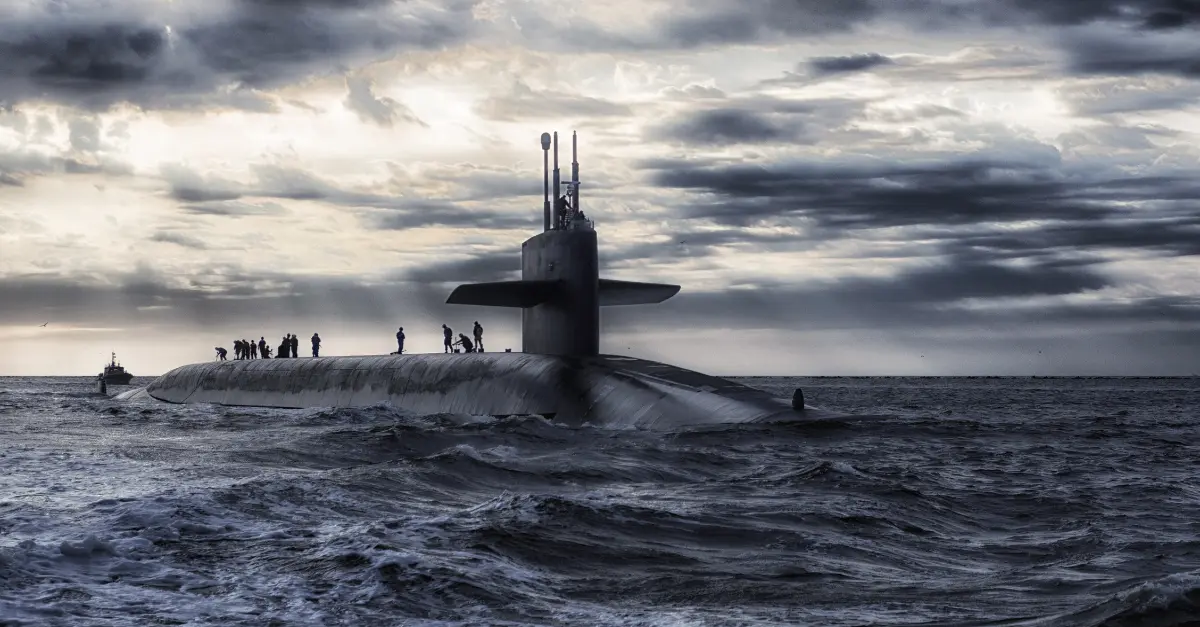
In this setting, a French attack submarine plays three roles that general staffs clearly distinguish. It monitors, quietly gathering intelligence. It protects, by escorting the vessels of the strategic ocean force or a carrier group. It deters, because its mere presumed presence complicates an adversary’s calculations. I stress that these functions belong to the general doctrine of SSNs, not to a specific mission assigned to the Rubis.
A major industrial and economic stake
The DGA quantifies the programme’s footprint: more than 10,000 people and 800 companies involved across the country. Today, 3,000 direct jobs, including 800 in subcontracting, are mobilised every day. These figures come from the institution itself, which has an interest in promoting its programme. They remain a useful order of magnitude for gauging the weight of the Cherbourg shipyard in the Cotentin economy.
There is also a sovereignty issue. Only a handful of countries master the design and construction of nuclear attack submarines. The DGA embraces this by stating that France remains in “the very small circle” of nations operating modern, high-performing SSNs. This mastery has a cost and requires keeping rare skills alive over several decades, without sudden swings in workload.
Points of vigilance
The subject is not free of debate, and I prefer to lay it out honestly. Supporters of the programme argue that a fleet of six modern SSNs is the minimum needed to ensure a permanent presence in several theatres. They also point out that the current delivery pace extends the life of the old Rubis-class boats, some of which are reaching an advanced age for a nuclear-powered vessel.
Sceptics raise other questions. They concern the overall cost of the class, the pace of deliveries, and the trade-off with other priorities in the military programming law, such as drones or air defence. I have no up-to-date cost figure in the source I consulted. It will have to be requested from the DGA or found in parliamentary reports before drawing any conclusion.
What to watch next
Three milestones will show how well the programme is under control. The first is the launch of the Rubis, which will depend on the preparation schedule at Cachin. The second is the De Grasse entering active service, announced as imminent by the DGA. The third is the delivery of the Casabianca, expected by 2030. In the meantime, the challenge will be to meet these deadlines without sacrificing the quality of the trials, which determine the operational credibility of each vessel.
One question remains open: how will France fit this new fleet to growing needs in the Mediterranean, the North Atlantic and the Indo-Pacific, without being able to be everywhere at once?
FAQ
Is the Rubis already in service?
No. It has just left its construction hall. It still has to be launched, go through quayside tests and then sea trials, and be delivered to the French Navy.
How many submarines does the Barracuda programme include?
Six submarines have been ordered. The Casabianca, the sixth and last, is due to be delivered by 2030 under the 2024-2030 military programming law.
Why is the name Rubis being reused?
The Navy reuses the names of units decorated for combat. The new Rubis inherits the traditions of the Second World War minelaying submarine, a holder of the Cross of the Liberation. The DGA cites 28 combat missions and 683 mines laid.
Where will the Rubis be based?
I have found no public information on its home port. That detail will have to come from the French Navy.