
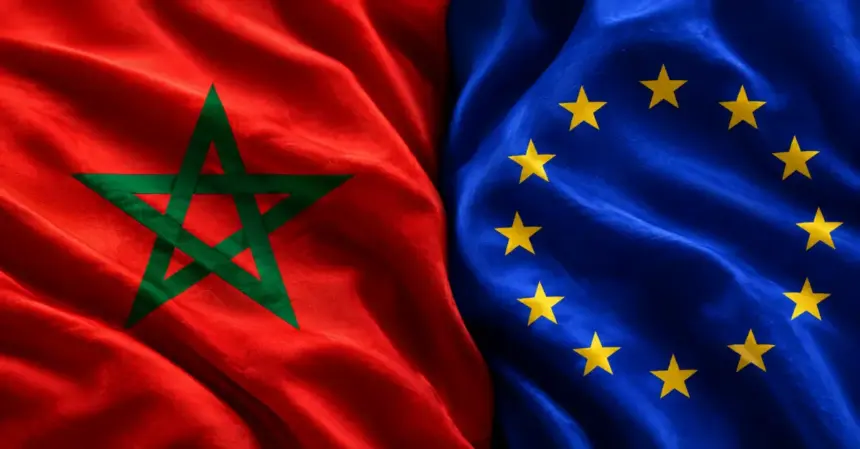
We say this with the candour of a newsroom that owns its point of view: Europe remains an indispensable partner, but the way it treats Rabat justifies the Kingdom no longer putting all its eggs in one basket. Recent events illustrate this well.
A major partner, but one that imposes conditions
We should first recall Europe’s weight. According to Afreximbank’s “African Trade Heatmaps 2026” report, based on 2025 data, Morocco’s trade reaches roughly $33 billion with France and $30 billion with Spain, against nearly $16 billion with China. Spain and France also rank among the Kingdom’s leading trading partners according to Moroccan statistics for 2024. No one in Rabat is thinking of turning their back on this market.
The problem lies in the nature of the relationship. For years, Morocco has been negotiating with a partner that ties its trade agreements to political questions, and that does not speak with one voice. On 4 October 2024, the Court of Justice of the European Union definitively annulled the agricultural and fisheries agreements, on the grounds that the consent of the so-called “people of Western Sahara” had not been obtained. Rabat denounced a “blatant political bias”. We see it above all as the symptom of a European legal and political framework in which the Moroccan Sahara issue serves sometimes as a grievance, sometimes as a bargaining chip.
The procedures then dragged on. The Council of the EU only authorised the opening of negotiations on a new fisheries agreement on 20 January 2026, even though the previous protocol had expired in 2023. In the meantime, NGOs and European lawmakers warned that any new agreement covering the Sahara would be “legally fragile”. For exporters and fishermen, this uncertainty has a concrete cost. Moroccan economic operators bear the burden, not the institutions that prolong it.
Pressure disguised as principle
European law can be defended. The judges in Luxembourg apply rules they consider binding, and organisations such as Human Rights Watch argue that the self-determination of the Sahrawis must remain central (even though every country in the world knows that Algeria is behind all of this). That view exists and deserves to be set out. But the accumulation of episodes fuels, in Rabat, the feeling of political pressure dressed up as moral considerations:
- Visas used as leverage. In 2021, France announced a halving of the visas issued to Moroccans, officially to secure more cooperation on consular travel documents. The measure was lifted at the end of 2022.
- The Ceuta crisis and the Spanish episode. In 2021, the diplomatic crisis with Madrid, triggered by the medical admission of the Polisario leader, showed that the issue could be instrumentalised. Spain ultimately revised its position in March 2022.
- The European Parliament and the press. In a resolution of January 2023, adopted in the wake of the corruption scandal affecting the institution, MEPs criticised the state of press freedom in Morocco. Rabat saw it as interference, all the more so as the same assembly was itself under scrutiny at the time.
- Agricultural protectionism. Quotas, sanitary controls and campaigns by European producer groups against Moroccan products, notably tomatoes, are a reminder that market opening has its limits once competition is felt.
- Migration outsourcing. Europe expects Morocco to contain flows towards its borders, while offering in return modest funding and mobility promises that are rarely kept.
Each point, taken in isolation, can be given a technical or legal explanation. Their repetition tells a different story: a relationship in which Rabat is required to prove its reliability without ever being assured of reciprocity.
The Moroccan Sahara, or the difference between announcement and method
On the Sahara, the contrast is stark. The United States recognised Morocco’s sovereignty over the Sahara in December 2020, under Donald Trump’s first presidency. That decision has been maintained and built upon. On 31 October 2025, the Security Council adopted Resolution 2797 with 11 votes in favour, none against and three abstentions (Russia, China, Pakistan). The text calls on the parties to negotiate on the basis of the autonomy plan proposed by Morocco, which it considers could be the “most feasible” solution. It also welcomes Washington’s readiness to host the negotiations, and a meeting was held at the US embassy in Madrid in February 2026, under the aegis of Ambassador Mike Waltz.
We put it plainly: in a few years, Washington has moved an issue that others had kept frozen for decades, sometimes taking advantage of its deadlock to put pressure on Rabat. Europeans do not all hold the same position, and it would be unfair to ignore that. Spain in 2022, France in 2024 and the United Kingdom in 2025 backed the autonomy plan, and Paris welcomed Resolution 2797. But these shifts came late, from capitals that had long kept the issue as a card to play. The institutions in Brussels, for their part, continue to adhere to the framework set by the Court of Justice.
America, a partner on the rise
The American figures point in the direction of diversification. According to the Census Bureau, trade in goods between the two countries reached roughly $5.3 billion over the first seven months of 2026, up from $4.33 billion a year earlier. US exports to Morocco rose by 25.2% to $4.07 billion, driven in particular by aerospace, which exceeds $1 billion. Morocco has been bound to the United States by a free trade agreement since 2006, an asset few African countries possess.
One point of caution is warranted, however: the balance is heavily in deficit for Morocco. For July 2026, US exports to the Kingdom ($686 million) are more than three times US imports from Morocco ($185 million). Diversifying is not enough; Moroccan products must also move up the value chain and find their place in American supply chains. Fertilisers, automotive and electrical equipment are the most advanced avenues.
Asia, an industrial lever to be handled with method
On the Asian side, China became Morocco’s third-largest trading partner in 2024, according to national statistics, with sharply rising imports but stagnating exports. This gap is a reminder that diversification is not a blank cheque. Beijing has nonetheless announced the removal of tariffs on imports from 53 African countries, including Morocco, from May 2026, which opens a window for Moroccan products. On the industrial front, Chinese investors are drawn to Morocco for its geographic position, its market-access agreements and its phosphates, a raw material for LFP batteries.
China is not the only face of Asia. Japan, South Korea and India offer complementary prospects, in automotive, energy and defence in particular. A serious strategy would treat them as full partners, not simply as suppliers of capital.
What diversifying means
Let us be precise, so as not to fall into slogans. Diversifying does not mean breaking with Europe, which will long remain the Kingdom’s main outlet. It means reducing vulnerability to a single counterpart, and therefore its ability to make us bend. Concretely, three priorities stand out: broadening the export base towards the American and Asian markets, negotiating with each partner without ceding technological or financial dependence, and protecting existing agreements against political or judicial reversals.
One question remains that current events do not yet settle: will the fisheries agreement under negotiation with Brussels, which aimed for an agreement in principle by the third quarter of 2026, hold up legally against new challenges? The answer will say a great deal about Europe’s ability to treat Morocco as a partner rather than as a debtor. In the meantime, Rabat has every reason to multiply its options.
FAQ
Is Europe still Morocco’s leading partner?
Yes. France and Spain rank among its main trading partners. Diversification aims to reduce dependence, not to break away.
What does Resolution 2797 say about the Moroccan Sahara?
Adopted on 31 October 2025, it calls for negotiations based on the Moroccan autonomy plan, which it considers to be the “most feasible” solution. It does not set the final outcome.
Why were the agricultural and fisheries agreements with the EU annulled?
The EU Court of Justice ruled on 4 October 2024 that the consent of the people of Western Sahara had not been obtained. Morocco disputes this reading.
Is China a risk-free alternative?
No. Morocco imports far more from China than it exports. The challenge is to balance trade and attract industrial investment.