
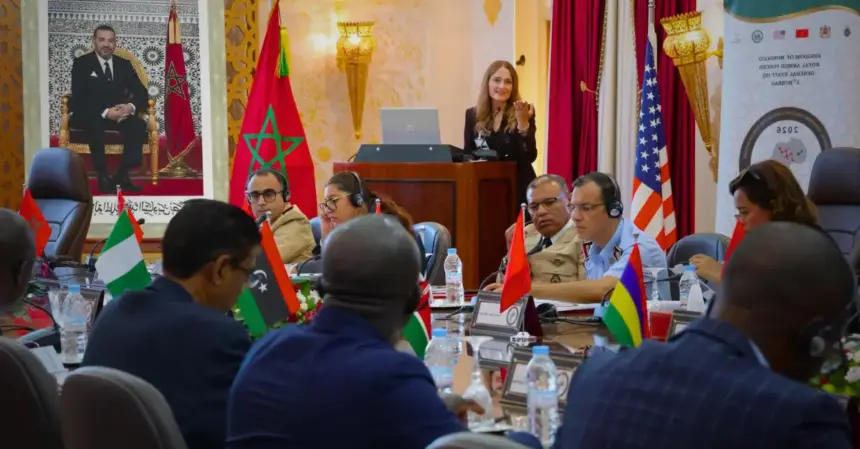
Bringing together practitioners from ten African States Parties to the Chemical Weapons Convention, the initiative illustrates Morocco’s growing role as a regional platform for non-conventional security cooperation.
A three-day exercise under multilateral supervision
The US Department of State, through its office dedicated to countering weapons-of-mass-destruction terrorism, organized this exercise, named “Atlas,” in partnership with Moroccan diplomacy and the Royal Armed Forces (FAR). The Pacific Northwest National Laboratory, a US national laboratory long involved in research on chemical and biological threats, provided the technical expertise needed to design the scenarios.
The format chosen — a tabletop exercise — is a standard method in the field of CBRN security (chemical, biological, radiological, nuclear): it allows officials from different agencies to test their coordination procedures against a fictional threat or attack scenario without handling any real material. Over three days, participants worked through prevention, detection and response to this type of threat, under the guidance of a panel of international experts, including representatives of the Organisation for the Prohibition of Chemical Weapons (OPCW), the body that oversees the verification regime established by the Chemical Weapons Convention (CWC) since it entered into force in 1997.
This format is not new to the region. In July 2024, the same State Department office organized, with support from PNNL specialists, the “Saharan Fox” exercise in Cyprus, focused on strengthening forensic capabilities against chemical terrorism, bringing together around fifty practitioners from a dozen countries, including Morocco, Algeria, Egypt, Kenya, Nigeria and Senegal. “Atlas” fits into this same logic of collective capacity-building, this time with Rabat as the anchor point rather than simply a participant.
Why chemical security remains a front-line issue
The threat of chemical terrorism is far from an abstract scenario. While the largest state arsenals remain, for the most part, under the control of the OPCW’s verification regime — which has overseen the destruction of declared stockpiles in Russia, the United States, Albania and Libya — the diversion of chemical precursors intended for industrial or agricultural use, often legally available, remains a persistent concern for intelligence and domestic security services. The use of sarin by the Syrian regime in 2013, and documented incidents involving non-state actors in Syria and Iraq, served as reminders that the line between a state program and clandestine acquisition can be porous.
For African States Parties to the CWC, the stakes are twofold. On one hand, there is a need to strengthen national legal frameworks that allow for the prosecution of possession or trafficking of chemical precursors — an effort the OPCW has been pursuing for several years with French-speaking African countries, notably through forums dedicated to legislation implementing the Convention. On the other hand, there is a need to build effective interagency cooperation among customs, armed forces, intelligence services and civil protection, a prerequisite for a rapid response in the event of an incident.
The regional security context gives this issue particular weight. The Sahel-Sahara belt has seen, following the gradual withdrawal of longstanding Western actors and the realignment of regional alliances after several Sahel states left ECOWAS, a documented decline in the capacity to monitor extremist networks. Against this backdrop, the proliferation of dual-use skills or materials — capable of serving both civilian purposes and the manufacture of rudimentary chemical agents — is among the scenarios that Western and African services are seeking to anticipate.
Morocco, a relay for non-conventional security cooperation
Organizing “Atlas” out of Morocco confirms an already well-established trend: the role the kingdom plays as a platform within the cooperative security architecture Washington has built on the African continent. This position has been built up in successive layers.
In December 2022, Rabat and Washington had already co-hosted in Tangier the first regional workshop of the Proliferation Security Initiative (PSI) in North Africa, bringing together civilian and military officials from ten governments around issues of interdicting cargoes linked to weapons of mass destruction. Morocco has also hosted, since 2022, the Marrakech Platform, an intergovernmental counterterrorism cooperation mechanism jointly overseen with the UN Office of Counter-Terrorism, which regularly gathers heads of security and counterterrorism agencies from across the continent.
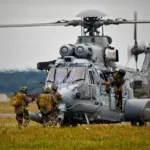
This momentum accelerated with the 2026 edition of African Lion, the largest annual joint military exercise held on the African continent under AFRICOM’s aegis. More than 400 service members from several countries gathered in Agadir in late April, for a program covering drones, cyber defense and satellite operations, among other areas. On that occasion, Rabat and Washington signed a defense cooperation roadmap covering the 2026-2036 decade, which anchors several recurring bilateral exercise frameworks over the long term, including the one known as “Atlas Handshake” — a distinct, mainly naval, variant within this family of joint exercises.
The accumulation of these initiatives — PSI, the Marrakech Platform, the CBRN component of African Lion, exercises like Saharan Fox and now Atlas — outlines a coherent strategy on the US side: turning Morocco into an entry point for disseminating security standards and practices aligned with Washington’s priorities to a wider set of African states. For Rabat, this centrality reinforces a security diplomacy built on the kingdom’s relative stability and decades of uninterrupted military cooperation with the United States, at a time when several traditional Western partnerships elsewhere in the region have weakened.
Key points to remember
- Format: three-day tabletop exercise
- Organizers: US Department of State, with technical support from the Pacific Northwest National Laboratory (PNNL)
- Local partners: Moroccan diplomacy and the Royal Armed Forces (FAR)
- Participants: practitioners from ten African States Parties to the Chemical Weapons Convention (CWC)
- Oversight: multilateral experts, including from the Organisation for the Prohibition of Chemical Weapons (OPCW)
- Topics covered: prevention, detection and response to chemical terrorism threats
What’s next for this regional cooperation
Exercises of this kind do not typically lead to immediate public announcements: their value lies in the accumulation of shared procedures and interpersonal contacts between agencies, rather than in short-term spectacular results. It remains to be seen whether “Atlas” will be repeated on a recurring basis, in the manner of Saharan Fox or African Lion, and whether other African capitals will, in turn, seek to host this type of training rather than take part in it as guests. The answer to that question will say a great deal about how the map of security cooperation between the United States and the African continent is being redrawn over the long term.
FAQ
What is the Chemical Weapons Convention (CWC)?
An international treaty that entered into force in 1997, banning the development, production, stockpiling and use of chemical weapons, with compliance verified by the OPCW.
What role does the Pacific Northwest National Laboratory play in this exercise?
This US national laboratory, specialized notably in chemical threat detection, provides the scientific and technical expertise needed to design the scenarios and train practitioners.
How does this exercise differ from a conventional military exercise like African Lion?
“Atlas” is a tabletop exercise focused on civilian-security interagency coordination against a chemical threat, while African Lion is a much larger multinational military exercise covering a far broader range of capabilities.
Has Morocco hosted similar initiatives before?
Yes, including the Tangier regional workshop of the Proliferation Security Initiative (PSI) in 2022, and it has hosted the Marrakech Platform for continental counterterrorism cooperation since 2022.