
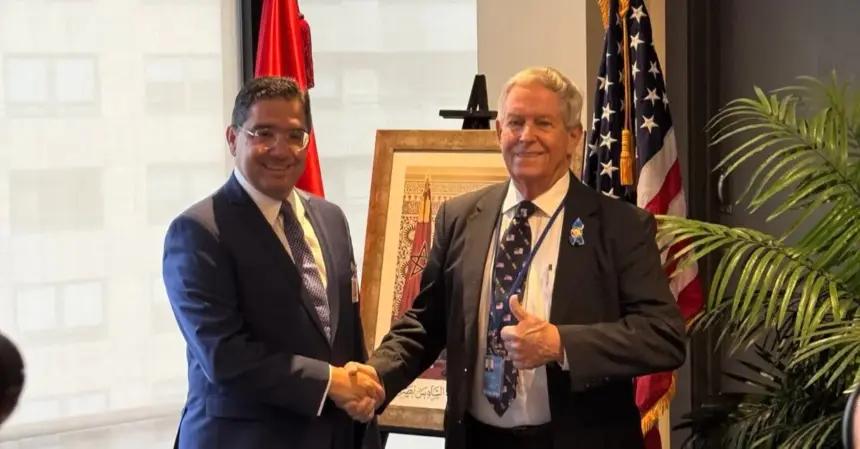
In a post on X, he says he is grateful to have met Morocco’s foreign minister, Nasser Bourita, to discuss the lasting friendship between the two countries, Moroccan sovereignty over Western Sahara and the need for such a designation. Under US law, the operative term is “designation,” and the distinction matters.
The congressman has been pursuing this for more than a year. Here I look at his track record, his arguments, what the bills under discussion actually contain and the objections they raise.
A lawmaker who has pushed the issue since winter 2025
Wilson is no newcomer to the file. He co-chairs the Congressional Morocco Caucus with Democrat Brad Schneider, and he urged Donald Trump to designate the Polisario as a terrorist organization even before the inauguration of January 20, 2025. A few landmarks help place the man.
- 🇺🇸 U.S. Representative since 2001, for South Carolina’s 2nd district
- 🎂 Born July 31, 1947, in Charleston, South Carolina
- 🏛️ Former South Carolina state senator (1985–2001)
- 🎖️ Former officer (colonel) in the National Guard
His approach has been that of a campaign in several stages. After meeting Nasser Bourita in Washington in April 2025, he announced he would introduce legislation, arguing that Iran was seeking a foothold in Africa through the Polisario. He filed the bill in June, then met the minister again in New York in September 2025, on the sidelines of the UN General Assembly, shortly before the Security Council’s deadline on Western Sahara. In February 2026, right after the Madrid meeting on the issue, he called on Algeria to reconsider some of its alliances, according to the Moroccan press.
The arguments put forward
Wilson describes the Polisario as a Marxist-inspired militia backed by Iran, Hezbollah and Russia, one that would give Tehran a strategic foothold in Africa and threaten a US ally. His bill relies on a 2025 Washington Post investigation, according to which Hezbollah trained Polisario fighters and Iranian drones are in its arsenal. He also cites a Heritage Foundation report describing Iranian drones, smuggling routes shared with Russian agents and funding of jihadist groups in the Sahel.
These are allegations made by their authors, and the Sahrawi movement disputes them. I report them as such: they underpin the case for designation, but no independent body has ruled on them.
What the bills actually provide
Three bills are circulating, sponsored by lawmakers from both parties. The first, the Polisario Front Terrorist Designation Act, was filed in the House in June 2025 by Wilson and Democrat Jimmy Panetta, then referred to the Foreign Affairs and Judiciary committees. It reportedly has thirteen Republican and two Democratic cosponsors, according to the American press. Among other things, it asks the State Department for a report on the Polisario’s leaders, operations, foreign backers and ties to Iran, Russia, Hezbollah and the Revolutionary Guards.
In the Senate, Ted Cruz, Tom Cotton and Rick Scott introduced a bill on March 11, 2026, with a more conditional mechanism: designation would follow only if the Secretary of State confirms cooperation with Iranian groups already listed as terrorist. Finally, Democrat Josh Gottheimer and Republican Ronny Jackson introduced the House counterpart of that text on July 30, 2026.
These bills must pass both chambers and be signed into law. To my knowledge, none has cleared committee. More importantly, formal designation rests with the Secretary of State, and I have found no announcement from the executive branch to date. Wilson’s message expresses a political will; it is not a decision.
What a designation would change
Listing an organization as a foreign terrorist organization generally entails freezing its assets in the United States, banning any material support and imposing travel restrictions on the people concerned. Ted Cruz says the Polisario and its leaders would be cut off from the global financial system. Supporters see it as a lever against Algiers, whose backing of the movement is regularly denounced by its critics.
Legal and practical objections
The project has met reservations. On April 30, 2026, two independent UN experts, including the Special Rapporteur on counter-terrorism, voiced concerns about Wilson’s bill. They fear inconsistencies with US obligations regarding the Sahrawi people’s right to self-determination. Western Sahara is, after all, on the UN list of non-self-governing territories.
A more practical objection also arises. The Polisario is among the parties invited to the current talks. One may wonder how that participation would square with a terrorist listing, and whether Washington, both mediator and partner of Rabat, would be ready to bear the consequences.
A busy diplomatic calendar
Wilson’s message comes in a dense sequence of events. At the end of October 2025, the Security Council adopted Resolution 2797, which treats the Moroccan initiative as the basis for settling the dispute. Analysts read it with nuance: the text cautiously called for negotiations taking the Moroccan plan as a basis, whereas the organizers of the Madrid meeting on February 8–9, 2026, told participants that this plan was the only document on the table. Closed-door talks followed in Washington on February 23–24.
Readings diverge. Algiers says it plays only an observer role, while France 24 judges that the US administration is de facto burying the self-determination referendum long demanded by the Polisario. A deadline is approaching: the mandate of the UN mission in Western Sahara, MINURSO, expires on October 31, 2026. Nasser Bourita, in New York for the 81st session of the General Assembly, met Secretary-General António Guterres on September 16.
What remains to be settled
For Rabat, the backing of lawmakers from both parties complements the executive’s position and gives it a firmer footing than the alternation of administrations. For Algiers and the Polisario, the challenge is to prevent the Sahara question from being reduced to a regional security issue tied to Iran, which would push self-determination into the background.
A fundamental uncertainty remains. Would a terrorist listing speed up negotiations by isolating one of the parties, or complicate them by closing the door on an interlocutor the United Nations still recognizes? The answer will depend less on a social media post than on the US administration’s decision and on the UN calendar in the coming weeks.
Frequently asked questions
Can Joe Wilson have the Polisario designated a terrorist organization?
No. He can introduce and champion a bill, but formal designation rests with the Secretary of State, and the bills must be passed by both chambers of Congress.
Is the Polisario currently designated a terrorist organization by the United States?
I have found no announcement to that effect to date. The bills introduced in the House and the Senate are under committee review.
Why is Joe Wilson so committed to this?
He presents the Polisario as a proxy of Iran, Hezbollah and Russia in North Africa. These accusations, which the movement disputes, rest on press investigations and think tank reports.
What deadline should we watch?
The expiry of the MINURSO mandate on October 31, 2026, which will trigger new discussions at the Security Council.