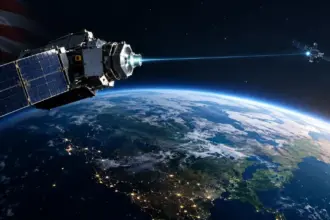
I have been watching the rise of Rassvet, Russia’s broadband constellation designed as a Starlink equivalent, for several months now. The latest orbital tracking data is a reminder of something obvious: launching dozens of satellites into low Earth orbit is not enough to build a working network. Two satellites from the second batch are expected to fall back to Earth and burn up in the atmosphere within a day or two. Behind this technical incident lies a broader strategic question: can Moscow build a sovereign space infrastructure, including for military uses?
What the tracking data shows
According to astrophysicist Jonathan McDowell, a satellite tracking specialist at the Harvard-Smithsonian Center for Astrophysics, two Rassvet-3 satellites never managed to raise their orbit. He has published an updated chart of the constellation’s altitude, and I find it revealing: most of the satellites from the two 2026 launches are stabilizing at around 500 to 510 km, while two spacecraft from the second batch have dropped below 230 km and are falling fast.
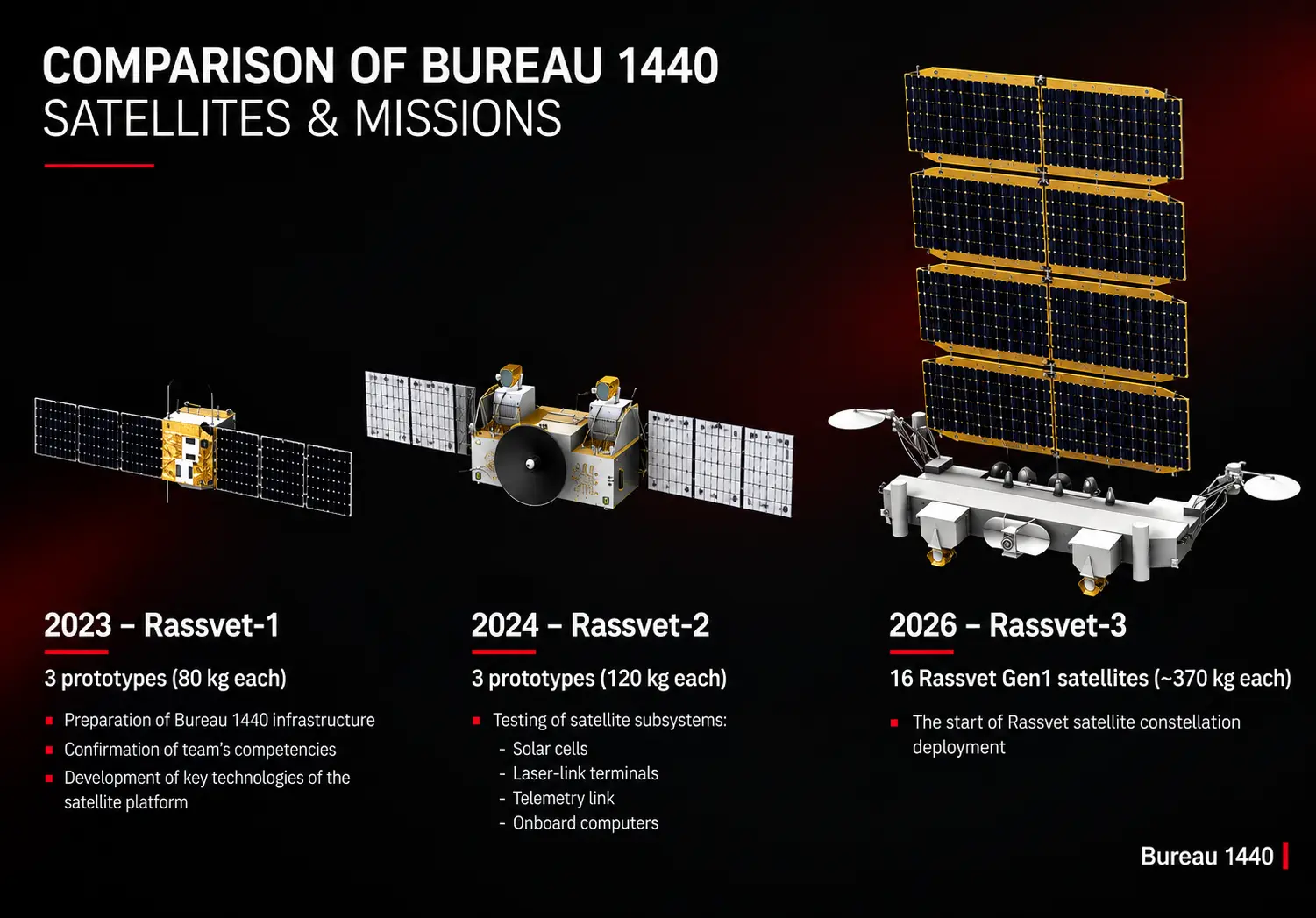
Here are the key figures to keep in mind:
- First batch: launched on March 23, 2026, with one satellite (object 4) re-entering the atmosphere in June without performing a single maneuver.
- Second batch: 16 Rassvet-3 satellites launched on July 19, 2026, on a Soyuz-2.1b rocket from the Plesetsk Cosmodrome.
- Two failed satellites: already below 300 km at the end of August, with no orbit-raising maneuver.
- Provisional tally: three satellites lost out of 32 launched, or about 9% of the fleet.
- Satellites still below the target altitude: one from the first batch at about 345 km, another above 470 km, and one from the second batch at about 363 km.
A note of caution is in order. McDowell does not say whether these last spacecraft are still working. Altitude and operational status are two different things, and I will avoid concluding either failure or success without further data.
Why these failures matter
A low insertion orbit is used to check a satellite’s behavior before it is raised to its service altitude. A spacecraft that does not maneuver at all, as with object 4 from the first batch, usually points to an early failure: propulsion, power, or communication with the ground. Without propulsion, atmospheric drag pulls the satellite down until it burns up.
A loss rate of around 9% is nothing dramatic for a program in its early stages. The first Starlink deployments also had their share of failures. But scale changes the picture. Bureau 1440 is aiming for 292 satellites by the end of 2027 and up to 900 by 2035. To keep to that schedule, series reliability will have to improve markedly, and so will the launch cadence.
A private player in a tightly controlled sector
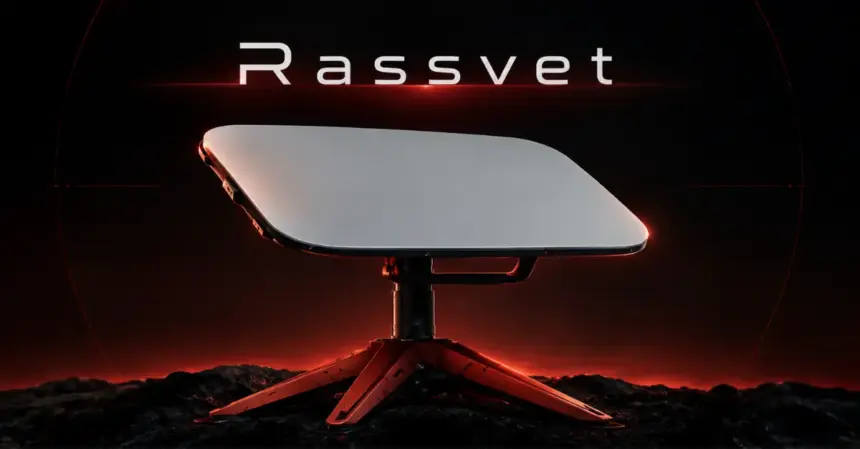
Rassvet is developed by Bureau 1440, a private company that began as a research unit within the mobile operator MegaFon. The system is meant to provide satellite internet access across the whole of Russia, with partial commercial service announced for 2027 and subscriber terminals weighing less than 15 kg.
This status deserves attention. In a Russian space sector long dominated by Roscosmos, the arrival of a private operator of this scale is notable. It does not necessarily mean independence from the state. Neither Roscosmos nor the Russian Ministry of Defense has announced the Rassvet launches, which keeps the military’s exact role in the project unclear.

The military stakes behind broadband
This is where the subject moves beyond the commercial sphere. According to tracking data, the constellation was already providing at least two daily coverage windows over Ukraine in August, each lasting more than an hour. That observation has raised concerns that Russian forces could eventually use it the way the Ukrainian military uses Starlink for its communications.
I remain measured on this point. Orbital coverage says nothing about how a system is actually used. Nothing in the information available proves any actual military use. But the hypothesis is plausible for two reasons:
- Modern armies depend on resilient communications, and low-orbit constellations are harder to neutralize than a single geostationary satellite.
- The Ukrainian experience with Starlink has shown the tactical value of mobile internet access in the field.
Against this, other analysts believe Russia is still far from an operational equivalent: few satellites in service, terminals still in development, and a deployment schedule that has yet to be proven. Both readings hold up, and that is precisely what makes this case interesting to follow.

What this says about the constellation race
The contrast with SpaceX is striking. Starlink counts thousands of satellites and enjoys a launch cadence that no competitor matches today. Rassvet stands at 32 spacecraft, with a Soyuz-2.1b rocket carrying batches of 16 satellites. Catching up, if it happens, will take years.
Still, Russia is not alone in wanting its own constellation: Europe, China and others are developing comparable projects, for reasons of digital sovereignty as much as commercial ones. Rassvet fits into this global trend, with its own specificities: a context of sanctions, limited access to advanced electronic components, and an openly security-driven dimension in the background.
My analysis
I draw three lessons. First, the current losses are modest but real, and they force Bureau 1440 to prove its reliability before accelerating. Second, with most satellites having reached their service altitude, the program is not at a standstill. Finally, the military dimension remains the big unknown: it will depend less on these isolated failures than on Moscow’s ability to maintain its launch cadence through 2027.
The real question, then, is not whether Rassvet can rival Starlink in the short term, but whether Russia can build a network large enough for its own needs quickly enough. The answer will come from the next launches.
FAQ
What is Rassvet?
It is a constellation of broadband satellites in low Earth orbit, developed by Bureau 1440, which the press describes as Russia’s answer to Starlink.
How many Rassvet satellites have been lost?
If the two failed satellites fall back as expected, the total will reach three out of 32 launched since March 2026.
Is Rassvet used by the Russian military?
No source in the available information confirms it. Concerns exist because of the coverage over Ukraine, but actual use remains to be established.
When is commercial service due to start?
Partial commercial service is planned for 2027, according to Bureau 1440’s timeline.