Trade explains most of the official agenda, but the calendar invites us to read the geopolitics as well.
The context: the end of MINURSO
The mandate of the United Nations Mission for the Referendum in Western Sahara ended on 31 October 2026, with the liquidation period starting on 1 November. The Security Council, meeting on 30 October, failed to reach an agreement on renewing the mission. It had been present for 35 years, since the 1991 ceasefire. The withdrawal is already under way: five military observers left Laâyoune on 16 November. Omar Hilale: “There is no longer a MINURSO, neither legally nor politically.”
Rabat welcomed this development. The royal cabinet nevertheless specified that the Kingdom’s commitment to the ceasefire would not change with the end of the mandate. I would point out that the Polisario, for its part, declared the end of that ceasefire in November 2020, which shows that the situation on the ground remains contested.
It is in this moment of transition that Rabat and Nouakchott are speeding up their bilateral files.
The road, an economic axis first and foremost
On 21 September, according to the article I am drawing on, the Equipment ministers of the two countries signed a framework agreement in Rabat to rehabilitate and widen Mauritanian National Road No. 4. Morocco’s Minister Delegate for Foreign Trade, Omar Hejira, himself referred to this September 2026 framework agreement, which covers the Nouakchott-Nouadhibou link, a distance of 480 kilometers.
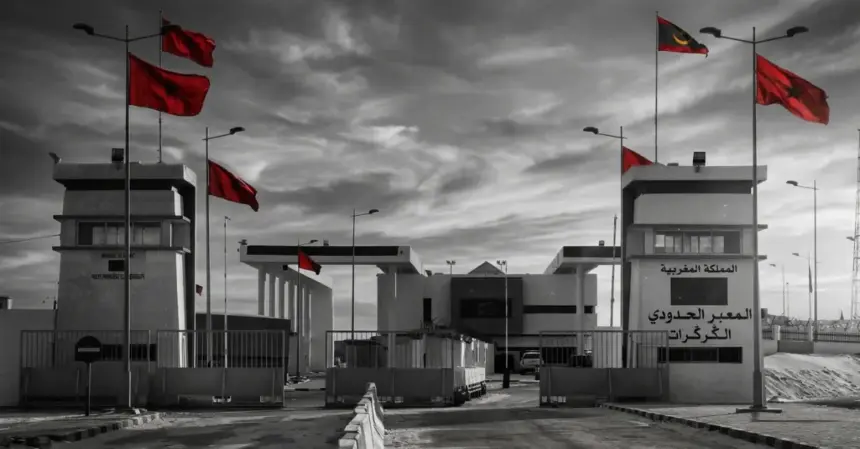
The stakes are concrete. On the Mauritanian side, this road extends from the Guerguerat border post, through which the trucks carrying Moroccan goods pass. Some of these trucks supply the Mauritanian market. Others continue on to West Africa, notably Senegal via Rosso. A road in better condition reduces travel times and transport costs.
On the Moroccan side, Minister Nizar Baraka had mentioned, again according to this source, a project to extend the Tiznit-Dakhla road as far as Guerguerat, with a later continuation toward Zouerate, in coordination with Nouakchott. I have found neither a timetable nor public funding for this extension: at this stage, it therefore remains an intention.
Trade, between a statistical record and the revision of an old agreement
On 16 November, at the opening of the third Morocco Week in Nouakchott, Omar Hejira stated that bilateral trade had reached nearly 3.7 billion dirhams in 2025, up 15% year on year. He also indicated that Mauritania was the second-largest African market for Moroccan exports.
The agreement to be revised dates from 4 August 1986. It rests on two product lists: list A, admitted duty-free in Mauritania, and list B, admitted duty-free in Morocco. It is a text from an era when trade was far smaller and the composition of flows very different.
Here are the key points of the discussions:
- Joint trade committee: its second session is scheduled for 27 January 2027 in Morocco, according to the Mauritanian press report.
- Joint working group: it is due to deliver by the end of January a plan to regulate the circulation of agricultural and food products.
- Announced content: harmonization of inspections, strengthening of Mauritanian laboratories, mutual recognition of sanitary accreditations.
- Wholesale market in Nouakchott: preliminary agreement on a site with cold chains and modern slaughterhouses.
- Quantified target: 6 billion dirhams in trade by 2030, with a larger share for Mauritanian exports.
This last point deserves attention. Hejira argued for an increase in Mauritanian exports to Morocco in order to ease the imbalance in flows. In other words, the balance today tilts clearly in Morocco’s favor. An agreement that did not correct this asymmetry would risk being perceived in Nouakchott as a one-sided text.
Beyond trade, a political reading
The original article argues that these measures go beyond the commercial framework and form part of Morocco’s desire to establish a “new reality” in the Sahara. I am not in a position to demonstrate this intention. The signed texts are technical and mention neither the status of the territory nor the border.
I can, however, point to facts that make this reading plausible. Infrastructure and customs normalization at Guerguerat consolidate a regular flow of goods. This flow relies on a post that Rabat says it secured in 2020 after blockades. And this reinforcement comes at the very moment when the only UN presence on the ground is disappearing.
The question of borders
The most sensitive point concerns the territory’s southern borders. According to the original source, Mauritania reportedly asked, during the Madrid round in February, for the creation of a committee tasked with clarifying, by consensus, the final international borders, drawing on the Secretary-General’s report of 1 October. I was unable to verify this point through an independent source, so I present it as information to be confirmed.
If it is accurate, this request would express a legitimate concern: Nouakchott wants to avoid a settlement of the Sahara issue leaving its northern border unresolved. The article suggests that direct bilateral dialogue could address the part of the issue that concerns the two countries, without going through a UN committee. This is an analytical hypothesis, not an announcement. I also note that the source asserts that the borders recognized by Mauritania raise no dispute with the region. Here again, no official document confirms this in what I have consulted.
What is at stake in the coming months
Three parameters seem decisive to me.
The first is implementation. A 480-kilometer road requires funding, calls for tender, and years of construction. For now, the published timetable is limited to the committee meeting of 27 January.
The second is the trade balance. The target of 6 billion dirhams in 2030 assumes strong growth, and the clause on Mauritanian exports will be a test of credibility.
The third is the security of the Guerguerat corridor. The withdrawal of MINURSO, which notably had monitoring and demining missions east of the defensive wall, leaves open questions: an Afrik.com article points out that demining east of the wall still has no successor.
FAQ
Does the end of MINURSO mean the end of the ceasefire?
No, according to the position expressed by Rabat: the royal cabinet states that its commitment to the ceasefire remains. The Polisario, for its part, declared the ceasefire over in 2020.
What is the volume of trade between Morocco and Mauritania?
According to Omar Hejira, it reached nearly 3.7 billion dirhams in 2025, up 15% year on year. The stated target is 6 billion dirhams by 2030.
When will the 1986 trade agreement be revised?
No signing date has been announced. The second session of the joint committee is scheduled for 27 January 2027 in Morocco.
Has Mauritania changed its position on the Sahara?
No public text indicates so. The agreements signed are commercial and road-related and do not address the status of the territory.