

These two cities, one at the gates of the Sahara, the other in the southern provinces, have become the two pillars of an energy strategy Morocco has been building for over a decade. I’ve passed through both several times while preparing treks in the Atlas and driving down toward the southern coast, and each time the landscape had shifted a little more. This article tells the story of how these two very different places are helping power an entire country.
Ouarzazate, Morocco’s solar laboratory
Ouarzazate was never chosen at random. Known to travelers for its film studios and as a gateway to the desert, the city enjoys exceptional sunshine, with more than 2,600 hours of sun per year and skies that stay clear most of the year. That’s what pushed Morocco, starting in 2013, to build what would become one of the largest concentrated solar power complexes on the planet there.
The Noor Ouarzazate complex spans roughly 3,000 hectares northeast of the city, in the rural commune of Ghessate. It wasn’t built all at once, but in successive phases, each using a different technology. That step-by-step approach is part of why the site still draws engineers from other countries who come to study it.
The Noor complex, a stack of technologies
The first phase, Noor I, came online in February 2016 with a capacity of 160 MW using parabolic trough CSP technology, where rows of curved mirrors focus sunlight onto a tube filled with heat-transfer fluid. Noor II followed with 200 MW, then Noor III with 150 MW using tower technology, a different setup where hundreds of adjustable mirrors reflect light toward a central receiver. Noor IV, more modest at 72 MW, introduced conventional photovoltaic panels, closer to what gets installed on rooftops today.
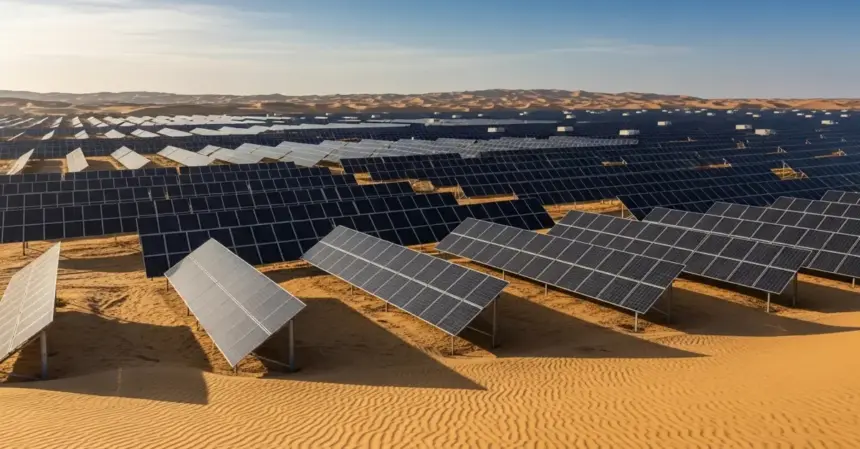
Altogether, the complex reaches a capacity of over 580 MW, making it one of the largest concentrated solar installations in the world. Its standout feature is thermal storage: some of the plants on site can hold heat for several hours and keep generating electricity after sunset, something a standard photovoltaic panel simply can’t do. According to figures published by Morocco’s sustainable energy agency, Masen, the complex supplies power to the equivalent of nearly two million Moroccans and avoids hundreds of thousands of tons of CO2 emissions every year.
What I saw driving toward Ghessate
I still remember the first time I spotted the mirrors of Noor III from the road leading up to the Tichka pass. At first you notice a kind of reflection, like a distant lake, and as you get closer you realize it’s tens of thousands of panels all angled toward the sky. A taxi driver in Ouarzazate once told me the site had brought in engineers, workers, and entire families to a city that, until then, had mostly lived off tourism and film production. That kind of local testimony often tells me more than any official figure: a megaproject like this genuinely reshapes life in a mid-sized city on the edge of the desert.
Laâyoune, where wind meets sun
If Ouarzazate is the visible symbol of Moroccan solar power, Laâyoune plays a different, quieter but equally strategic role. The city, capital of the southern provinces, has something Ouarzazate doesn’t: steady Atlantic winds, averaging over 11 meters per second at some sites, a figure that makes it one of the most favorable regions in the world for combining solar and wind.
Noor Laâyoune and Noor Boujdour, the starting point
The region’s first solar installations, Noor Laâyoune I and Noor Boujdour I, came online in 2018 under the Noor PV I program. They’re modest compared to the Ouarzazate complex, at around 80 MW for Laâyoune and 20 MW for Boujdour, but they laid the groundwork for a local industrial ecosystem and proved photovoltaic power could work in an area that previously had little infrastructure. Since then, the Noor PV II program, announced with a total capacity of 800 MW spread across several sites in the kingdom including Laâyoune and Boujdour, has taken over, and an expansion project called Noor Boujdour II, around 350 MW, is set to significantly multiply installed capacity in the region.
Betting on solar-wind hybrids in the southern provinces
What really sets Laâyoune apart is the hybrid approach developers are pursuing there. By combining solar, wind, and increasingly battery storage, the goal isn’t just to generate electricity during daylight hours anymore, but to deliver a stable output, almost comparable to a conventional power plant, available for much of the day and night. Nearby wind farms at Tarfaya, Foum El Oued, and Akhfennir, which together add up to several hundred megawatts, fit into the same regional push. A representative from developer ACWA Power, quoted in trade press, described these sites as proof that renewable energy can now provide baseload power, not just a supplement to the conventional grid.
Why these two cities attract so many projects
You might wonder why Morocco chose to concentrate so much investment in two cities instead of spreading projects across the whole country. The answer comes down to a combination of factors rarely found together elsewhere in the kingdom.
- Some of the highest direct sunshine levels on the African continent, with very few cloudy days throughout the year
- Vast stretches of sparsely populated, largely non-arable land, available for large-scale installations without competing with agriculture
- Relative proximity to the national grid, which limits transmission losses
- A clear political commitment dating back to the Moroccan Solar Plan launched in 2009, with an official target of 52% renewable installed capacity by 2030
- Potential for local economic development, through skilled and unskilled jobs created during both construction and operation
That combination is why Ouarzazate and Laâyoune have become, almost by default, the two unofficial capitals of Morocco’s energy transition.
The numbers that stand out in 2026
It’s hard to talk about solar energy without backing it up with concrete data, even in a sector that moves fast. Solar currently accounts for around 6% of Morocco’s electricity generation, a modest share compared to hydropower or conventional thermal sources, but one that keeps growing as new phases come online. The Ouarzazate complex alone reportedly required an investment of more than two billion dollars, funded through a mix of Moroccan public money, loans from international lenders such as the World Bank and the French Development Agency, and partnerships with private operators.
Nationally, Morocco is now aiming for an electricity mix that’s mostly renewable, combining solar, wind, and hydropower, with the stated ambition of becoming a green electricity exporter to Europe through undersea interconnections currently under study. It’s no coincidence that ambitious projects like the privately-backed subsea cable linking Morocco to the UK emerged around the same time: the country is clearly trying to turn its climate advantage into a strategic position in the European energy market.
The limits you won’t find in the brochures
An honest article on this topic can’t stop at the flattering numbers. I’ve spoken with several people working in Morocco’s renewable energy sector, and the picture they paint is more nuanced than the one presented at ribbon-cutting ceremonies.
Water, the resource everyone forgets
The CSP technology used at Ouarzazate, the mirrors that concentrate heat, requires water to cool the plants and regularly clean the reflective surfaces exposed to desert dust. In a region that’s structurally water-stressed, that paradox keeps coming up in criticism of the complex, even though the most recent phases have switched to air-cooling systems that use much less water. It’s a detail rarely mentioned in public-facing presentations, and one worth knowing if you’re genuinely interested in the topic.
Financing and skills transfer
The other limitation has to do with the economic model. These megaprojects rely heavily on public-private partnerships and international financing, which raises questions about long-term debt and control over the infrastructure. Several Moroccan energy experts also point out that the country still needs to strengthen local training of engineers and specialized technicians, so it doesn’t remain permanently dependent on foreign expertise for maintenance and technological innovation. Building engineering schools and dedicated research centers, particularly around Ouarzazate, is a step in that direction, but there’s still a long way to go.
What this means if you’re traveling through southern Morocco
For a traveler or trekker passing through the region, these installations aren’t just an industrial curiosity. They’ve reshaped the local economy of cities that used to rely almost entirely on tourism, subsistence farming, or fishing. In Ouarzazate, new hotels, restaurants, and services have sprung up to accommodate technical teams arriving from around the world, which indirectly benefits visitors passing through on their way to the Dadès Gorges or Merzouga’s dunes.
In Laâyoune, the growth of solar and wind projects has come with broader infrastructure development, including new roads, a university hospital, and investment in higher education. If you’re planning a road trip down the Atlantic south coast, spotting these sites along the way, often visible right from the main road, adds an unexpected dimension to the trip: you set out for the desert and the dunes, and stumble onto one of the largest fields of solar mirrors in the world.
If you’re mapping out a route through this area, I’d recommend pairing a visit to the Ouarzazate complex with a stop at the kasbahs of the Dadès Valley, a classic that stays underrated compared to Marrakech or Fez [internal link: our guide to the Dadès Valley kasbahs].
FAQ
What is Morocco’s largest solar power plant? The Noor Ouarzazate complex, with a combined capacity of over 580 MW spread across four plants using different technologies, remains the country’s largest solar installation and one of the biggest CSP facilities in the world.
Why was Ouarzazate chosen for this project? The city has exceptionally strong direct sunshine, vast available land, and a relatively close connection to the national grid, three conditions rarely found together elsewhere in the country.
Does solar already cover a large share of Morocco’s electricity? Not yet. Solar currently makes up around 6% of the national electricity mix, well short of the overall target of 52% renewable installed capacity set for 2030, which also includes wind and hydropower.
Can tourists visit the Ouarzazate complex? Some guided visits are available through local agencies or organized tours, but free access to the site remains limited for industrial safety reasons. It’s best to check with the Ouarzazate tourist office before planning a visit.