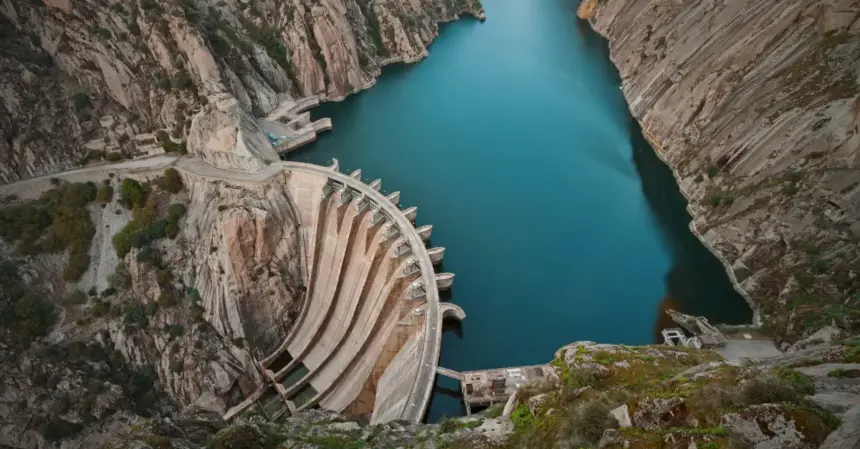
At 91% completion in early October 2026, according to information gathered by Le360 from project officials, this 79-metre-high structure with a 190-metre crest length is expected to begin impoundment at the end of December 2026, with full completion of the works scheduled for March 2027. With a storage capacity of approximately 1.07 billion cubic metres, it will become Morocco’s fifth-largest dam by reservoir volume.
I sought out official data and field reports to understand what this 1.2 billion dirham investment, launched in March 2022 under the National Programme for Drinking Water Supply and Irrigation 2020-2027, really means. Launched at the initiative of King Mohammed VI, the programme — whose envelope was raised to 150 billion dirhams after revision in response to successive droughts — aims to strengthen the Kingdom’s water security in the face of climate stress that spares no shore of the Mediterranean.
A strategic structure for an arid region
Built at the confluence of the Oued Grou and four tributaries, in a gorge near Ksar Moghel, the gravity dam constructed with roller-compacted concrete (RCC) relies predominantly on Moroccan expertise. The latest works focus notably on the compacted concrete and the finalisation of electromechanical equipment, according to Moulay El Hassan Faïk, project manager at the Ministry of Equipment and Water.
The expected benefits are concrete for the province of Figuig, in the Oriental region, which has been hard hit by drought. The dam is set to secure drinking water supply for approximately 7,500 inhabitants in the communes of Beni Tadjit, Chouiter, Aïn Chaïr and Bouanane. On the agricultural side, irrigated areas are projected to rise from 500 hectares to around 3,000 hectares, and volumes allocated to agriculture from 5 to 30 million cubic metres per year, according to projections reported by Le360. Other sources mention an increase from 415 to nearly 4,300 hectares. It will also contribute to groundwater recharge and the preservation of oasis zones.
Estimated annual inflows stand at around 107 million cubic metres. The site has already generated several hundred thousand workdays (nearly 400,000 according to some estimates, 436,800 according to others), with a significant share of local labour, and has enabled the construction of an approximately 40-kilometre access road.
Key figures for the Kheng Grou dam
- Storage capacity: 1.07 billion m³ (5th largest nationally)
- Investment: approximately 1.2 billion dirhams
- Height / crest length: 79 m / 190 m
- Progress (early October 2026): 91%
- Planned impoundment: December 2026
- Completion: March 2027
- Drinking water beneficiaries: ~7,500 inhabitants
The eastern border and the context of Algerian accusations
The site lies close to the eastern border with Algeria. This location gives the project an additional strategic dimension in a context of tense bilateral relations since the severing of diplomatic ties in 2021. Since 2024, Algerian Minister of Hydraulics Taha Derbal has repeatedly accused a “neighbouring country” of the “intentional and systematic drying up” of dams and surface waters in western and southwestern Algeria. These statements were made notably on the sidelines of the World Water Forum in Bali (May 2024) and during the 10th Meeting of the Parties to the Water Convention in Ljubljana (October 2024).
Algerian grievances focus mainly on the Kaddoussa dam, commissioned in 2021 on the Oued Guir, which is accused of having reduced inflows to the Algerian Djorf Torba dam (capacity of approximately 365 million m³). Allegations of pollution affecting the Hammam Boughrara dam have also been raised. Morocco, for its part, presents these constructions as the exercise of its sovereignty over its surface water resources, in a country that has itself faced several consecutive years of low rainfall. Moroccan analyses stress that Morocco faces the same climatic constraints and that the accusations amount more to a media war than to an independently documented hydrological reality.
Regarding Kheng Grou specifically, a 2024 Médias24 article indicated that the Oued Kheng Grou has no connection with the Oued Guir that flows into Algeria. No source consulted shows that this dam has been named in Algerian statements. It nevertheless forms part of Morocco’s policy of maximising the mobilisation of surface waters near the eastern borders.
Stakes and perspectives
This dam illustrates the national priority given to water security. The 2020-2027 National Programme aims to increase storage capacity, develop desalination, optimise irrigation (drip systems) and interconnect basins. In the face of climate change, which is intensifying drought episodes across the Maghreb, mobilising surface water is a rational response to reduce pressure on aquifers and protect populations and oasis agriculture.
On the Algerian side, the accusations fit into a narrative of victimisation vis-à-vis a neighbour portrayed as hostile. To date, they are not supported by shared hydrological data or accessible independent international expertise. Both countries lack cooperation mechanisms on shared or adjacent basins, even though the scarcity of the resource is structural.
The commissioning of Kheng Grou will strengthen the resilience of Figuig province and the Oriental region. It will not by itself resolve national water stress, but it forms part of a long-term strategy combining dams, transfers, desalination and demand management. For relations with Algiers, it is likely to feed the existing discourse rather than create it. Evidence of intentional drying remains to be produced; the reality of the regional rainfall deficit is, for its part, documented on both sides of the border.
The question remains open: in a Mediterranean basin where water has become an issue of sovereignty as much as of survival, is the construction of national infrastructure sufficient, or will shared data and frameworks for concerted management one day be required?
FAQ
When will the Kheng Grou dam be commissioned?
Impoundment is planned for the end of December 2026, with completion of the works in March 2027, according to the latest information from project officials (October 2026).
What is its capacity and national ranking?
Approximately 1.07 billion cubic metres, which will make it Morocco’s fifth-largest dam by storage capacity.
Does the dam directly affect Algerian water resources?
Algerian accusations mainly target other structures such as Kaddoussa on the Oued Guir. Moroccan sources indicate that the Oued Kheng Grou is not connected to the Oued Guir that crosses into Algeria. No publicly available independent data confirms a direct impact from Kheng Grou.
Why is this project strategic for Morocco?
It secures drinking water and irrigation in an arid zone close to the border, within the framework of the 2020-2027 National Programme designed to strengthen resilience to water stress.