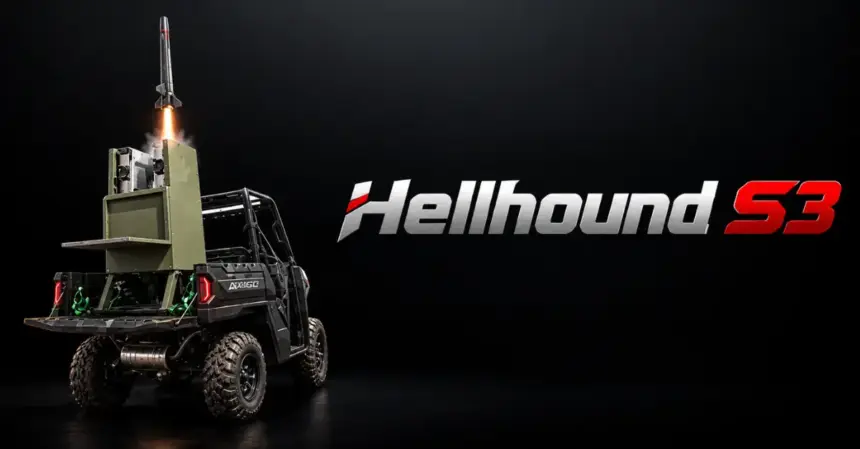
When a small Alabama company fires two turbojet drones from a recreational utility vehicle, with a single operator and a handheld controller, I don’t see just a technical demonstration. I see a hint of how armies may soon think about firepower: fewer heavy platforms, more small effectors produced in volume. Here is what the test shows, and what it doesn’t prove yet.
What Cummings Aerospace has actually demonstrated
According to the company, the test took place on August 25, 2026, at the Pendleton drone launch site in Oregon, and the results were announced on October 12. An engineer from Cummings Aerospace, a company based in Huntsville, Alabama, fired two Hellhound S3 drones in succession from a Polaris utility vehicle. Both aircraft carried inert payloads and followed preset trajectories at different speeds. The company says all objectives were met.
Several firsts are claimed:
- first Hellhound launch from a vehicle, after more than a dozen flight tests in its portable configuration;
- first use of a new launcher that can hold up to eight drones;
- first burst firing of the S3;
- first time a single operator controlled several Hellhounds simultaneously.
An important caveat: these claims come from the company. In the information available to me, I found no independent validation and no military communication about this test. This is an industry demonstration, not a military qualification.
How a single operator flies two drones
Before launch, the operator programs the waypoints, altitudes and trajectories of each drone on the handheld fire control system. Once airborne, the aircraft follow these routes autonomously. They send data back to the controller, who can watch both flights live, change a mission or abort it.
This is the nuance I find most interesting. We are not talking about full autonomy, where the machine would decide on its own. We are talking about an operator who plans, supervises and keeps the ability to correct or stop. CEO Sheila Cummings sums up the idea this way: instead of manually piloting a single drone to a target, one soldier can deploy several Hellhounds against several targets with a single system. She adds that a small unit can thereby produce fires that previously required an entire battery.
That last sentence is a sales argument, not a field finding. It does show the promise, though: multiplying the effect of a small team.
A jet-powered drone, not a propeller
The Hellhound S3 is the size of a baseball bat and weighs about 6 kg (13 lb), according to the manufacturer. Its turbojet lets it fly more than 60 km at a top speed of 618 km/h (384 mph). The company stresses that this speed is well above that of the propeller-driven drones and loitering munitions commonly used in Ukraine.
Speed matters because it shortens an adversary’s reaction time. A slow propeller drone can be spotted and dealt with using light means. A faster vehicle leaves less time to do so. I remain cautious: speed alone says nothing about resistance to jamming, real-world accuracy or the ability to get through dense defenses. None of these points was publicly tested here, since the payloads were inert.
Another argument put forward is production. Built from 3D-printed parts and commercially available components, the S3 can be produced at more than 100 units per month, according to the manufacturer. In its portable version, the drone, launch container and control station weigh less than 11 kg in total, which allows a single soldier to carry and launch everything.

A multimission weapon, on paper
Cummings Aerospace presents the Hellhound as a versatile system: loitering munition, precision-guided munition, one-way attack drone or drone interceptor. The mission modules (penetrating, fragmentation, electronic warfare and decoy) can reportedly be swapped in under two minutes and without tools.
Why does this matter? Because a single vehicle can, in theory, play several roles depending on the situation, which simplifies logistics. But versatility comes with the usual trade-off: each role is rarely as effective as a dedicated solution. No public data allows us, at this stage, to judge the performance of each module.
The launcher, the real story of the announcement
In my view, the real novelty is not the drone but its launcher. The multi-pack device can be lifted by two people and installed on various U.S. military vehicles, crewed or uncrewed. The company plans next:
- salvo firings from this launcher;
- use from an uncrewed ground vehicle;
- use from an uncrewed surface vessel at sea.
This roadmap shows the ambition: turning any platform, even a modest one, into a strike asset. It is a logic of saturation and reduced cost, already at the heart of many military debates.
From portable to Golden Dome, the family expands
Cummings Aerospace, a small business founded in 2009 and owned by a Native American woman, unveiled the Hellhound at SOF Week 2025, along with a larger version, the S4. Launched from a tube, the S4 is 1.47 m long, weighs 20 kg in its container, can reach targets 130 to 140 km away and stay airborne for more than an hour and a half. The company offers it as a low-cost cruise missile and as a complementary surveillance solution for the Golden Dome missile defense program.
Again, this is the company’s commercial positioning, not a selection by the program.
The strategic stakes
Cost versus threat. The general logic, seen in several recent conflicts, is to avoid answering cheap devices with very expensive munitions. A mass-produced jet drone could serve as an interceptor or a low-cost attacker. With no published price, I can’t say whether the equation holds.
3D printing and distributed production. If the announced production rates are confirmed, the supply chain would depend less on heavy industrial sites. It is also a sovereignty issue for countries that might want to equip themselves, including in Europe.
The Mediterranean question. The Mediterranean basin concentrates tension zones, critical sea lanes and a heavy naval presence. The prospect of launches from uncrewed surface vessels directly concerns these theaters. This is, however, my own extrapolation: nothing in the announcement mentions the Mediterranean.
The ethical and operational debate. Supporters of these systems see them as protecting soldiers and as a proportionate response to threats. Critics worry about the proliferation of cheap autonomous munitions, the risk of escalation and the difficulty of guaranteeing real human control when one operator manages several devices at once. Both positions are defensible, and the August test settles neither.
What remains to be proven
Several questions remain open: behavior under jamming, accuracy with live payloads, reliability in salvo, real cost, and the actual interest of customer armies. A successful demonstration with inert payloads is a step, not proof in combat.
What I take away is that the subject is no longer just the drone, but the ability to launch and supervise several effectors, from very different platforms, with very few people. If upcoming salvo firings and tests from uncrewed platforms confirm the approach, the discussion will be less about a product than about a doctrine.
FAQ
What is the Hellhound S3?
It is a 3D-printed turbojet drone weighing about 6 kg, designed by Cummings Aerospace. According to the company, it flies more than 60 km and at up to 618 km/h.
Can one operator really control several drones?
During the August 25, 2026 test, a single operator supervised two Hellhounds on autonomous missions, according to the company. The operator can change or abort each mission in flight.
Is the Hellhound already used by an army?
I found no confirmation of a contract or deployment in the available information. The test described is an industry demonstration.
What is the difference between the S3 and the S4?
The S4 is larger: 1.47 m, 20 kg in its container, a stated range of 130 to 140 km and more than an hour and a half of endurance. The S3 is the portable version.