I have long observed the shifts in military doctrine across the Mediterranean basin and on Europe’s eastern flank, where conventional artillery is gradually giving way to autonomous systems and saturation attacks. While the war in Ukraine has highlighted the critical role of consumer drones modified into loitering munitions, the French Ministry of the Armed Forces and the Directorate General of Armaments (DGA) have tackled the problem from the opposite end: turning battlefield urgency into a standardized, secure and mass-produced industrial model.
The recent exercise of a purchase option covering several hundred MX-10 DAMOCLES remotely operated munitions marks a major strategic turning point. This choice confirms the acceleration of French rearmament while laying the groundwork for a genuine sovereign European industry of attack drones, already demonstrated by a first export success with Luxembourg.
DAMOCLES’ Industrial Takeoff
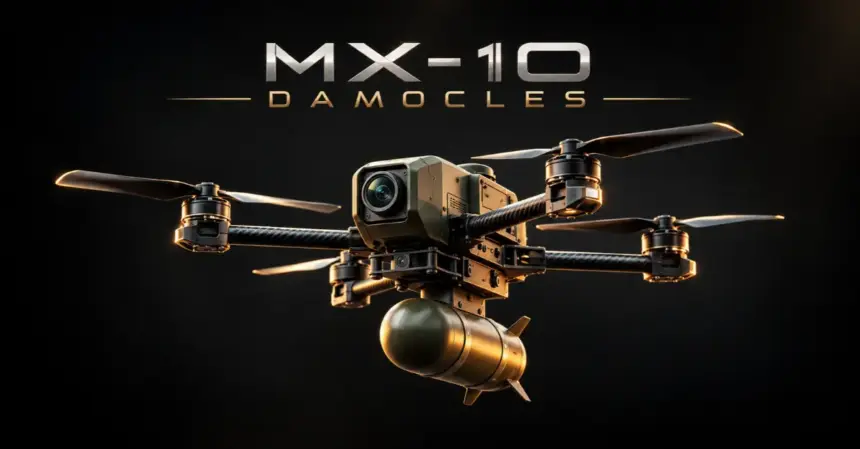
The MX-10 DAMOCLES is no longer a mere laboratory experiment. Jointly developed by aerospace manufacturer Delair and defense giant KNDS France, this compact 3.5 kg quadcopter embodies France’s answer to the needs of modern warfare. Designed to be carried in a backpack, it carries a 550-gram fragmentation and incendiary warhead capable of neutralizing light vehicles or infantry groups at distances of 10 to 20 kilometers.
MX-10 DAMOCLES: Technical Data Sheet and Industrial Benchmarks
-----------------------------------------------------------------------
• Total weight / Architecture : 3.5 kg / Vertical-takeoff quadcopter
• Range / Endurance           : 10 to 20 km / 40 minutes
• Payload                     : KNDS explosive-incendiary warhead (550 g)
• Production rate             : 100 units per day (Delair / Schaeffler)
• French framework contract   : Up to 2,270 units over 7 years (signed in 2024)
• First export customer       : Luxembourg (contract > €1.6M signed in 06/2026)
-----------------------------------------------------------------------
This responsiveness is the result of a deep restructuring of supply chains. To meet demanding production rates, Delair teamed up with the French site of German automotive supplier Schaeffler. This transfer of know-how from the automotive sector made it possible to multiply the initial production capacity several times over, reaching 100 drones per day, and showed that a responsive defense industrial and technological base (DITB) can emerge very quickly.
Security and Sovereignty: The Luxembourg Equation
The contract of just over €1.6 million signed by Luxembourg in June 2026 is not merely a modest budget line. It represents the first export success of a European loitering munition qualified by a government.
Why did the Grand Duchy make this choice? An analysis of the award criteria reveals two decisive factors:
A reinforced safety chain: Unlike modified civilian drones, which carry a high risk of accidental detonation or hacking, DAMOCLES incorporates five successive safety mechanisms. Its safe-arming system (DSA) allows the operator to abort an attack at the last second, put the aircraft back into a hover, and either re-engage another target or cancel the mission.
Doctrinal and operational synergy: By choosing equipment already qualified by the French Army and the French Navy, Luxembourg gains direct access to the French military’s test centers and training infrastructure, which it does not have on its own territory.
A New Acquisition Paradigm: Separating the Airframe from the Warhead
One of the most fascinating lessons of this equipment phase lies in the evolution of DGA procurement procedures. By launching separate calls for tens of thousands of warheads on one side and for the vehicles (the drones) on the other, the French State breaks with the traditional rules of armament procurement.
The goal is to avoid rapid obsolescence: airframes, connectors and navigation software evolve at a near-monthly pace under pressure from electronic jamming, while explosive charges remain stable over time. The DGA is thus building up strategic warhead stocks over several years, while ordering regularly updated batches of drones. KNDS is positioning itself strategically on both fronts, either on its own or through industrial partnerships.
Toward the Medium-Range Program and the MATARIS Ambition
Strengthening the DAMOCLES fleet is only the first step of a much broader roadmap. France has allocated more than €500 million in its 2026 budget for the development of loitering munitions and related capabilities, notably under the third phase of the French Army’s Contact Drones program.
KNDS is now pushing its integrated MATARIS range, targeting the medium-range segments. The geopolitical stakes go well beyond France’s borders: the aim is to build a sovereign technological shield against the American or Turkish systems that currently dominate the global market. The selection of the winner of the medium-range program, expected any day now, will determine who leads the next stage of this doctrinal revolution.
Frequently Asked Questions
What is the main difference between DAMOCLES and a homemade FPV drone?
DAMOCLES is a certified military system featuring five safety levels, a remote strike-abort system and reliable navigation in jammed, GPS-denied environments. Modified civilian FPV drones lack these safety guarantees for operators and remain highly vulnerable to electronic warfare.
Why is delivery of the new French tranche planned for 2027?
This schedule matches the staggered delivery calendar of the framework contract signed in 2024. It allows manufacturers to absorb the ramp-up, after the supply of the first 460 units delivered over 2025–2026, while adjusting production to changing operational needs.
Can DAMOCLES operate at sea?
Yes, the MX-10 DAMOCLES is deployed with both the French Army and the French Navy. Its vertical takeoff capability and compact size allow it to be carried aboard surface vessels for armed reconnaissance or close-protection missions.