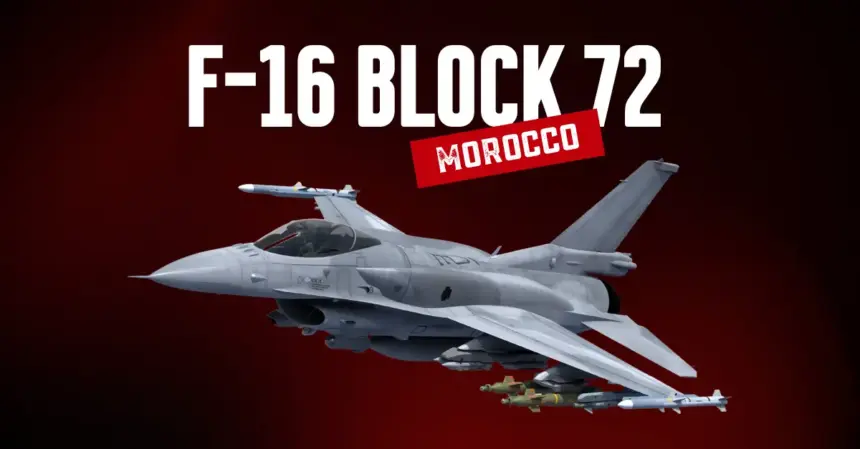
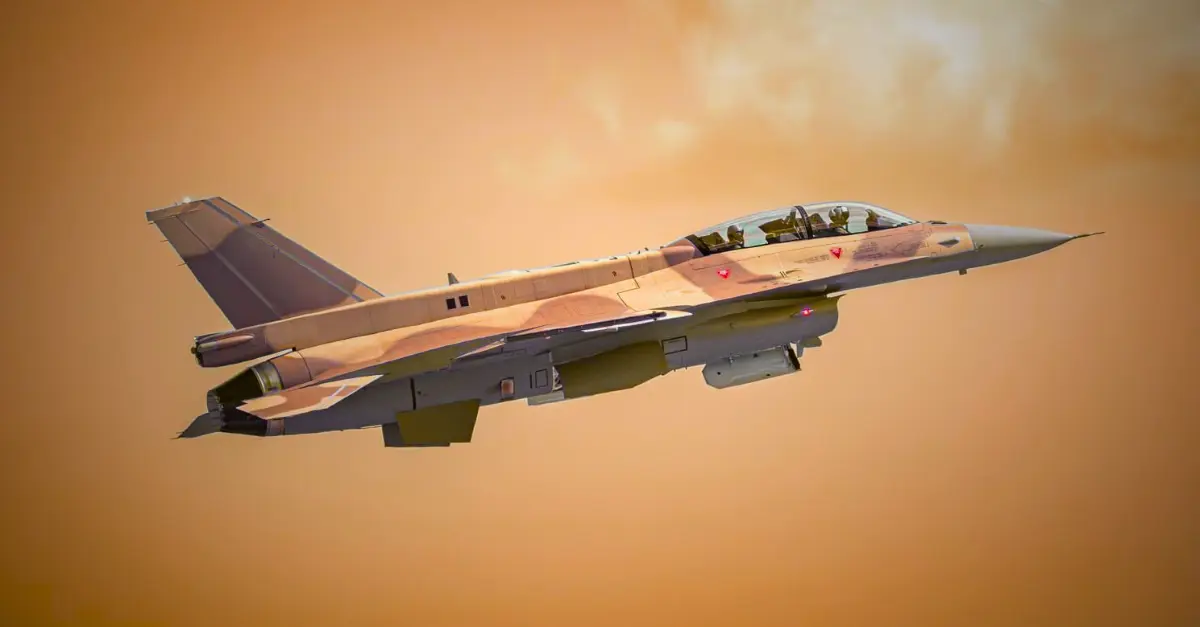
The aircraft, a two-seat F-16D, took off from the Greenville plant in South Carolina. According to the manufacturer, it is also the first series-production F-16 Block 72 to have flown, across all orders. Morocco is the launch customer.
For a defense column, the event may look technical. I believe, on the contrary, that it says something about the Kingdom’s strategic trajectory. After a seven-year wait, the F-16 Block 72 is leaving the realm of promises. The question now is what this aircraft actually changes for the Moroccan air force, and what it does not.
A program launched in 2019, a seven-year wait
The timeline already sheds light on the significance of the announcement. In 2019, the US State Department approved the sale of 25 F-16C/D Block 72 fighters to Morocco, for an estimated $3.787 billion. According to the information published on the deal, the package also includes Pratt & Whitney F100-PW-229 engines and AN/APG-83 radars.
Almost seven years have passed between the approval and the first flight. This reflects a particular industrial context. Morocco signed for a version that was still being finalized, and the relocation of the production line from Fort Worth to Greenville added further complexity. Lockheed Martin also indicated this spring that the technology configuration of the aircraft destined for Morocco and Taiwan had required modifications following flight tests.
I do not see this as a failure, but as the price of being the first to receive a brand-new version. Launch customers bear the teething problems, and that is the whole logic of the title.
What the Block 72 changes in practice
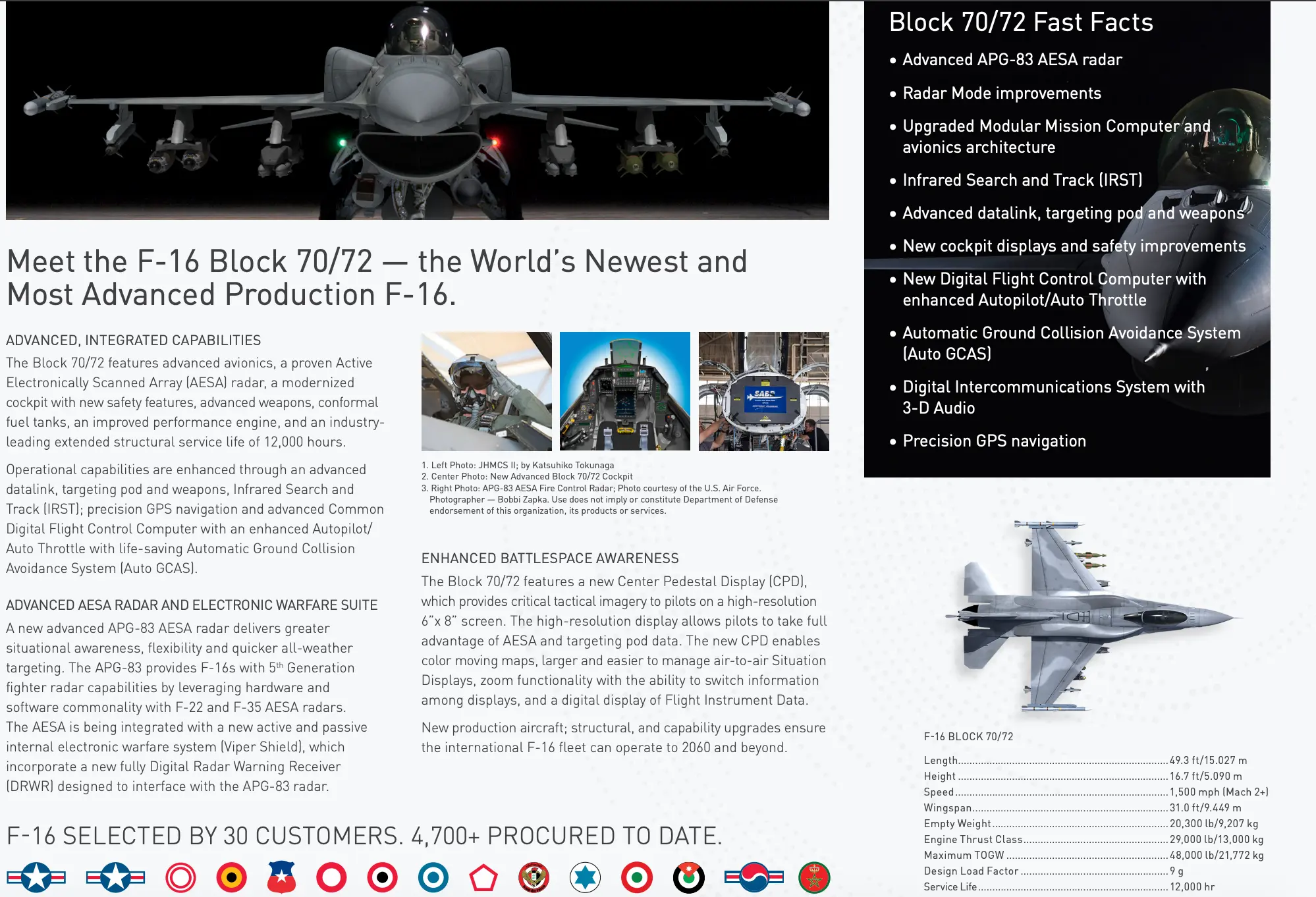
On paper, the Block 72 keeps the F-16 airframe. It modernizes almost everything else. It belongs to the Block 70/72 family, which Lockheed Martin presents as the newest and most advanced version of the Fighting Falcon.
Here are the elements that matter most to an air force:
- An AESA radar, the AN/APG-83. This electronically scanned radar detects and tracks targets farther away and more precisely, resists jamming better and proves more reliable than the radars of previous generations.
- Stronger electronic warfare. The Viper Shield protection system is regularly cited among the most advanced offered on the F-16.
- A modernized cockpit and mission computer. They improve how information is presented to the pilot and allow more recent weapons to be integrated.
- A longer structural life. Lockheed Martin claims a service life more than 50% longer than that of earlier F-16s, which extends the fleet’s operational horizon.
- Improved safety. The automatic ground collision avoidance system, already proven on other F-16s, is part of the additions.
One useful clarification for anyone comparing with the versions sold to other countries. The Block 70 and Block 72 share the same radar, the same cockpit and the same mission systems. The main difference lies in the engine. The Block 70 uses the General Electric F110, and the Block 72 the Pratt & Whitney F100-PW-229.
Why the engine matters more than it seems
The choice of the F100 is not trivial. The F-16C/D Block 52+ aircraft that Morocco has operated for about fifteen years already use this engine family. For mechanics, supply chains and spare parts, continuity is a real asset.
In an air force, aircraft availability often weighs more than theoretical performance. A modern aircraft grounded for lack of parts deters no one. By unifying the engine equipment across its fleet, Rabat limits ownership costs and simplifies training. It is a less spectacular argument than a radar, but I believe it is decisive over the long run.
A modernization that goes beyond the 25 new aircraft
The 25 new aircraft are only one part of the program. Morocco has also been authorized to upgrade its 23 existing F-16s to the more recent F-16V standard. In time, the fleet should therefore consist of new aircraft and upgraded aircraft, sharing a common architecture.
This two-tier approach seems coherent to me. It raises the technological level of the entire fleet rather than creating two squadrons of different standards. It does, however, require a rapid build-up of skills among crews and maintenance personnel.
The industrial side, often overlooked
Lockheed Martin highlights its partnership with Maintenance Aéro Maroc. A maintenance, repair and overhaul center of more than 8,000 square meters is planned at Benslimane. It is initially meant to handle C-130 Hercules aircraft, with an announced extension to other platforms, including the F-16.
I consider this point as important as the first flight. A national heavy-maintenance capability reduces dependence on foreign suppliers and keeps part of the added value on Moroccan soil. It fits the Kingdom’s stated ambition to become a regional aeronautics hub. The timeline for the site’s ramp-up, however, remains to be confirmed.
The F-35 question
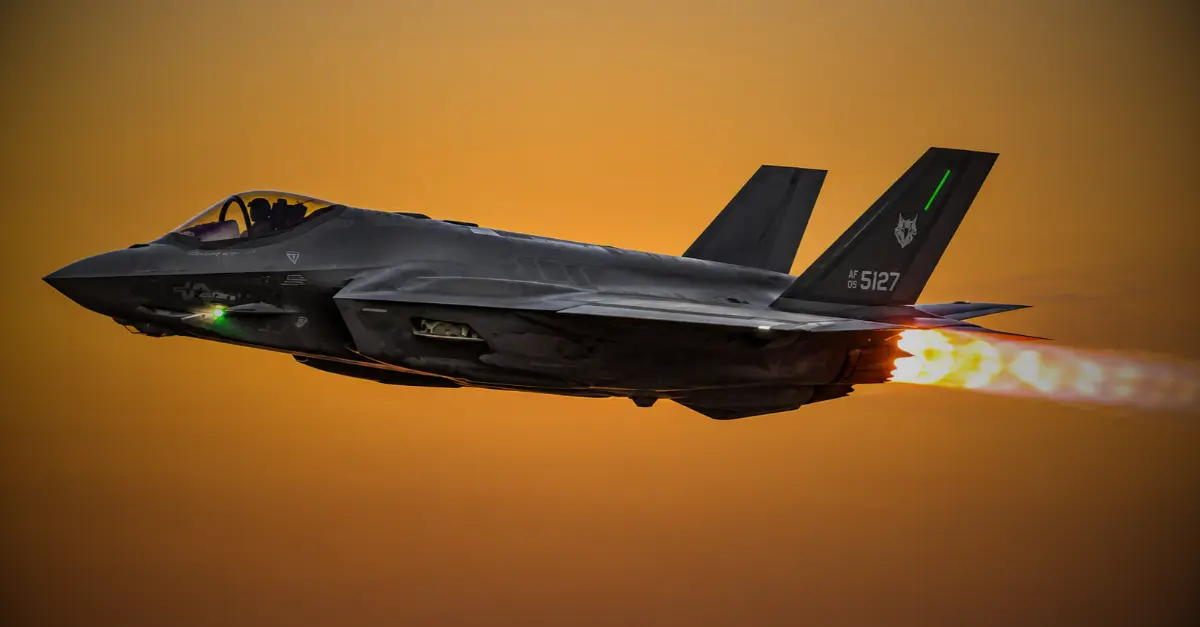
The Block 72 also feeds a debate about what comes next. Press reports have for several years mentioned talks between Rabat and Washington about the F-35, a fifth-generation stealth fighter. At this stage, nothing points to a decision or a contract. Some analysts see it as a possible extension of the Block 72. Others point out that cost, export conditions and data sovereignty would raise heavy questions.
My view is that the Block 72 should be judged for what it is: a solid and coherent step up for the existing fleet, not an answer, on its own, to a fifth-generation fighter.
What to watch
Several milestones will determine the real value of the program:
- the end of flight testing and the date of first delivery to Morocco, which has not been announced to my knowledge;
- the delivery pace of the other 24 aircraft;
- the progress of the upgrade of the existing F-16s;
- the ramp-up of the Benslimane center;
- the possible follow-up to the discussions on a fifth-generation aircraft.
A combat aircraft is only one link in the chain. Its value depends on pilot training, spare-parts availability, weaponry and integration into a broader defense system. The first flight marks a milestone, not the finish line.
FAQ
When did the first F-16 Block 72 fly?
On October 6, 2026, at Lockheed Martin’s Greenville plant in South Carolina. It is a two-seat F-16D.
How many aircraft has Morocco ordered?
Twenty-five F-16C/D Block 72 fighters, under a sale approved in 2019 by the US State Department for about $3.787 billion.
What is the difference between the Block 70 and the Block 72?
Both share the same radar, the same cockpit and the same mission systems. The Block 72 uses a Pratt & Whitney engine, while the Block 70 uses a General Electric engine.
When will Morocco receive its first aircraft?
The date has not been officially specified. The aircraft must first continue its flight testing before being handed over to the customer.