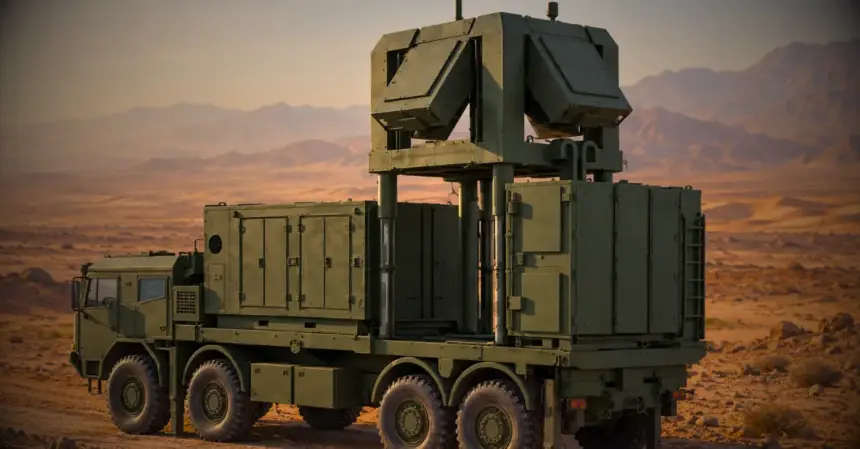
This announcement reflects what I see as a structural shift: faced with a growing number of drones, rockets and missiles, armed forces are looking for radars that are more mobile, more open and able to quickly sort very different kinds of threats.
A radar designed for integrated air and missile defense
The cxMHR is a C-band active electronically scanned array (AESA) radar, fully digital and software-defined. In this type of radar, many small transmit/receive modules steer the beam with no mechanically moving parts. The system can therefore react faster and adapt to a wide range of targets, changing its functions through software updates rather than hardware changes.
Leonardo DRS designed it for integrated air and missile defense, known by the acronym IAMD. The idea is to make sensors, command posts and interception systems work together, so that tactical ballistic missiles, cruise missiles, rockets and unmanned aircraft systems are handled as a single whole.
Everything in a single container
The manufacturer highlights an engineering point that I find revealing: integration. The cxMHR brings together four AESA panels, an identification friend or foe (IFF) system, a command and control system and auxiliary equipment in a single ISO-standard container. This container can be transported by air, land or sea and deployed on a single vehicle.
The stakes are as much tactical as logistical. A radar that sets up quickly and moves quickly is harder to locate and neutralize, and it can be sent wherever it is needed. The trade-off is that it must be protected and supported in the field, which depends on operational doctrine and not on the equipment alone.
Announced characteristics
The elements below are statements by Leonardo DRS. I have not been able to confirm them with an independent source.
- Continuous 360-degree hemispheric coverage, provided by four AESA panels
- Detection, tracking and identification of tactical ballistic missiles, cruise missiles, rockets and drones
- Announced range of more than 90 km against drones and loitering munitions, and more than 330 km against transport aircraft
- AI-based tracking and classification, with rapid target updates
- Open architecture compliant with the MOSA approach, with interfaces to FAAD, Medusa, SAPIENT, Lattice, ASTERIX, MICAD and RAFT
Leonardo DRS itself specifies that real-world performance depends on the target and on operational conditions. This caveat is essential. A catalog range is never a combat range. The contrast between the two figures shows it: a small, low-flying drone is much harder to detect than a transport aircraft, hence the gap between more than 90 km and more than 330 km.
Artificial intelligence, an asset yet to be confirmed
The use of artificial intelligence for tracking and classification is one of the manufacturer’s central arguments. When dozens of objects arrive at the same time, an operator cannot sort them by hand. The software must tell a rocket from a bird, a cheap drone from a cruise missile, and produce tracks precise enough to allow fire control.
Leonardo DRS claims that its radar offers tracking quality sufficient for this use. I remain cautious on this point. Automatic classification performs well when conditions are well known, but it runs up against jamming, decoys and evolving adversary tactics. Only testing and operational use can measure its reliability, and those results are rarely made public.
An open architecture to integrate with allies
The second notable design choice is the adoption of the MOSA approach, short for Modular Open Systems Approach. It aims to let a piece of equipment fit into existing architectures without a complete redesign, and to be upgraded module by module rather than replaced.
The list of interfaces cited by the manufacturer mixes American command systems, data-sharing protocols and more recent standards. It reflects a drive for interoperability, which is both a commercial argument and a necessity. Coalitions rarely field equipment from a single industrial supply chain, and a radar unable to communicate with neighboring networks loses most of its value.
Why this matters
I see three issues.
The cost of interception. An interceptor missile often costs far more than the drone or rocket it destroys. A radar that tracks low-cost targets precisely helps choose the most proportionate response, whether a missile, a gun or an electronic countermeasure. It does not resolve the cost imbalance on its own, but it limits the waste of precious munitions.
Saturation. Recent conflicts have shown that attacks combining drones, rockets and missiles can seek to saturate defenses. The ability to track a large number of tracks at the same time is becoming a decisive criterion.
The industrial base. The start of initial production marks a stage of maturity, but it does not mean a large-scale deployment. The number of units, the customers and the delivery schedule have not been specified in the information available to me. I therefore refrain from commenting on any potential orders.
Limits and debates
A critical distance must be maintained. Some analysts point out that a better radar is useless if interceptor stocks are insufficient. Others stress that multiplying sensors complicates the chain of command and cybersecurity, since a software-driven system is also exposed to cyberattacks. Finally, announcements made at trade shows are manufacturers’ statements. The real measure remains testing under real conditions.
Key takeaways
The cxMHR illustrates the shift from an air defense built around fixed installations to a network of mobile, open, software-driven sensors able to handle very heterogeneous threats. It remains to be seen who will buy it, at what pace, and whether interception and protection capabilities will keep up. It is on these points, more than on the announced ranges, that the value of the system will be decided.
FAQ
What is Leonardo DRS’s cxMHR?
It is a C-band AESA radar, digital and software-defined, designed for integrated air and missile defense. It fits in an ISO container that can be deployed on a single vehicle.
What threats can it detect?
According to the manufacturer, it detects, tracks and identifies tactical ballistic missiles, cruise missiles, rockets and unmanned aircraft systems, with 360-degree coverage.
Are the announced ranges guaranteed?
No. Leonardo DRS states that real-world performance depends on the target and on operational conditions. The announced values are more than 90 km against drones and more than 330 km against transport aircraft.
Which systems can it connect to?
Designed according to the MOSA approach, it integrates into IAMD architectures through interfaces such as FAAD, Medusa, SAPIENT, Lattice, ASTERIX, MICAD and RAFT.