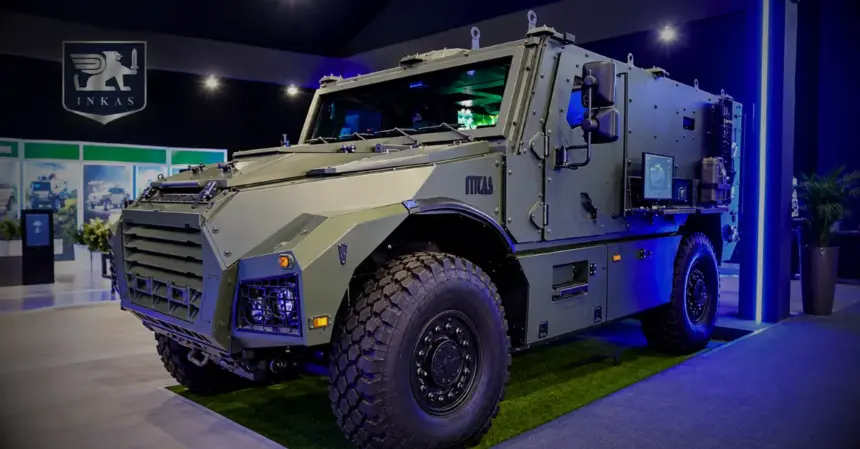
The site could be located near Casablanca, according to the company’s representative in Morocco. We gathered his statements on the sidelines of a defense trade show, where the group was presenting a new kind of counter-drone vehicle. Nothing has been signed at this stage, and these announcements should be treated with caution.
A hybrid vehicle as a showcase
The vehicle displayed at the show illustrates the manufacturer’s approach. Its representative describes it as a “mixed” vehicle: it can be used for border defense and counter-drone missions, but can also be configured as an ambulance. This versatility reflects a demand that is increasingly visible among armed forces, which are looking for platforms able to switch from a security mission to a medical or logistical support mission.
The feature highlighted is the onboard counter-drone system, which the company presents as new, including on a global scale. We were not able to independently verify this claim of novelty, and it should be considered a commercial assertion until precise technical specifications are published. The real-world performance of this type of system, particularly its ability to detect, identify and then neutralize small aircraft, is judged through trials and operational use, rarely in an exhibition hall.
What the Inkas representative says
His remarks are fairly clear on the timeline of the process, and vaguer on its outcome. The executive explains that he took up his post in Morocco a year and a half to two years ago, and that discussions on setting up armored vehicle and drone factories began at that time. He specifies that the negotiation is being led by the Canadian parent company with the Moroccan authorities, and in particular with the Ministry of Defense, and that it is “very advanced.”
Asked about a timeframe, he says news could come very soon, “within hours, not even a day.” We remain attentive to this kind of phrasing. In the defense world, the announcement of an agreement in principle, a memorandum of understanding or a letter of intent should not be confused with a firm investment decision, nor with the start of production. No official confirmation from the Moroccan side was available at the time of writing.
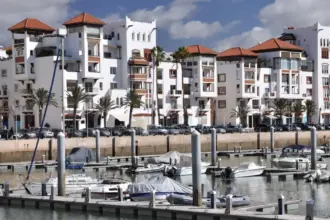
On the financial side, he indicates that a plant of this kind “starts” at around 50 million, with a budget that could rise to 300 or 400 million depending on the scale of the project and the host region. The currency was not specified during the exchange. The site would “surely” be close to Casablanca, in an industrial park, but the executive remains cautious by adding “maybe.”
Finally, he mentions a second project, described as an innovation, which the company intends to present to the government within about a month. He did not detail its nature in the excerpt available to us.
Why Morocco attracts defense manufacturers
This move is part of a broader trend. For several years, Rabat has been seeking to reduce its dependence on arms imports by developing a defense industrial base on its own soil. Several projects have been announced or launched with foreign partners, in aeronautics, armored vehicles and drones, and the kingdom has adopted a framework intended to facilitate these investments. I stick here to this general movement, without going into the details of each file, which we will verify before publication.
The motivations are of several kinds:
- Sovereignty: producing locally secures maintenance, spare parts and supplies in the event of international tension.
- Economy: a factory creates skilled jobs, attracts subcontractors and can feed exports to Africa and the Middle East.
- Skills transfer: integrating cutting-edge technologies into the local industrial fabric trains engineers and technicians.
- Diversification of partners: the kingdom is multiplying its suppliers, whether American, Israeli, Turkish, European or, now, Canadian.
The Casablanca region offers clear advantages in this respect: a port, an airport, a motorway network, a labor pool and an already structured industrial ecosystem, notably in the automotive and aerospace sectors.
A booming drone market
Combining armored vehicles and drones in a single project is far from trivial. The conflicts of recent years have shown how much drones, including small and low-cost ones, alter the balance on the battlefield, and how exposed ground vehicles are to these threats. Hence the interest in active protection, jamming or interception solutions, which the manufacturer says it has integrated into its vehicle.
Morocco, for its part, has invested in this field, both through acquisitions and through local production programs. For a foreign manufacturer, setting up in the kingdom means positioning itself in a growing market, while benefiting from geographic proximity to Europe and sub-Saharan Africa.
Reservations to keep in mind
Several points call for caution, and it would be misleading to gloss over them.
First, there is no confirmation from the Moroccan side. Negotiations over a defense contract usually take place discreetly, and the statements of a commercial representative, however sincere, do not commit the state. Second, the announced investment range is very wide, from roughly 50 to 400 million, which reflects a hypothesis more than a settled plan. Finally, arms production is subject to export authorization requirements, technology transfer controls and government approvals, notably on the Canadian side, which can delay or reshape a project.
There is also a deeper debate. Supporters of these investments stress the industrial benefits and the upgrading of the Moroccan economy. Other observers point out that the rise of arms industries in a region marked by strategic rivalries, notably with neighboring Algeria, is part of an arms race whose effects on regional stability are debated. The subject therefore cannot be reduced to either an economic opportunity or a threat, and deserves to be followed with nuance.
What to watch next
We will follow three elements in the coming weeks: the possible official announcement of an agreement, the precise location of the site and the production timeline, as well as the nature of the second project that the company is due to present to the government. The kingdom’s ability to turn these announcements into lasting production chains, with real local integration, will be the true test.
FAQ
Who is Inkas Aerospace & Defense?
It is a Canadian company specializing in armored vehicles and security and defense equipment, active in several international markets.
Is the factory confirmed?
No. Its representative in Morocco speaks of very advanced negotiations with the authorities, but no official agreement has been made public to date.
How much would the investment be?
The executive mentions a starting point of around 50 million, which could reach 300 to 400 million depending on the scale of the project. The currency was not specified.
Where could the factory be located?
Probably near Casablanca, in an industrial park, according to the same executive, who remains cautious on this point.