
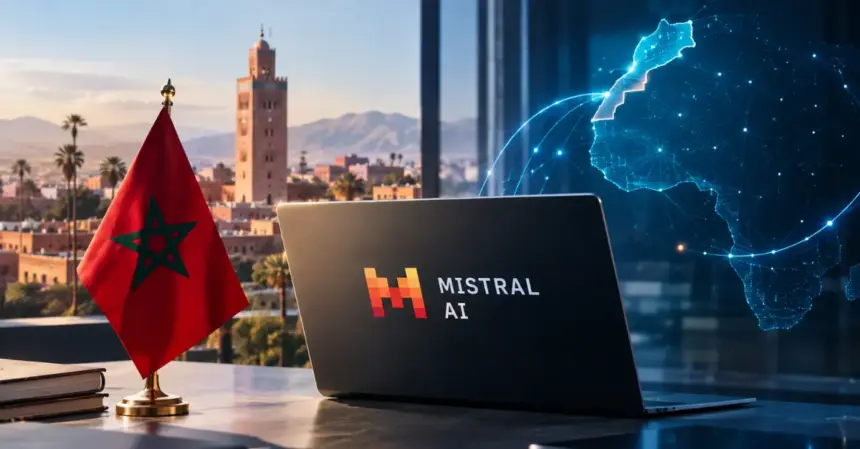
The press release is restrained, but the signal is clear: Rabat wants artificial intelligence to understand the language its citizens actually speak. I looked at what the announcement contains, what it does not yet say, and why it matters beyond the technical details.
What the ministry actually announced
Two tools are involved. The first is a language identification classifier, able to recognise and tell apart several Arabic dialects, including Moroccan Darija. The second is an automatic speech recognition model built on Mistral AI’s Voxtral technology. It transcribes speech into text, including when speakers switch between Arabic, French and English within the same conversation.
According to the ministry, these tools are, or will soon be, available as open source. Public administrations, startups, researchers, developers and companies will be able to use them to build their own applications. The release adds that other models and use cases are under development as part of this multi-year partnership.
The announcement falls under two official frameworks: the “Maroc Digital 2030” strategy and the “AI Made in Morocco” roadmap. Both aim, in the authorities’ words, at a “sovereign, responsible” form of artificial intelligence adapted to the linguistic and cultural realities of the Kingdom.
Key points
- Two models: a dialect identifier covering Arabic varieties, Darija included, and a speech transcription system derived from Voxtral.
- Transcription designed to handle switching between Arabic, French and English.
- Open-source distribution, aimed at administrations, businesses, startups and researchers.
- A multi-year partnership with Mistral AI, of which these tools are only the first step.
Why Darija is a particular challenge for AI
To a non-specialist, the difficulty may seem surprising. Arabic is one of the most widely spoken languages in the world, and AI systems already process it. But they rely mostly on Modern Standard Arabic, the language of the media and official texts. Darija is something else. It is the language of the street, the home, the market and social media, and increasingly of audiovisual creation.
It has several features that make life hard for machines. It is written in a loosely standardised way, sometimes in Arabic script, sometimes in Latin characters with numerals standing in for certain sounds. It borrows heavily from French, Spanish and Amazigh. And its speakers switch languages within a single sentence, a phenomenon linguists call code-switching. A system trained on Standard Arabic handles these exchanges poorly, and a system trained on French does not handle them at all.
This is why the press release’s mention of switching between Arabic, French and English strikes me as significant. It suggests the designers aimed at speech as it is practised, not at an idealised version of the language.
What these building blocks are for
A dialect classifier may sound trivial, yet it is a piece of infrastructure. Before processing a text or a recording, a system must know which variety of language it is dealing with. The tool can be used to sort corpora, route a request to the right model or filter training data. It is therefore a prerequisite for many other developments.
Speech transcription has more visible applications. The ministry refers to improving the quality of public services and digital inclusion. One can imagine voice-enabled counters in administrations, automatic subtitling of audiovisual content, meeting notes, or access to services for people less comfortable with writing. These are my own hypotheses. At this stage, the ministry has not detailed specific deployments or a timetable.
A choice built on an existing base
It is also worth understanding what “developed with Mistral” covers. Voxtral is a family of audio models that Mistral AI launched in 2025 and made available under an open licence. According to an analysis published by the Ecofin Agency, the new tools draw on models the company had already released under open licences, and the documentation distinguishes the original Voxtral model from the Darija adaptation produced for Rabat.
This is not a criticism. Adapting a general-purpose model to a language or dialect is the most economical and realistic route for a country that lacks the computing resources of the large American or Chinese groups. But the word “sovereign” must be used with precision. Here, sovereignty lies less in controlling the technology end to end than in controlling linguistic data, uses and, ultimately, the applications that follow.
The distinction between “open source” and “open weight” is also worth recalling. Mistral describes itself as a developer of open-weight models: the parameters are published and reusable, but the training data is not always disclosed. Depending on the exact terms of the licence, the freedom to reuse, modify and commercialise may vary. Moroccan developers will examine this point closely.
The economic and strategic stakes
Economically, opening up the models lowers the barrier to entry for the local ecosystem. A young company in Casablanca or Rabat can build a transcription service or a voice assistant without starting from scratch. Researchers at Moroccan universities get a common base on which to measure, compare and improve. If the momentum holds, it could stimulate a sector where Morocco is seeking to establish itself, between digital services, outsourcing and content production.
Strategically, the issue is dependence. The large American platforms already process Darija, but unevenly and according to commercial priorities that are not those of Moroccan administrations. Having open tools makes it possible to host processing on national servers, which addresses concerns about the confidentiality of public data.
Geopolitically, the announcement fits into the rapprochement between Paris and Rabat seen in recent years. For France, pairing a flagship AI company with a country of the Global South, in a language that the American giants do not prioritise, reflects a logic of influence: exporting a cooperation model based on openness rather than dependence. For Morocco, diversifying its technology partners is a constant of its economic diplomacy.
Reservations and open questions
Several points remain unanswered, and I would rather state them than sidestep them.
First, quality. No performance indicator has been released, neither transcription error rates nor comparisons with existing solutions. Until independent evaluations are published, it is premature to judge the models’ reliability, particularly given the diversity of regional accents.
Second, data. We do not know how the training corpora were assembled, by whom, or with what guarantees of consent and privacy protection. Voice recordings are sensitive data, and the question deserves to be asked as these tools come into use in public services.
Third, adoption. An open model creates value only if competent teams take it up. That requires computing resources, talent and funded use cases. The press release mentions building up the national ecosystem’s skills, but most of the work remains to be done.
There is also a more critical view. Some observers consider that such announcements enhance the image of institutions more than real usage, and that a roadmap is only worth its deployments. Conversely, its defenders point out that opening the tools allows everyone to check the promise for themselves.
A first step to be judged over time
What I take from this announcement is a reasonable bet, well framed and still modest. These two tools do not make Morocco an AI power. They do, however, lay a technical foundation for a language long neglected by digital systems. What remains to be seen is whether that foundation will be adopted, evaluated and enriched, or whether it will remain one more press release. The answer will come from the first products that use it, and from the transparency with which their results are published.
FAQ
What is Voxtral?
Voxtral is a family of speech-processing models developed by Mistral AI, a French artificial intelligence company. In this announcement, it serves as the basis for a transcription model adapted to Darija.
Are the tools free and open to everyone?
The ministry says they are, or will soon be, released as open source for administrations, businesses, startups, researchers and developers. The precise conditions will depend on the licence chosen, which will need to be checked at publication.
Do these models understand mixed-language speech?
According to the press release, the speech recognition model transcribes speech even when it alternates between Arabic, French and English. No performance figures have been made public, however.
Why is Darija a problem for current AI systems?
It is loosely standardised in writing, rich in loanwords and often mixed with other languages. Systems trained mainly on Standard Arabic or on European languages therefore handle it poorly.