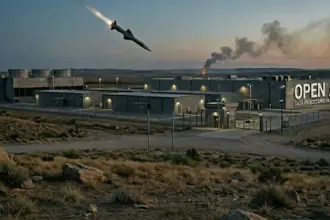


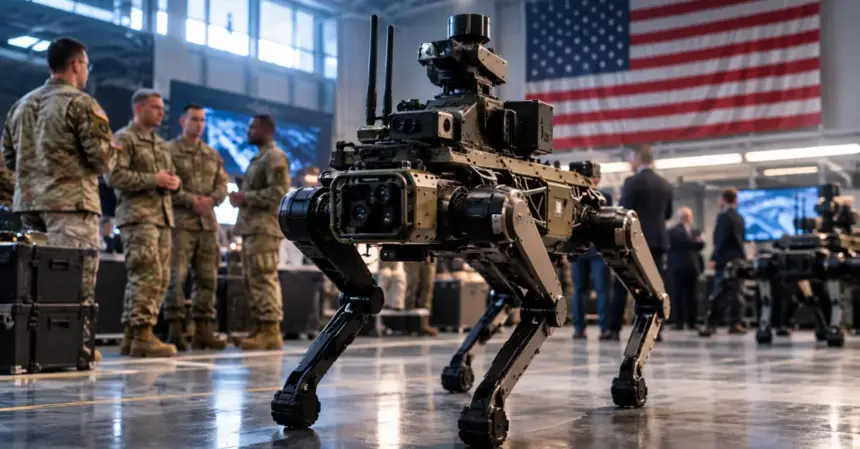
According to the announcement, the United States is creating “AutoWarCom,” a military command devoted entirely to drones, robots and autonomous warfare systems. It will eventually be led by a four-star general, the highest rank in the American military, which says a lot about the weight it is meant to carry. Behind the phrase “killer robots,” used by critics of these technologies and picked up by the press, lies a fundamental question: how far should autonomous weapons be allowed into the arsenal of a major power?
Key takeaways
- The United States announces “AutoWarCom,” a command dedicated to drones, robots and autonomous systems.
- It will eventually be led by a four-star general.
- The goal: test, improve and produce these systems much faster.
- Ukraine has shown the effectiveness of low-cost drones on the battlefield.
- Organizations worry about machines striking without direct human validation.
Why a dedicated command, and why now
I read this decision first as an admission about organization. Until now, drone and robot programs were scattered across the services, agencies and procurement offices, each with its own budgets and timelines. A single command is meant to end that fragmentation.
The announcement fits into a sequence that was already visible. On April 29, 2026, Pete Hegseth, who runs the Pentagon, now styled the “Department of War,” told the House Armed Services Committee that a sub-unified command for autonomous warfare would soon be announced. The speech came with an unprecedented budget request for fiscal year 2027.
Ukraine as the trigger
The Secretary of War keeps repeating that recent conflicts, Ukraine first among them, have shown how quickly relatively cheap drones can transform a battlefield. On this point, most military analysts agree. A device costing a few hundred or a few thousand dollars can threaten an armored vehicle worth several million, or force an adversary to fire very expensive interceptor missiles.
What stands out is the reversal of industrial logic. For decades, Western armies favored rare, sophisticated and costly systems. Ukraine imposed the opposite: massive quantities of simple machines, modified constantly at the pace of the front. The Pentagon clearly wants to adopt that cycle of adaptation.
A shorter development cycle
The stated goal is to bring military personnel, engineers and companies closer together. A new system should be tested, improved and then produced without waiting for the long traditional procedures of military procurement, which are notorious for their heaviness.
Pete Hegseth has defended this principle for several months, promising to buy faster and to simplify processes he considers byzantine. Traditional defense contractors, along with younger tech companies, see a considerable market in it.

The figures put forward show the scale of the bet:
- roughly $54 billion requested for 2027 for the Defense Autonomous Warfare Group, against roughly $226 million previously;
- close to $74 billion when all budget lines tied to drones and counter-drone defense are added up in the request;
- a total that Pentagon officials describe as the largest American investment ever made in these technologies.
At this stage, this is a budget request, not appropriated funds. Congress still has its say, and I will be watching how lawmakers examine these amounts.
From remote control to autonomy
This transformation goes beyond simple remotely piloted drones. The official objective is to generalize robotic and autonomous capabilities, at a time when artificial intelligence plays a growing role in modern warfare: intelligence sorting, navigation without a radio link, swarm coordination, target designation support.
I distinguish three levels here, because the debate too often blurs them. A teleoperated system remains fully piloted by a human. An automated system performs precise tasks within a framework set in advance. An autonomous system makes decisions based on its environment. The most sensitive area is where a machine could select and attack a target without direct human validation: that is where the term “killer robots” takes on its full polemical meaning.
The existing American legal framework
The United States is not starting from a blank page. A Pentagon directive, number 3000.09, has governed autonomous weapon systems since 2012 and requires “appropriate levels of human judgment” over the use of force. It was updated in 2023.
The wording is deliberately flexible: “human judgment” does not necessarily mean an operator approving every shot. For its defenders, that flexibility lets oversight adapt to context, for example against a hypersonic missile that no operator could counter in time. For its critics, it leaves too much room for interpretation.
What opponents of killer robots denounce
This acceleration worries organizations campaigning against lethal autonomous weapons. The Stop Killer Robots campaign brings together more than 270 organizations calling for an international treaty. Their central demand is meaningful human control over every targeting decision.
Their concerns fall into three categories:
- the difficulty of complying with international humanitarian law, in particular the distinction between combatants and civilians, when an algorithm decides;
- the question of accountability: who answers for an erroneous strike, the commander, the programmer or the manufacturer;
- the risk of an arms race, in which each side automates for fear that the other will do so first.
These experts recall that the international community has already managed to ban weapons deemed unacceptable, such as antipersonnel mines and cluster munitions. The comparison is debatable, since an autonomous drone is a dual-use tool, far harder to regulate than a mine, but it feeds diplomatic thinking.
The supporters’ argument
It would be unfair to present only one side. Proponents of a buildup in autonomy make serious arguments. First, protecting soldiers: sending a machine rather than a man into a minefield or against air defenses has an obvious logic. Second, speed: in a fight saturated with drones, the human decision loop may become too slow. Finally, deterrence: if rivals such as China or Russia invest massively, staying on the sidelines would, in their view, be a strategic mistake.
This argument about great-power competition carries great weight in Washington. I note, however, that it works like a slope: every advance by the adversary justifies the next one, and the ethical debate slips into the background.
What to watch next
Several indicators seem decisive to me in the coming months:
- Congress’s vote on the funds requested for 2027;
- the precise rules of engagement that will accompany the new command, and whether they are published;
- the place given to industry, between large groups and start-ups;
- the evolution of international discussions, notably in Geneva, where the subject has been debated for years without a binding treaty.
The debate now opening is immense: in tomorrow’s wars, how far will we let a machine decide in place of a soldier? The answer will be read not only in Pentagon press releases, but in how democracies accept, or refuse, to set limits themselves before the battlefield imposes them.
FAQ
What is AutoWarCom?
According to the announcement, it is a new American military command devoted to drones, robots and autonomous warfare systems.
Are killer robots already deployed?
Armed drones have been used for a long time, but generally with a human operator approving the strike. The debate concerns systems capable of choosing and attacking a target on their own.
Is there an international ban on autonomous weapons?
No. Negotiations are taking place at the UN, but no binding treaty exists to date.
Why is the United States accelerating?
The Pentagon cites lessons from Ukraine, where cheap drones have shifted the balance on the ground, and wants to shorten its development and production timelines.